Coldstream, Melbourne
End of Lease Clean
Brendan S.’s clean
one time
Completed October 2026
$814Recorded booking amount
Recorded tasks: Inside Oven Deep Clean, Interior Windows Clean, Inside Cabinets & Drawers + 1 more
Cleaners on this visit
JOHN

Know the cost. More room for life.
End of lease cleaning prices
Quick answer: An end of lease clean with Simply Maid costs $423 for a 1 bed, 1 bath home, $455 for 2 bed, 1 bath and $519 for 3 bed, 2 bath. Those are fixed prices including GST and the Care & Cover fee, for an empty home that has been kept on top of, with the oven, inside cupboards and interior windows included. A home that needs a proper reset adds up to $191; walls are wiped to remove marks, and full wall washing, a balcony, garage or blinds are extras, and carpet steam cleaning is a separately selected extra. A home that needs more than a proper reset can add extra hours at $93 per cleaner-hour. The price is the same in every city we serve.
Price your home
End of lease & move-in clean
One-off: end of lease cleans are booked one visit at a time.
$455
End of lease & move-in clean for 2 bed, 1bath. Includes GST and the Care & Cover fee.
Pay after your clean · free cancellation up to 24h
Change the rooms to see your home's price.
Your clean, priced today
Current Simply Maid price · live from our booking calculator
| Home | Price | With “Some build-up” | With “Needs a proper reset” | Cleaner time booked |
|---|---|---|---|---|
| 1 bed, 1 bath | $423 | $519 | $614 | 4h 30m |
| 2 bed, 1 bath | $455 | $551 | $645 | 4h 50m |
| 2 bed, 2 bath | $487 | $583 | $677 | 5h 10m |
| 3 bed, 1 bath | $487 | $583 | $677 | 5h 10m |
| 3 bed, 2 bath | $519 | $615 | $709 | 5h 30m |
| 3 bed, 3 bath | $551 | $647 | $741 | 5h 50m |
| 4 bed, 2 bath | $551 | $647 | $741 | 5h 50m |
| 4 bed, 3 bath | $583 | $679 | $773 | 6h 10m |
| 5 bed, 2 bath | $583 | $679 | $773 | 6h 10m |
| 5 bed, 3 bath | $615 | $711 | $805 | 6h 30m |
AUD, fixed, including GST and the Care & Cover fee, for an empty home with no extras or discount code. The oven, inside cupboards and interior windows are included. “Cleaner time booked” is the planning allowance for one cleaner, not a measured time: two cleaners share it and are on site for about half as long, at the same price. Homes larger than 5 bedrooms or 3 bathrooms are priced in booking. The price is the same in every city we serve.
Whether you call it an end of lease, bond or vacate clean, here is what it costs for your size of home, what the price should cover, how to tell two quotes apart, and what your state's rules actually ask of you.
They are fixed prices for an empty home that has been kept on top of, with no extras or discount code, including GST and the Care & Cover fee. A home with some build-up costs $96 more, and one that needs a proper reset $191 more.
The table prices an empty home that has been kept on top of: surfaces mostly clear, with marks a quick wipe would lift. Booking asks how much attention the home needs. If it has some build-up or needs a proper reset, the two "With" columns show the difference, and the price you see in booking already includes it. A home that needs more than a proper reset can add extra hours at $93 per cleaner-hour, for up to 4 hours.
Each extra bedroom or bathroom moves the price by the same fixed step. Count ensuites as bathrooms: wet areas are the slowest rooms in an end of lease clean.
Wall washing, a balcony, the garage and blinds are priced separately, below. A discount code comes off at checkout and isn't in these figures.
It is the time our calculator books for one cleaner. Two cleaners share it and are on site for about half as long, for the same price. We don't publish how long jobs actually took until we have enough timed visits to do it honestly.
Our calculator has no location input, so a two-bedroom clean costs the same in Perth as in Sydney. Local guides explain what other companies charge where you live.
Keep the home-cleaning quote, any specialist extras and your move-out preparation as separate lines until you have a complete quote.
Start with the home-size and condition assumptions above. If carpeted rooms or furnishings need treatment, check carpet cleaning prices and upholstery cleaning prices. Confirm the combined total rather than adding standalone booking totals together.
Use the move-out cleaning plan for sequencing and the printable end-of-lease checklist for recording tasks. Neither replaces your booked inclusions or the condition requirements for your tenancy.
Still living in the home? Deep cleaning prices explain the alternative for a lived-in property. Pick the checklist that matches the work, then compare the price.
The oven, range hood, inside cupboards and drawers, the dishwasher and interior windows and tracks are part of the clean; full wall washing ($93 a room), a balcony ($70), the garage ($139) and blinds ($23 each) are extras.
The checklist below is the one your cleaner works from, read live from our booking system. Anything on it is part of the price; anything priced as an extra is shown with today's price; and anything we don't do is listed plainly so you can book it elsewhere.
Vacuuming is included. Add professional carpet steam cleaning to your end-of-lease clean, or book carpets on their own. Confirm any lease or pet-approval requirement and allow drying time before inspection.
Inside the oven, the racks and the glass are part of every end of lease clean. For an oven with years of baked-on carbon, see oven cleaning prices for when a specialist is the better choice.


This summary does not replace the end-of-lease checklist. The home-clean package includes the named interiors. Carpet extraction and the other named extras must be selected separately. Describe the condition, arrange access, and check your agreement and local guidance for any tenancy requirement.
An agreed clean is not a bond guarantee.
| Extra | Price | Cleaner time |
|---|---|---|
| Wall Washing | $93 per room (up to 6) | 60 min each |
| Garage Deep Clean | $139 | 90 min |
| Blind Cleaning | $23 per blind (up to 20) | 15 min each |
| Balcony/Patio Deep Clean | $70 | 45 min |
| Extra hours | $93 per cleaner-hour (up to 4) | 60 min each |
| Eco & green cleaning products | $5 | 3 min |
| Carpet steam cleaning — bedrooms / studies | $60 per item (up to 10) | 40 min each |
| Carpet steam cleaning — living / large rooms | $120 per item (up to 10) | 80 min each |
| Carpet steam cleaning — hallways | $30 per item (up to 10) | 20 min each |
| Carpet steam cleaning — flights of stairs | $90 per item (up to 5) | 60 min each |
| Steam cleaning — 2-seater sofa | $120 per item (up to 5) | 80 min each |
| Steam cleaning — 3-seater sofa | $180 per item (up to 5) | 120 min each |
| Steam cleaning — 4-seater sofa | $240 per item (up to 5) | 160 min each |
| Steam cleaning — additional chaise / modular seat | $60 per item (up to 10) | 40 min each |
| Steam cleaning — armchair / recliner | $60 per item (up to 10) | 40 min each |
| Steam cleaning — dining chair — seat only | $15 per item (up to 20) | 10 min each |
| Steam cleaning — dining chair — seat and back | $30 per item (up to 20) | 20 min each |
| Steam cleaning — office chair | $30 per item (up to 10) | 20 min each |
| Steam cleaning — loose cushion | $15 per item (up to 20) | 10 min each |
| Steam cleaning — ottoman / footstool | $30 per item (up to 10) | 20 min each |
| Steam cleaning — fabric headboard | $60 per item (up to 5) | 40 min each |
| Steam cleaning — cot mattress | $30 per item (up to 5) | 20 min each |
| Steam cleaning — single / king-single mattress | $60 per item (up to 10) | 40 min each |
| Steam cleaning — double mattress | $90 per item (up to 10) | 60 min each |
| Steam cleaning — queen mattress | $120 per item (up to 10) | 80 min each |
| Steam cleaning — king mattress | $150 per item (up to 10) | 100 min each |
| Steam cleaning — small rug | $30 per item (up to 10) | 20 min each |
| Steam cleaning — large rug | $60 per item (up to 10) | 40 min each |
From our live end of lease checklist and booking calculator, checked 20 October 2026. Listed prices include GST.
We book 4h 30m of cleaner time for a 1 bed, 1 bath home, 4h 50m for 2 bed, 1 bath and 5h 30m for 3 bed, 2 bath; two cleaners share it, so they're on site for about half as long. A home that needs a proper reset adds up to 2h, and extra hours can be added at $93 per cleaner-hour.
Kitchens and bathrooms. The oven, range hood and inside cupboards, then grout, shower screens and exhaust fans, take most of the time, which is why an extra bathroom adds as much time as an extra bedroom. Wall washing, a garage or a balcony add their own time, shown under the table.
Companies that put hours in their packages often allow more: one Perth company's price list allows about 6 hours for a one-bedroom vacate clean, 7 for two bedrooms and 8 for three, and a national cost guide estimates 3 to 5 hours for a one-bedroom and 5 to 8 for three bedrooms (both read 2 October 2026). Hours don't compare well between companies: they depend on how many cleaners come, the condition assumed and what's on the checklist. Compare the total and the task list, and ask how many cleaners are coming.
Current Simply Maid price · live from our booking calculator
| Home | Cleaner time booked | Two cleaners on site, about | Time with “Some build-up” | Time with “Needs a proper reset” |
|---|---|---|---|---|
| 1 bed, 1 bath | 4h 30m | 2h 15m | 5h 30m | 6h 30m |
| 2 bed, 1 bath | 4h 50m | 2h 25m | 5h 50m | 6h 50m |
| 2 bed, 2 bath | 5h 10m | 2h 35m | 6h 10m | 7h 10m |
| 3 bed, 1 bath | 5h 10m | 2h 35m | 6h 10m | 7h 10m |
| 3 bed, 2 bath | 5h 30m | 2h 45m | 6h 30m | 7h 30m |
| 3 bed, 3 bath | 5h 50m | 2h 55m | 6h 50m | 7h 50m |
| 4 bed, 2 bath | 5h 50m | 2h 55m | 6h 50m | 7h 50m |
| 4 bed, 3 bath | 6h 10m | 3h 05m | 7h 10m | 8h 10m |
| 5 bed, 2 bath | 6h 10m | 3h 05m | 7h 10m | 8h 10m |
| 5 bed, 3 bath | 6h 30m | 3h 15m | 7h 30m | 8h 30m |
Cleaner time is the planning allowance our calculator books for one cleaner, not a measured time. Two cleaners share it, so they are on site for about half as long at the same price. Extras add their own time: wall washing 60 minutes per room, garage deep clean 90 minutes, blind cleaning 15 minutes per blind, balcony/patio deep clean 45 minutes, eco & green cleaning products 3 minutes, carpet steam cleaning — bedrooms / studies 40 minutes per item, carpet steam cleaning — living / large rooms 80 minutes per item, carpet steam cleaning — hallways 20 minutes per item, carpet steam cleaning — flights of stairs 60 minutes per item, steam cleaning — 2-seater sofa 80 minutes per item, steam cleaning — 3-seater sofa 120 minutes per item, steam cleaning — 4-seater sofa 160 minutes per item, steam cleaning — additional chaise / modular seat 40 minutes per item, steam cleaning — armchair / recliner 40 minutes per item, steam cleaning — dining chair — seat only 10 minutes per item, steam cleaning — dining chair — seat and back 20 minutes per item, steam cleaning — office chair 20 minutes per item, steam cleaning — loose cushion 10 minutes per item, steam cleaning — ottoman / footstool 20 minutes per item, steam cleaning — fabric headboard 40 minutes per item, steam cleaning — cot mattress 20 minutes per item, steam cleaning — single / king-single mattress 40 minutes per item, steam cleaning — double mattress 60 minutes per item, steam cleaning — queen mattress 80 minutes per item, steam cleaning — king mattress 100 minutes per item, steam cleaning — small rug 20 minutes per item, steam cleaning — large rug 40 minutes per item. Measured, across all our services: on 178 recent cleans with check-in and check-out times from our cleaner app, time on site was a median 99% of the time booked (middle half 81–117%). We don't yet have enough timed end of lease cleans to publish their own figure.
Because two quotes rarely describe the same job: they count the home differently, assume a different condition, include different tasks, treat GST differently, and some are fixed while others run by the hour.
The biggest gap. One company's price includes the oven, inside cupboards, interior windows and tracks; another lists each as an extra. Carpet steam cleaning is almost always extra: the companies we checked charged about $35 to $150 a room, or $55 to $240 for a whole home.
A home that was cleaned every fortnight and one that hasn't been cleaned properly in a year are different jobs. A quote that doesn't ask about condition is either padded for the worst case or will change on the day.
A fixed price can't run on. An hourly quote without an estimate of hours and a cap can.
A "from" price describes the smallest, cleanest home it covers. Some companies quote without GST, which makes them look about 10% cheaper than they are.
Some agents recommend a particular cleaner. That can be convenient, but you are free to compare it with other quotes, and in Queensland and Western Australia a landlord or agent can't insist you use a particular company.
It can be, and how much attention the home needs can get it there on its own: our one-bedroom price is $423 for a home that's been kept on top of, $519 with some build-up and $614 if it needs a proper reset, before any extras.
It is the title of a Sydney Reddit thread that sits near the top of Google for end of lease cleaning prices, and it is the right instinct: check the number against what it buys.
Ask the company what condition it assumed and to list every task in the price, then compare it line by line with the checklist above and with what other companies publish (the table below). Published prices usually assume a home in reasonable condition, and every one-bedroom price we found published was below $605. A price isn't unfair because it is higher; it is hard to judge until you know the condition and the work it covers.
Market check
Published one-bedroom prices run from about $200 to $480 across the seven cities, and the spread within each city is wide because scope, GST and the condition assumed all differ.
These are the lowest and highest prices that cleaning companies publish on their own websites for each home size, re-read on 12 October 2026. They are not averages and not quotes for your home. We left out comparison guides and marketplace estimates (they are compiled from each other), copied price tables, price pages dated before 2025, and prices that include carpet steam cleaning.
Each city guide lists every price with its link and scope, alongside the local rules: Sydney, Melbourne, Brisbane (where it's a bond clean), Perth (a vacate clean), Adelaide, the Gold Coast and Canberra.
| City | 1 bedroom | 2 bedrooms | 3 bedrooms | 4 bedrooms |
|---|---|---|---|---|
| Sydney | $329 to $440 (8) | $390 to $605 (7) | $430 to $880 (7) | $540 to $968 (7) |
| Melbourne | $270 to $468 (8) | $300 to $498 (8) | $340 to $578 (8) | $380 to $695 (8) |
| Brisbane | $340 to $480 (3) | $440 to $660 (3) | $595 to $740 (2) | $650 to $900 (3) |
| Perth | $200 to $330 (4) | $280 to $385 (3) | $340 to $440 (3) | $400 to $550 (3) |
| Adelaide | $210 to $349 (3) | $240 to $449 (3) | $270 to $500 (3) | $300 to $549 (2) |
| Gold Coast | $299 to $335 (2) | $369 to $400 (2) | $449 to $600 (2) | $529 to $680 (2) |
| Canberra | $270 to $399 (5) | $352 to $459 (5) | $385 to $549 (5) | $440 to $689 (5) |
Some providers price 3 and 4 bedroom homes with one bathroom; ours assume two. GST is stated by only some providers; a price published without GST has the 10% added, as in each city guide. Source: Providers' own price pages, each listed with its link in the city guides, checked 2 October 2026.
Market check
Two companies that publish one end of lease price list for every city they serve put a 2 bed, 1 bath home at $386 to $438, and a 3 bedroom home at $503 to $527.
These are prices each company publishes on its own website, re-read on 12 October 2026, beside ours for the same home. Read the scope column: one company's price is for an apartment with one bathroom and lists the fridge as an extra; the other is its own calculator's figure for an unfurnished, single-storey home and doesn't say whether GST is included. The city guides list the local companies.
End of lease clean. Of 2 published prices from 1 company for the same bedrooms and bathrooms as a home we price, 1 is lower than ours and 1 is higher. By their own pages, 1 company charges extra for the fridge, which our end of lease clean includes. Also listed, not counted: 2 without stated GST treatment.
Market observation · what other providers publish
| Home | Lowest to highest published price | Providers | Simply Maid today |
|---|---|---|---|
| 2 bedrooms | $386 to $438 | 2 | $455 (2 bed, 1 bath) |
| 3 bedrooms | $503 to $527 | 2 | $519 (3 bed, 2 bath) |
The span of prices providers publish for that many bedrooms, from the rows below: fixed prices, “from” prices and providers’ own calculators, not an average and not a quote for your home. Prices quoted without GST have the 10% added. Bathrooms, carpet steam cleaning and what is included differ between them, so compare the scope column before the totals. A size appears only when at least two providers publish a price for it.
| Provider | Home | Price | What the figure is | What it covers | Simply Maid today, same home |
|---|---|---|---|---|---|
| Calibre Cleaning | 2 bed, 1 bath | $438 inc GST | Published price | End-of-lease deep clean of a 2-bedroom, 1-bathroom APARTMENT incl. oven, interior windows, skirting boards and door frames; fridge, microwave and steam cleaning cost extra. | $455 |
| Calibre Cleaning | 3 bed, 1 bath | $503 inc GST | Published price | End-of-lease deep clean of a 3-bedroom, 1-bathroom APARTMENT incl. oven, interior windows, skirting boards and door frames; fridge, microwave and steam cleaning cost extra. | $487 |
| Whizz | 2 bed, 1 bath | $386 · GST not stated | Provider’s calculator | Calculator output for an unfurnished end-of-lease clean, 1 storey, 2 bed, 1 bath, no extras, postcode 2000; includes oven and cupboards; fridge and carpet steam extra. | $455 · not counted (GST not stated) |
| Whizz | 3 bed, 2 bath | $527 · GST not stated | Provider’s calculator | Calculator output for an unfurnished end-of-lease clean, 1 storey, 3 bed, 2 bath, no extras, postcode 2000; includes oven and cupboards; fridge and carpet steam extra. | $519 · not counted (GST not stated) |
Published prices read from each provider’s own website on 12 October 2026, as advertised, not quotes for a specific home. GST is shown only where the provider states it; an ex-GST price is compared with 10% added. A price is counted as lower or higher only when it is a stated price for the same bedrooms and bathrooms and is not a regular-visit rate. A page that doesn’t mention a task tells us nothing about whether it is included. Companies with one national price list. Local companies are compared in each city guide.
Give every company the same description of the home, ask for a fixed total with GST, and get the list of tasks in writing so you can add the same extras to both before comparing.
Ask every company the same questions, in writing, and keep the answers with the quote.
Then add the same extras to both quotes before you compare totals. A $380 quote that adds the oven and inside cupboards later is not cheaper than a $455 quote that includes them.

Ask each provider for the same written scope, pricing unit, frequency, minimum and full total. An unstated inclusion or GST treatment is unknown. A starting price, historical bill and current fixed quote are different kinds of evidence.
Keep unanswered conditions beside the price.
Choosing between providers? End of lease cleaning providers in Australia compared. Compare move-out providers’ inclusions, carpet extras, inspection timing and re-clean conditions.
For most renters a fixed price is safer, because the total can't run on; an hourly quote is only comparable once you know the hours, the number of cleaners and any minimum or cap.
You know the total before the clean starts. The risk sits with the company: if the job runs long, it's their time. Check what the fixed price assumes (empty home, condition) and what happens if the home doesn't match.
An hourly quote is only comparable once you know three things: how many hours they expect, how many cleaners, and whether there's a minimum or a cap. Two cleaners for five hours is ten labour hours on a five-hour visit. Without a cap, a long job is your cost, not theirs.
Many price lists, including ours, are built on cleaner time. One cleaner for six hours and two cleaners for three hours are the same labour, the same price and a very different afternoon. Ask how many cleaners are coming so you know when to expect them to finish.
Not with us: the price depends only on bedrooms, bathrooms, condition and extras, so it is the same on a Saturday as on a Tuesday, the same in January as in September, and the same for a unit, townhouse or house; the only date charge is a $40 same-day booking fee, which booking asks you to accept first.
Other companies' price lists do vary on these. In the Sydney market check, some added $50 for a same-day clean, $50 to $75 for a second storey or priced double-storey homes separately, and one Melbourne company charges more for a furnished home. Pets and a second storey don't change our price either; tell us about them when you book so the cleaner is ready.
End of lease cleans peak in January and February and on Saturdays and Mondays in our records, because that's when leases end. The price doesn't rise then, but cleaners book out sooner, so book as soon as you know your moving date.
We don't charge by the hour, but our fixed price works out to about $94 per hour of booked cleaner time for a 2 bed, 1 bath home, and that covers GST, supplies, insurance, our fee and any re-clean.
That figure isn't a cleaner's wage. The minimum casual rate under the Cleaning Services Award is $33.85 an hour (Level 1, from 1 July 2026, Fair Work Ombudsman), before super, insurance, travel, products and GST. That is why an hourly end of lease quote well under about $50 usually leaves something out, or comes with more hours than you expect.
If a company quotes by the hour, multiply the rate by the hours it expects and the number of cleaners, add GST if it isn't included, and compare that total with a fixed price for the same checklist. See cleaning prices across Australia for hourly rates more broadly.
For a home you're leaving or moving into, the end of lease clean ($455 for 2 bed, 1 bath) is planned for an empty home and includes interior windows and tracks, which are an extra on a deep clean ($361 for the same home).
See deep cleaning prices for the deep clean in full.
It depends how much of the risk you want to carry: a company like ours arranges the cleaner, insurance, payment and any re-clean; an independent cleaner or a marketplace job can cost less, but you check insurance, products and what happens if the agent finds something missed.
You book a fixed checklist at a fixed price, and the company finds the cleaner and handles a re-clean. With us, the Care & Cover fee in every price includes $10M public liability insurance, ID-verified cleaners and re-cleans under our terms, and you pay after the clean.
Often cheaper, and good cleaners work this way. Before you agree, ask for their ABN and references, whether they hold public liability insurance, whether they bring products, whether GST is included, and exactly what they'll do if the agent finds something missed. Consumer Protection WA's advice applies everywhere: check the cleaner's ABN and references, walk them through the job first, never pay any money up front, and inspect the work before you pay.
If your landlord claims cleaning costs against your bond, an itemised invoice for the clean you paid for is useful evidence, and in Western Australia an invoice counts for more than a quote. Under the Australian Consumer Law, any cleaning service must be done with due care and skill.
With us, only if you approve it: your price is set by what you book, and extra time on the day is added only when you say yes to a request.
Your price is set by what you book: the home size, its condition, the extras and the date. On the day, three things can change what you pay, and none of them is a surprise surcharge:
We don't add parking costs to your booking. We place a hold on your card about 48 hours before the clean and charge you only after it's done.
For an empty 2 bed, 1 bath unit in reasonable condition, our fixed price is $455, with the oven, inside cupboards and interior windows included and GST in the total.
Here is how a lower headline price can end up costing more. Quote B is an illustration built from prices we saw in our Sydney market check on 2 October 2026, not one company's real quote.
$390 + $60 + $50 = $500, plus 10% GST = $550. It is "from" a two-bedroom price, so a home that needs more work could cost more again.
Both quotes still leave out carpet steam cleaning, which you book separately if your lease needs it, and both should tell you what happens if the agent finds something missed.
From our booking records
Mostly small ones: 72% of the move-in and move-out cleans on our previous booking platform were one- or two-bedroom homes, and the most common single layout was 2 bedrooms with 1 bathroom.
Most published cost guides lead with a three-bedroom house. In our records that size was the third most common, so look up your own bedroom and bathroom count in the price table rather than the guide's example.
Brisbane was the exception: 51% of our 53 Brisbane bond cleans were homes of three bedrooms or more (see bond cleaning prices in Brisbane).
Simply Maid booking history · not today’s price
| Home | Bookings | Share |
|---|---|---|
| 1 bedroom | 433 | 25.2% |
| 2 bedrooms | 804 | 46.9% |
| 3 bedrooms | 294 | 17.1% |
| 4 bedrooms | 117 | 6.8% |
| 5 or more | 68 | 4.0% |
Completed move-in and move-out cleans on our previous booking platform, all seven cities (82% in Sydney), December 2015 to March 2025: 1,716 bookings from 1,604 customers. That platform sold one combined move-in/move-out clean, so the two can't be separated, and it didn't record whether a home was a unit or a house. Our current platform's 16 end of lease cleans since April 2026 are too few to add yet. Computed 2 October 2026.
From our booking records
On our previous platform 83% of end of lease bookings named a bundle that already covered the oven, inside cupboards and inside windows; 50% added something beyond it, most often a balcony or carpet steam cleaning.
In September 2026 we corrected an earlier version of this analysis that had counted the bundle's own oven, cupboard and window items as separate purchases. The table counts only items chosen outside the bundle. Carpet steam cleaning is recorded in the old-platform data. It is available as a separately selected extra today; historic whole-booking totals are not current carpet prices.
Carpets were a Melbourne habit: 35% of our Melbourne end of lease bookings added carpet steam cleaning, against 17% in Sydney (see end of lease prices in Melbourne).
Simply Maid booking history · not today’s price
| Item | Bookings | Share of all end of lease bookings |
|---|---|---|
| Balcony or patio | 440 | 25.6% |
| Carpet steam cleaning | 314 | 18.3% |
| Wall washing | 196 | 11.4% |
| Inside the fridge | 123 | 7.2% |
| Window glass or sliding doors | 104 | 6.1% |
| Blinds or shutters | 75 | 4.4% |
The same 1,716 bookings as the first table: completed move-in and move-out cleans on our previous booking platform, all seven cities, December 2015 to March 2025. Computed 2 October 2026. A booking can appear in several rows. These are recorded selections, not an audit of invoices.
From our booking records
On our previous platform the median end of lease booking was charged $499 for two bedrooms in 2022 to 2025, including any extras; the median for all sizes moved from $358 in 2019 to $561 in 2024 as our rate card changed.
This is what customers were charged, not what they were quoted: the booking total after any discount, including extras such as carpet steam cleaning or a balcony and GST where it was added. It is history from old rate cards, so use the price table at the top for today's price. Bookings with an unpaid balance were left out so a part-payment can't skew a median.
Simply Maid booking history · not today’s price
| Home | Median charged | Middle half of bookings | Bookings |
|---|---|---|---|
| 1 bedroom | $410 | $399 to $549 | 87 |
| 2 bedrooms | $499 | $449 to $669 | 159 |
| 3 bedrooms | $519 | $499 to $652 | 71 |
| All sizes | $516 | $449 to $665 | 347 |
The same 1,716 bookings as the first table: completed move-in and move-out cleans on our previous booking platform, all seven cities, December 2015 to March 2025. Computed 2 October 2026.
From our booking records
About a week ahead is typical: the median booking on our previous platform was made 7 days before the clean, and bookings on our current platform have been similar.
Book for after the removalists have gone and, where you can, a few days before the final inspection. That leaves time to walk through, tell us within 48 hours if anything on the checklist was missed, and have it fixed before the agent arrives.
Leave the power and water on until the clean is finished. In our records February and January had the most end of lease cleans and September the fewest, and end of lease cleans fell on a weekend more often than other cleans. Those are counts of our own bookings, so they can't promise a quiet day near you.
Simply Maid booking history · not today’s price
| Measure | Previous platform | Current platform (since April 2026) |
|---|---|---|
| Days booked ahead (median) | 7 (middle half 3 to 14) | 8 days (middle half 3 to 17), 30 bookings |
| Booked 3 days ahead or less | 28% | Too few to publish |
| Booked more than 2 weeks ahead | 25% | Too few to publish |
| On a Saturday or Sunday | 20% (other cleans 14%) | Too few to publish |
The same 1,716 bookings as the first table: completed move-in and move-out cleans on our previous booking platform, all seven cities, December 2015 to March 2025. Computed 2 October 2026. Current-platform figure: 30 end of lease bookings made March to September 2026, counted from booking to clean date.
No state makes a professional end-of-lease clean compulsory, and neither does the ACT: the standard is the condition the home was in when you moved in, apart from fair wear and tear, and a professional can be required only in narrow cases such as carpets after an approved pet.
The rules differ by state, including when a lease can ask for professional carpet cleaning or name the cleaner, and our guide do you need professional end-of-lease cleaners? compares them, with a moving-out guide for NSW, Victoria, Queensland, WA, South Australia and the ACT.
Where a professional clean earns its keep is time and risk: the oven, cupboards and window tracks are off your list, and if the agent finds something missed it is the cleaner's job to come back.
No cleaner can promise that: a bond claim can cover rent, damage and other costs, and a disputed claim is decided by your state's bond body or tribunal, not the cleaner.
What a cleaner can promise is to come back and fix cleaning it missed. Ours: tell us within 48 hours of the clean, with photos if you have them, and we schedule a re-clean of those items at no cost, completed within seven business days of the original clean. If it is still not right after that, we review it and give a fair credit or refund. That is a re-clean promise, not a bond guarantee, and it sits on top of your rights under the Australian Consumer Law. See our terms.
Many companies advertise a "bond back guarantee". In the terms we read, it usually means a free re-clean of the items booked, reported within a window of 24 hours to 7 days, often with the agent's report as evidence. Read the conditions, not the headline.
Take dated photos before and after the clean, compare the exit condition report with the one from when you moved in, and keep receipts. Queensland, the only state that publishes the reasons for bond claims, reported cleaning as the most common reason in 2025–26, at 22.7% of claim reasons; 57.2% of Queensland bonds were still refunded in full.
If you have the time, the products and an empty home a day or two before the inspection, a careful DIY clean can meet the standard; as a guide, we book 4h 50m of cleaner time for a 2 bed, 1 bath home.
Work from your entry condition report: it is the standard you'll be held to. Inspectors look hardest at the oven and range hood, inside cupboards and drawers, bathroom grout and screens, window tracks, skirting boards, light switches and marks on walls. Our end of lease cleaning checklist goes room by room.
A mixed approach can save money: do the easy rooms yourself and book a professional for the kitchen and bathrooms, or clean the home yourself and book only the carpet cleaner your lease requires.
Our price is the same everywhere we clean; what changes from city to city is what other companies charge, the homes people live in and the local tenancy rules, which each city guide covers.
Simply Maid booking history · not today’s price
| City | End of lease cleans on record | Home booked most for a regular clean | End of lease price for that home today | City guide |
|---|---|---|---|---|
| Sydney | 1,416 since 2015 | 2 bed, 1 bath | $455 | End of lease prices in Sydney |
| Melbourne | 177 since 2017 | 3 bed, 2 bath | $519 | End of lease prices in Melbourne |
| Brisbane | 52 since 2018 | 3 bed, 2 bath | $519 | Bond clean prices in Brisbane |
| Adelaide | 33 since 2018 | 2 bed, 1 bath | $455 | End of lease prices in Adelaide |
| Canberra | 27 since 2018 | 1 bed, 1 bath | $423 | End of lease prices in Canberra |
| Perth | 24 since 2018 | 4 bed, 2 bath | $551 | End of lease prices in Perth |
| Gold Coast | 3 since 2018 | Not enough data | — | Bond clean prices on the Gold Coast |
Counts are completed end of lease (move-in and move-out) cleans on both our booking platforms, from our first in each city. Most were in Sydney, so a city with a small count has too few to describe on its own; its guide says so and uses local market prices instead. The most-booked home counts standard cleans since 2021, where a city has at least 100. Prices are the same in every city.
Vacuuming is included. Professional carpet steam cleaning is a separately selected, unit-priced extra, or a standalone booking. Choose the areas in booking and review the minimum charge and total before confirming.
Yes. Inside the oven, the range hood, inside cupboards and drawers, the dishwasher and interior windows and tracks are on our end of lease checklist at no extra charge.
No state requires it. Queensland's RTA says a lease can't make you use a particular cleaner or pay a set cleaning fee, and WA's Consumer Protection says landlords can't insist on a particular cleaning company. You can compare the agent's recommendation with other quotes.
No. A bond claim can cover rent, damage and other costs, and a disputed claim is decided by your state's bond body or tribunal. A cleaner can promise to fix cleaning it missed; ours is a re-clean if you tell us within 48 hours.
Not with us. A unit, townhouse or house with the same bedrooms and bathrooms has the same end of lease price; pets and a second storey don't change it either.
No. Our price is the same on any day and in any month. The only date-related charge is a same-day booking fee, and booking asks you to accept it first.
The same as an end of lease clean of the same home: a move-in clean is booked as our end of lease clean, with the same checklist, from $423 for a 1 bed, 1 bath home and $455 for 2 bed, 1 bath.
Only if your lease or pet approval requires it, and the rules differ by state: in NSW professional fumigation can be required only for an approved indoor mammal, and in Queensland a pet approval can include pest treatment at the end of the tenancy as a special term, though you choose who does it. We don't do pest control.
Only for cleaning genuinely needed to return the home to its starting condition, apart from fair wear and tear. Compare the exit and entry condition reports, keep dated photos, and ask for the invoice behind any claim.
Three kinds of number, kept apart: today's prices from our live booking calculator, history from our completed bookings, and market prices from other companies' own websites.
Read from the same calculator the booking form uses each time this page is shown, including GST and the Care & Cover fee, for an empty home that has been kept on top of, with no extras or discount code. The calculator has no location input, so prices are identical in every city.
Completed move-in and move-out cleans on our previous booking platform (December 2015 to March 2025), matched to our production records; cancelled and unfulfilled bookings excluded. "Charged" is the booking total after discounts, including extras and any GST added; bookings with an unpaid balance are left out of amounts. A median needs at least 30 bookings from 20 customers, a middle-half range 50, and a share 30. Most of these bookings were in Sydney, so we show city figures only where a city clears those thresholds. Our current platform began in April 2026 and its end of lease cleans will be added once there are enough.
Prices that cleaning companies publish on their own websites, first read on 2 October 2026 and re-read on 12 October 2026, for end of lease cleans of 1 to 4 bedrooms. We exclude comparison guides and marketplace estimates, copied or franchise price tables, pages dated before 2025 and prices that include carpet steam cleaning, and we never average the ends of a range.
| Measure | All seven cities |
|---|---|
| Completed cleans, current platform (since our current booking platform began in April 2026) | 248 |
| · Standard cleans | 134 |
| · Deep cleans | 98 |
| · End of lease cleans | 16 |
| Standard cleans since January 2021 (home sizes) | 22,177 |
| All completed cleans on record | 56,580 |
Booking figures recalculated daily; last run 20 October 2026, data through 19 October 2026. Prices read live from our booking calculator on 20 October 2026.
Who wrote and edited this article, when its sources were checked, and what changed.
Earlier entries record what was published at the time. Later corrections take precedence.
8 October 2026 — Updated by Huy Hoang.
Checked this guide against the current booking catalogue. Prices, discounts, allocated times and interior inclusion summaries use live production values where shown. Corrected package comparisons and first-visit explanations where relevant; existing recurring customers retain their agreed terms.
More room for life
Choose your home size, then book at the fixed price shown. Nothing is booked or paid until you confirm, and we charge only after the clean.
Pay after your clean · free cancellation up to 24h
Every outside source this guide relies on, with the date we read it. Competitor prices are listed with their links in the market table.
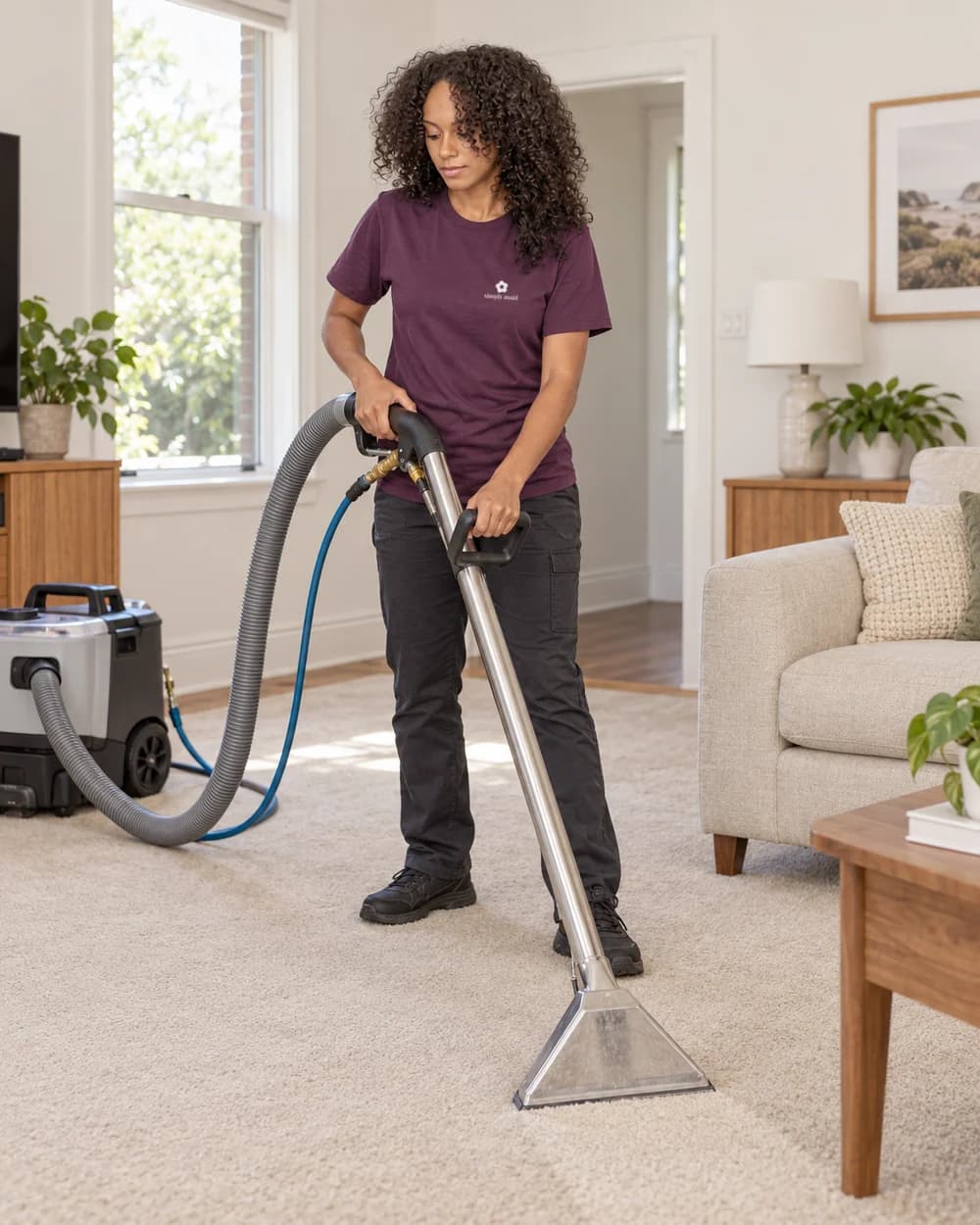
A little extra care for your carpets
Book professional hot-water extraction on its own, or add it to a deep or end-of-lease clean. Choose the bedrooms, living rooms, hallways and stairs that need attention.
Our pricing guide explains the room units, minimum charge and current checkout examples. Booking fees are itemised before you confirm. Enter your address in booking to check availability.
Simply Maid · completed cleans
Selected examples from Simply Maid’s own records across Australia. Any customer feedback shown is selected positive feedback about that visit. Historical work and prices do not establish current availability.
Coldstream, Melbourne
Brendan S.’s clean
one time
Completed October 2026
$814Recorded booking amount
Recorded tasks: Inside Oven Deep Clean, Interior Windows Clean, Inside Cabinets & Drawers + 1 more
Cleaners on this visit
Annandale, Sydney
JEREMY P.’s clean
one time
Completed October 2026
$427Recorded booking amount
Recorded tasks: Inside Oven Deep Clean, Interior Windows Clean, Inside Cabinets & Drawers
Cleaners on this visit
Semaphore, Adelaide
BENJAMIN W.’s clean
one time
Completed October 2026
$395Recorded booking amount
Recorded tasks: Inside Oven Deep Clean, Interior Windows Clean, Inside Cabinets & Drawers
Showing 3 of 9 selected examples. Amounts are historical booking records; today’s quote uses your property and requirements.