Most dishwasher problems, from smells to gritty glasses, start in the filter at the bottom of the tub. Clean it, clear the spray arms and wipe the door seal, then let a hot cleaning programme do the rest.
Quick answer: Twist out the filter from the base of the tub, rinse it under hot running water with a soft brush, and lock it back in. Poke blocked spray-arm holes clear with a toothpick, wipe the door seal with a damp cloth, then run the empty machine on its hottest programme with a dishwasher cleaner. About 10–15 minutes hands-on, plus one programme. Use vinegar only if your manual allows it: brands disagree.
Vinegar, bicarb, bleach or a dishwasher cleaner: what works
Method | Verdict | Why |
|---|---|---|
Dishwasher cleaner, empty machine, hottest programme | Use this | Made for grease and limescale. Finish's bottle, for one, goes upside down in the bottom rack, cap on, on a programme of at least 65 °C, no detergent. |
A cup of white vinegar on the top rack | Only if your manual allows it | LG Australia suggests a cup of white vinegar on the top rack, and CHOICE suggests two cups in a bowl. Miele says vinegar can lead to rust and leaks in its machines. Fisher & Paykel recommends a dishwasher cleaner or descaler in its DishDrawers, then a wash with detergent straight afterwards. Your manual outranks a general guide. |
Bicarb sprinkled in the base overnight | Optional, for a smell only | CHOICE suggests a cup overnight, and LG a cup sprinkled in the base after a vinegar cycle. The filter is the usual culprit. |
Vinegar and bicarb together | Don't | They neutralise each other, so the fizz adds no cleaning power. |
Bleach | Don't | Miele warns it can corrode the stainless-steel interior. |
Dishwashing liquid in the detergent cup | Don't | It foams up; Fisher & Paykel lists hand-washing liquids among unsuitable detergents that may damage its DishDrawers. |
The washing machine has its own brand rules for vinegar, bleach and cleaners: see How to Clean a Washing Machine (Front Loader and Top Loader).
What the main brands say
Brand | Filter | Cleaning programme |
|---|---|---|
Miele | Every week | Miele DishClean for regular care, IntenseClean for heavy grease, Miele Descaler now and then |
Fisher & Paykel DishDrawer | Once a month, or sooner if you see food | A dishwasher cleaner or descaler, then a normal wash with detergent straight afterwards |
Bosch | Regularly | Bosch Dishwasher Care every 1–2 months; Machine Cleaner every 4–6 months |
LG | Rinse under warm water, with a soft brush for stubborn bits; some models have a second filter | Machine Clean where fitted, otherwise the hottest programme, with a dishwasher cleaner, citric acid or a cup of white vinegar on the top rack |
Brand unknown | Check weekly, clean at least once a month | Any dishwasher cleaner, empty, hottest programme, every 1–3 months |
How to deep clean a dishwasher, step by step

Part removal, cleaning products and programmes vary by model. Stop for leaks, damage or electrical faults and contact the manufacturer’s service support.
Read the illustration as text
- Filter and spray arms
- Switch off and let the machine cool; follow the manual to remove and refit parts.
- Seal and door edges
- Wipe away trapped residue with a soft cloth.
- The maintenance programme
- Refit all parts, then use the cleaner and empty-machine programme your manual specifies.
Your model’s manual outranks a general recipe.
1. Take out and rinse the filter (about 5 minutes)
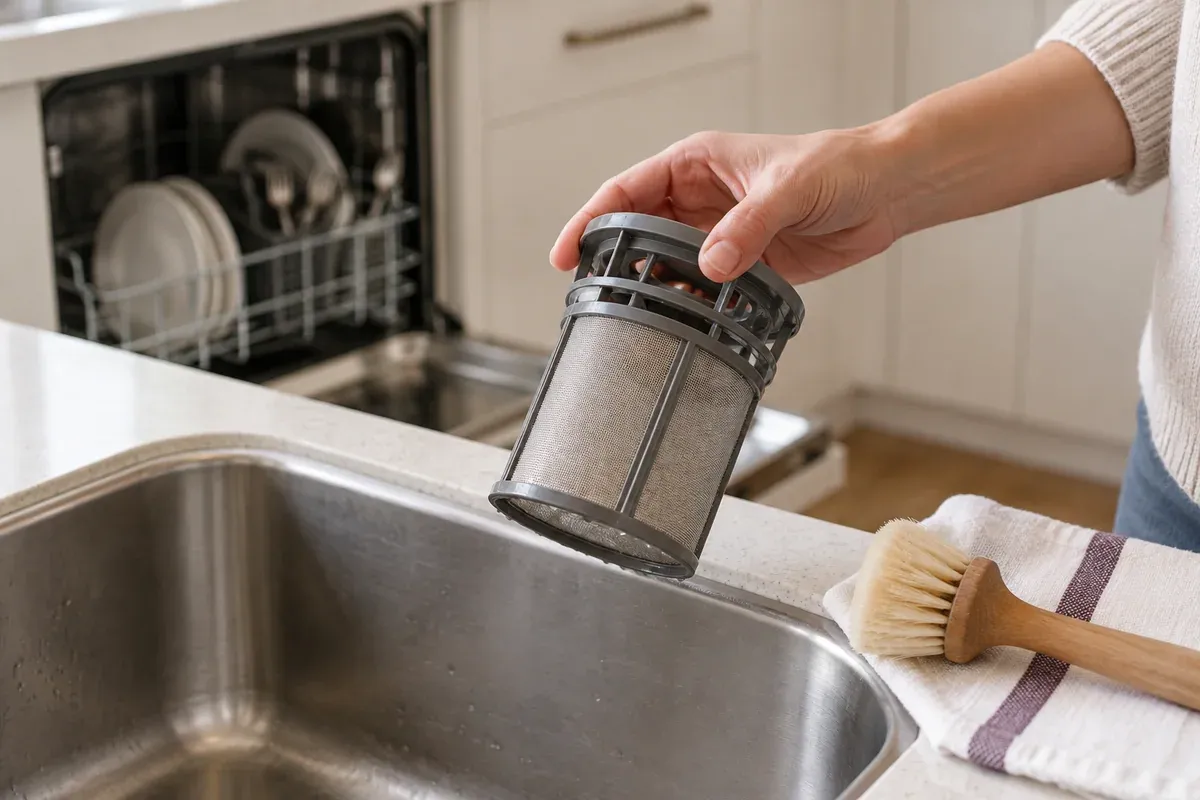
Wait until the machine has cooled, because the base can still be hot after a wash, then switch it off at the wall. Pull out the bottom basket and lift out loose scraps. Twist the filter cylinder (most turn anticlockwise) and lift it out; on many machines a flat mesh plate underneath lifts out too. Rinse both under hot running water, brushing the mesh gently with a soft brush. Don't bend the mesh or use a wire brush, and feel for broken glass before you reach into the hole.
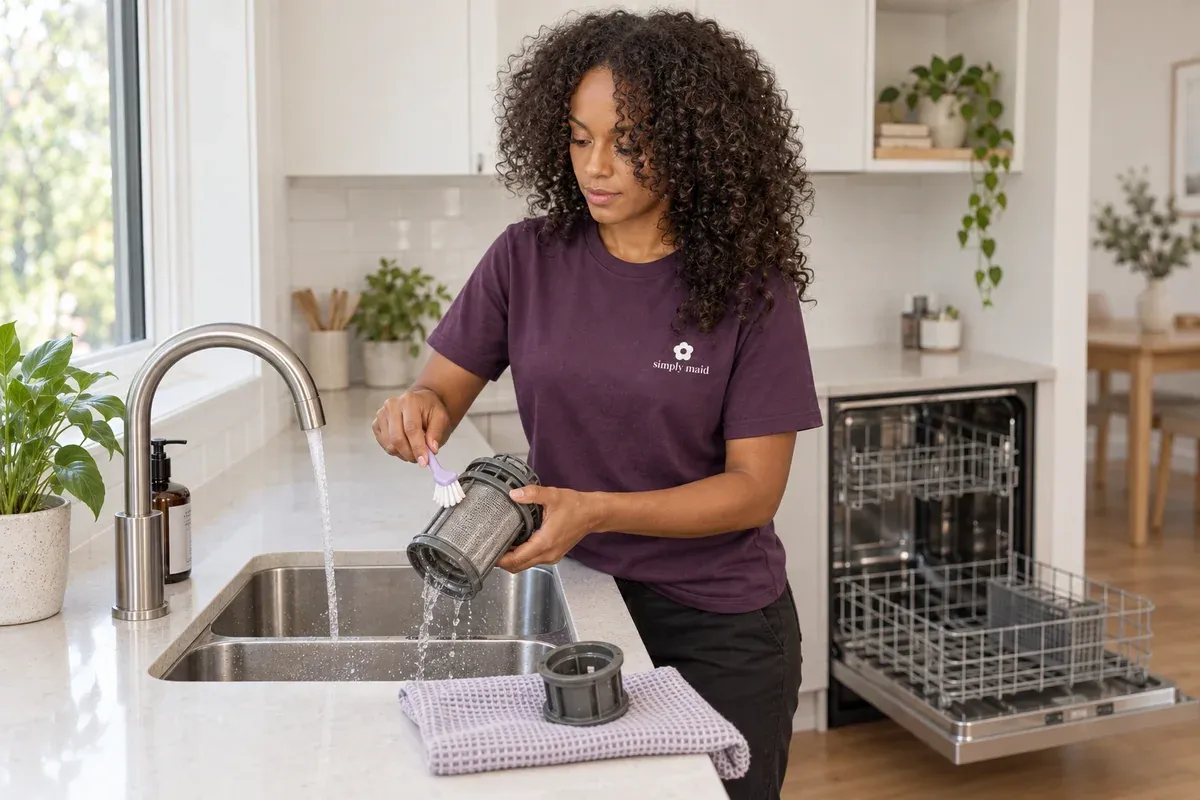
Refit the parts until they lock, and never run the machine with the filter out. If yours won't turn, look for arrows on the filter or search your brand and model number plus "filter" for its diagram. A torn mesh or broken tab needs a replacement part.
2. Clear the spray arms (2–3 minutes)
Spin each arm by hand: it should turn freely without hitting a rack. Push out anything stuck in the holes with a toothpick, never a metal skewer (CHOICE warns sharp metal damages them). If an arm is still blocked, unclip it, rinse it through under the tap and refit it.
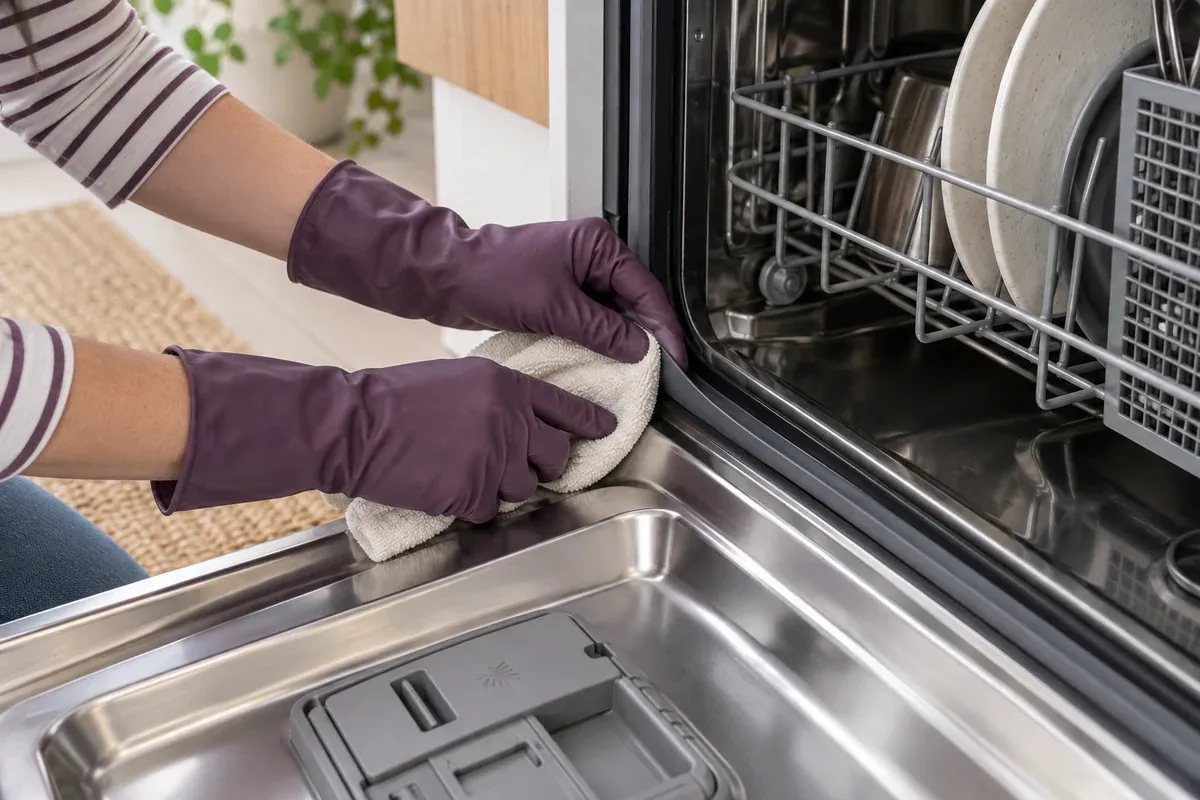
3. Wipe the door seal, door edge and dispenser (about 3 minutes)
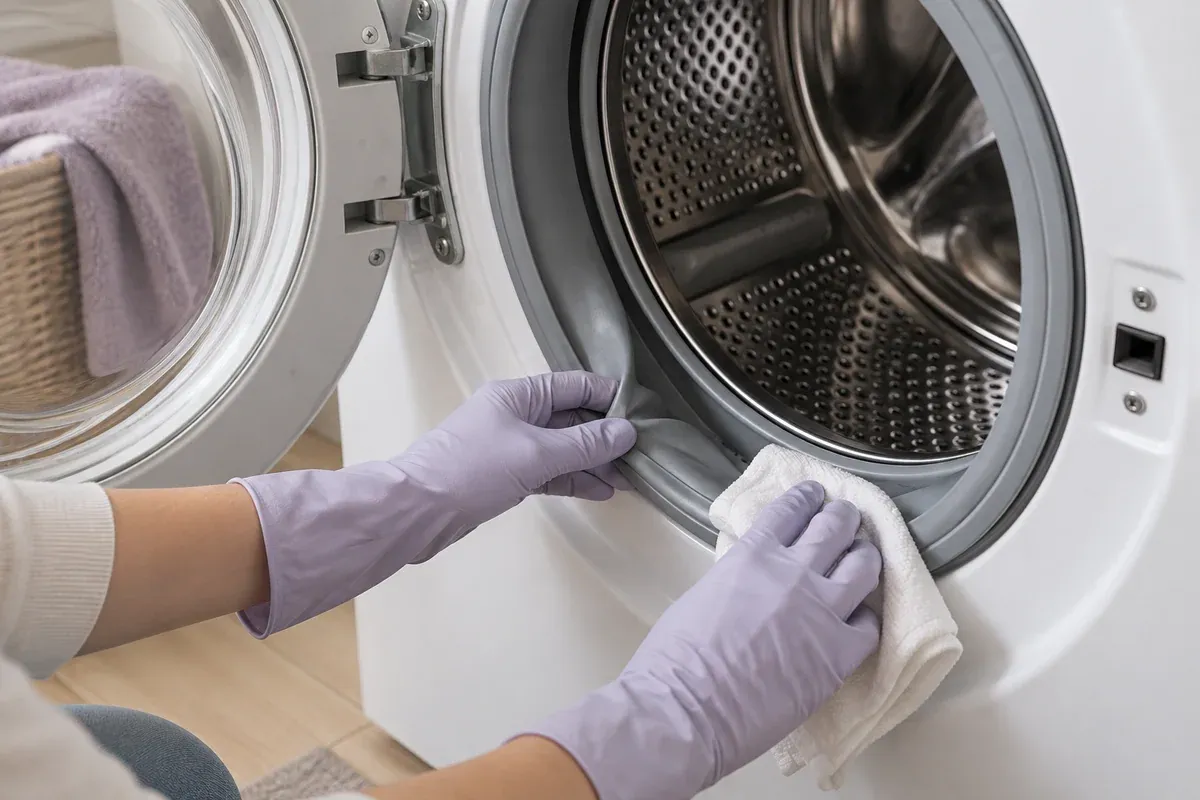
Wipe the rubber seal, the bottom lip of the door and the dispenser with a soft damp cloth, then dry them. Don't pull the seal out of its channel. A split or loose seal needs a new one, not stronger cleaners. The stainless front gets the same soft-cloth care as in How to Clean Stainless Steel Without Streaks.
Safety Never mix cleaning products. Victoria’s Better Health Channel: “Do not mix bleach with ammonia, acids or other cleaners – this can release hazardous chlorine or chloramine fumes.” Ventilate the room during and after use. Wear gloves and eye protection. Follow the label's dilution and contact time. In an emergency call 000. For poisoning advice call the Poisons Information Centre on 13 11 26 — 24 hours, anywhere in Australia.
4. Run a hot cleaning programme (hands-off)
Put a dishwasher cleaner in the empty machine, where its pack says, and run the hottest programme, usually Intensive or Pots and pans. Every 1–3 months suits most homes. Top up the rinse aid while you're there.
Done looks like a filter you can see through, arms that spin freely, a seal with no grit in it, and no smell when you open the door the next morning.
How often should you clean a dishwasher filter?
Look at it every week and rinse it whenever you can see food on it, and at least once a month; the brand table above has each maker's interval. Wipe the seal at the same time.
How to get rid of a dishwasher smell (and other problems)
What you notice | Likely cause | What to do |
|---|---|---|
A smell when you open the door | Food in the filter (Miele's first suspect), the seal or the door lip | Steps 1 and 3. Leave the door ajar after the cycle so it dries. |
Water left in the base after a cycle | A blocked filter or drain | Clean the filter. If it still won't drain, call the maker's service line. |
White film or spots | Hard water, too little rinse aid or, on machines with a softener, no salt | Top up rinse aid. If there's a salt compartment, fill it with dishwasher salt (not table salt) and set it to your water's hardness: Hard Water in Australia: Signs and Limescale. |
Cloudiness that won't rub off | Etched glass | It's permanent; no cleaner reverses it. Wash fine glasses in the sink: How to Wash Dishes by Hand Properly. |
Food left on dishes | A blocked filter or spray holes, or crowded racks | Steps 1 and 2, and keep the arms' path clear. |
If it leaks, trips the power or shows a fault code, stop using it and call the maker's service line with the model number from the door edge. Simply Maid cleaners don't service or repair appliances.
A Simply Maid deep clean or end of lease clean includes cleaning inside the dishwasher and its filter. A standard clean wipes the outside of your appliances but not the inside of the dishwasher.
Frequently asked questions
Should I leave the dishwasher door open?
Yes, ajar after the cycle ends. CHOICE says it helps the seals last and the moving air keeps mould and smells at bay. Close it again if children, pets or people walking past could trip on it or climb in.
Can a dirty dishwasher make you sick?
The evidence is about what grows, not who gets sick. A 2016 study of 30 home dishwashers in Slovenia found fungi in 25, most often on the rubber door seal; it didn't measure illness, and the authors' concern was people with weakened immunity or cystic fibrosis. Either way, wiping the seal is the practical answer.
Last reviewed 24 September 2026 · Update history
Sources
- Miele Australia, Caring for your dishwasher: filter, vinegar, bleach.
- Fisher & Paykel, DishDrawer DD60D2 user guide (PDF): filter, cleaners to avoid.
- Bosch Australia, Dishwasher cleaning and care: care-product intervals.
- LG Australia, Dishwasher maintenance guide: filters, Machine Clean, vinegar and citric acid.
- CHOICE, How to clean your dishwasher (26 Sep 2024): spray arms, seals, bicarb.
- Finish Dishwasher Cleaner pack directions (Chemist Warehouse listing): pack directions.
- ABC News, Vinegar and baking soda: does it work? (Nathan Kilah, 2024): why the two cancel out.
- Zupančič et al., fungi in household dishwashers, PLOS ONE 2016: 30 Slovenian dishwashers.
Related reading
Change log
Who wrote and edited this article, when its sources were checked, and what changed.
View all historyHide earlier history
Earlier entries record what was published at the time. Later corrections take precedence.
- Edited by
- Huy Hoang
24 September 2026: How to Clean a Dishwasher: the guide now opens with one routine that works on most machines (filter, spray arms, seal, then a dishwasher cleaner on the hottest programme) and gives a verdict on vinegar, bicarb and bleach. It adds each main brand's filter and cleaning intervals and one table for smells, white film and cloudy glasses.
- Edited by
- Huy Hoang
Editorial correction, 20 September 2026: removed universal vinegar and seal-bleaching advice, unsupported odour guarantees and the fixed 20-minute claim. Clarified model-specific parts, programmes and maintenance intervals, and the limits of the cited fungal study. Images illustrate cleaning actions and do not document a Simply Maid product test.