If the dishes feel like the one chore that never, ever ends — you're not imagining it. Between breakfast, lunch, dinner, and the endless round of snack plates and water bottles, the kitchen sink has a way of filling back up the moment you've emptied it. But washing dishes by hand doesn't have to drain your evening.

Quick Answer: Scrape away food, wash with warm water and hand-dishwashing liquid at its label dose, then rinse with clean water. Start with lightly soiled items and leave greasy cookware until last. Soak stuck-on food only when the item's care instructions allow it. Let ordinary crockery air dry on a clean rack; dry knives, timber and seasoned cast iron promptly as their makers direct.
Why Hand Washing Dishes Still Matters
Even if you own a dishwasher, some items need hand washing. Check the care instructions: dishwasher suitability varies between glasses, pans, knives and other kitchenware. And in many Australian rentals and older homes, a dishwasher simply isn't an option.
This guide covers routine household washing-up. Cleaning removes food and grease; it is not the same as sanitising. Food Standards Australia New Zealand (FSANZ) makes that distinction in its food-business guidance. Do not treat ordinary soapy water as a validated sanitising process, or assume this household routine replaces requirements for a food business.
What You'll Need
Before you start, gather these tools by the sink:
- A dish brush — choose soft bristles suitable for the item
- A soft sponge — for glasses, mugs, and lightly soiled items
- Hand-dishwashing liquid — use the bottle's dose, not automatic-dishwasher detergent
- A clean drying rack — plus a clean tea towel for items that need immediate drying
- A sink plug — for a basin wash or a permitted soak
Tip: Keep a separate brush or sponge for greasy items. Grease transfers easily and makes cleaning other dishes harder.
How to Wash Dishes by Hand in 4 Steps
Step 1: Prepare Your Sink
Clear the sink and give it a quick scrub with dish soap and a sponge. You're about to fill it with soapy water, so starting clean matters.
Scrape food into the bin before washing. Plug the clean sink and use warm water that is comfortable to work in. Measure hand-dishwashing liquid according to its label: concentrations differ. For example, the Australian directions for Koala Eco Lemon Myrtle & Mandarin Dish Soap specify approximately 10 mL in a sink of warm water. That is a product-specific example, not a dose for every detergent.
Safety note: Do not put your hands in scalding water to try to sanitise dishes. Sanitising depends on a suitable process, temperature and contact time; there is no universal instant-kill temperature for household washing-up.
Step 2: Soak Stuck-On Food Only When Needed
Freshly used dishes often need no soak. For dried-on food on soak-safe items, the American Cleaning Institute suggests about 15–30 minutes before washing. The item's manufacturer takes priority if it specifies a different method.
The right soaking time depends on the food residue and the item's material. Soak to loosen food, then wash; do not make an overnight sinkful the default.
Important exceptions:
- Knives — wash separately and keep the sharp edge visible instead of leaving blades hidden in washing-up water. Victorinox recommends prompt cleaning and careful handling. Never soak wooden-handled knives; dry knives promptly after rinsing.
- Wooden cutting boards — never soak. Wood absorbs water and warps over time. Wash immediately, then dry straight away.
- Seasoned cast iron — do not soak; follow the wash, dry and oil routine below.
Step 3: Scrub From Cleanest to Dirtiest

Washing order helps manage the water; it does not establish sanitisation. Timber and seasoned cast iron need prompt drying, and some items must not soak.
Read the illustration as text
- Lightly soiled items
- Begin with suitable glasses, cups and ordinary crockery.
- Greasy cookware
- Leave the heaviest soil until later; change dirty water.
- Rinse and dry
- Use the drying method required by the item’s material.
Handle knives separately with their edges visible.
Order matters here. Start with the least soiled items and work toward the greasiest:
- Glassware and cups — use a soft sponge
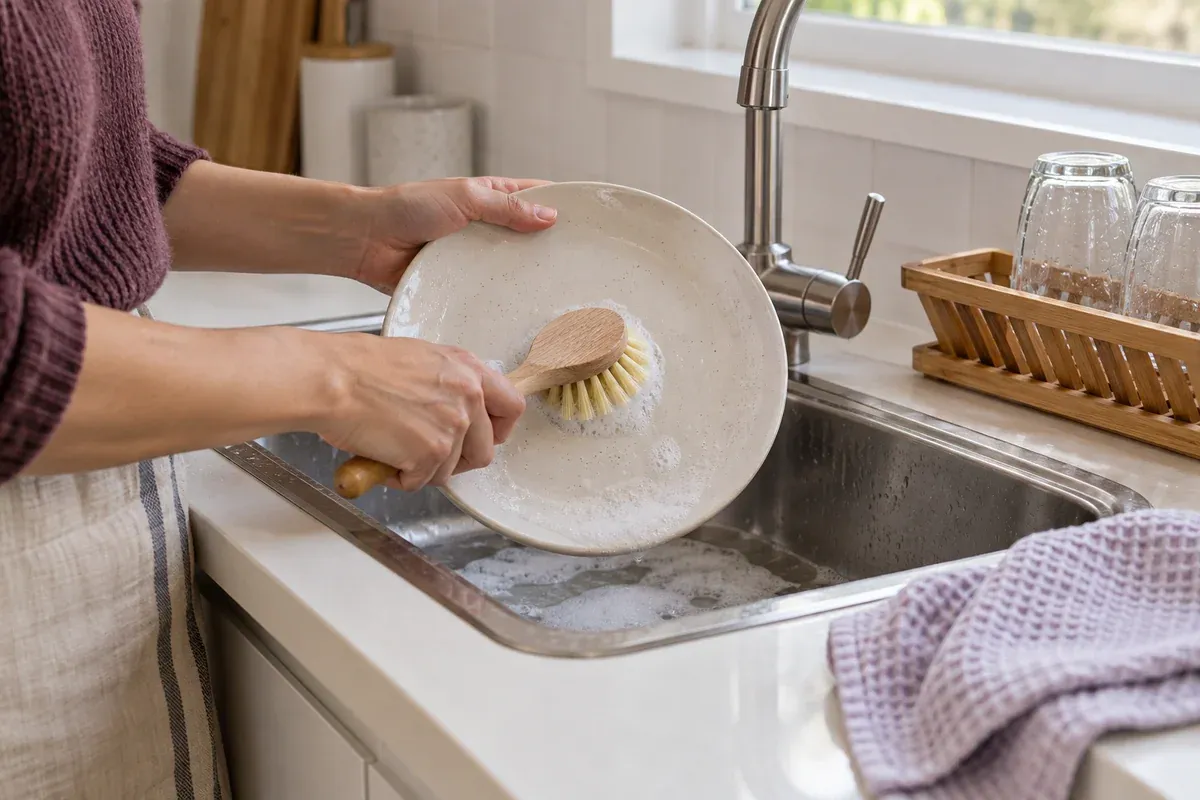
- Plates and bowls — a dish brush works well
- Cutlery — pay attention to fork tines where food hides
- Serving dishes and containers — scrub inside and out
- Pots, pans, and baking trays — save these for last
This keeps your water cleaner for longer. If the water gets too murky or greasy, drain and refill — dirty water won't get anything clean.
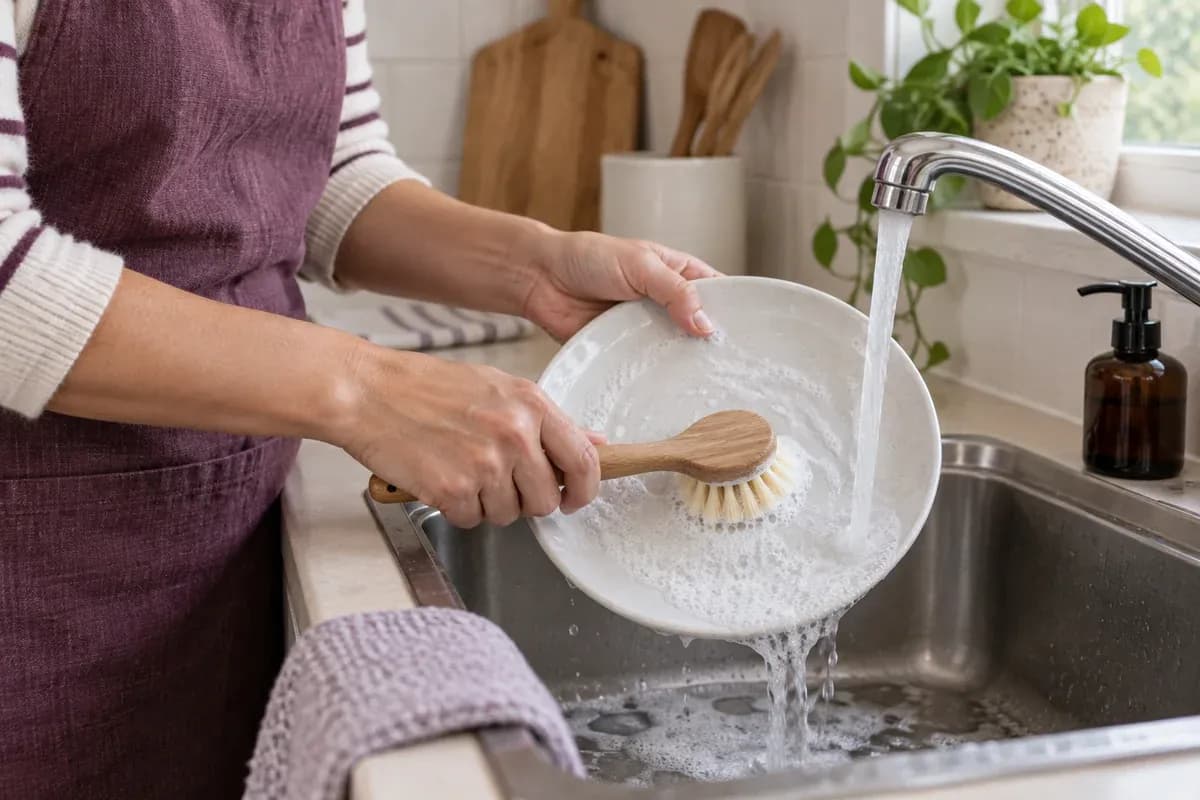
For greasy items, use a dish brush rather than a sponge. A 2022 study from the Norwegian Institute of Food, Fisheries and Aquaculture Research (Nofima) found that dish brushes harbour significantly fewer bacteria than sponges, largely because they dry faster between uses.
Step 4: Rinse and Dry
Rinse each item under running water, using one hand to hold the dish and the other to wipe away remaining soap. A quick visual check catches anything you missed.
For ordinary crockery and utensils:
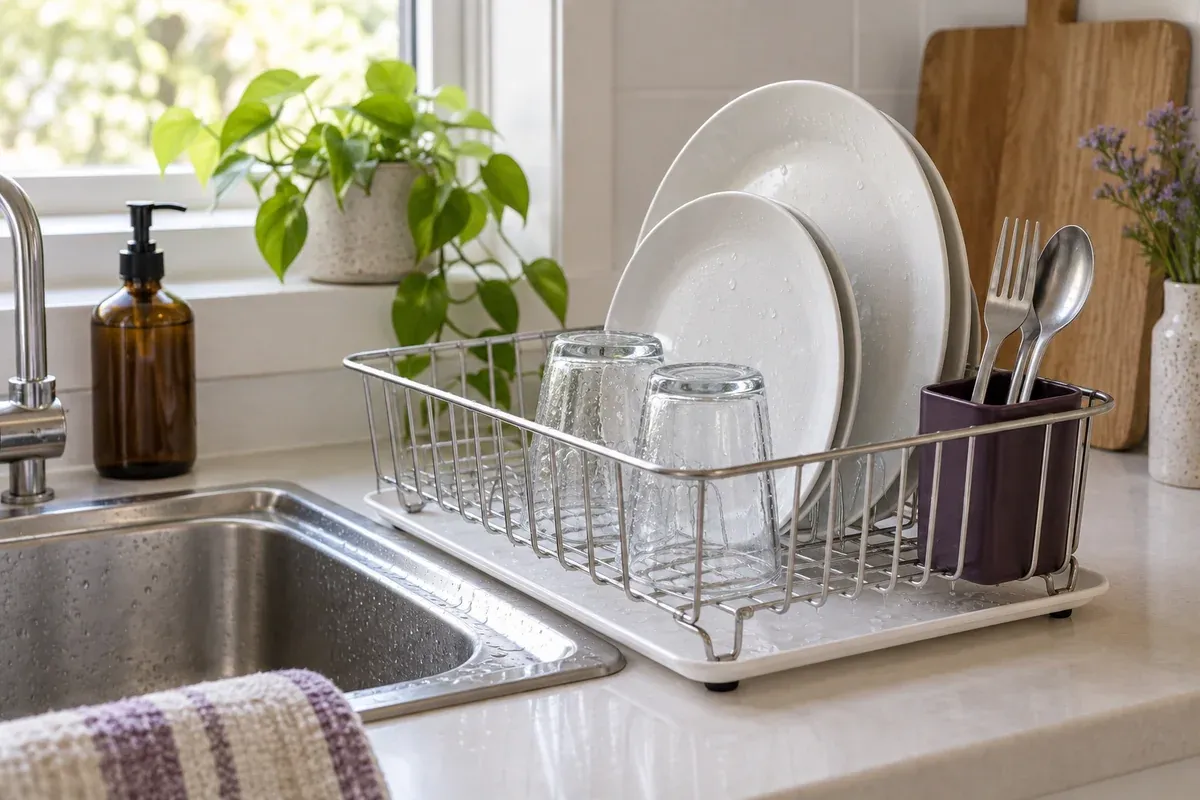
- Air drying on a clean rack — leave space for water to drain and air to circulate.
- Towel drying — use a clean, dry tea towel, not one already used on hands or benches. FSANZ's utensil guidance prefers air drying but permits clean tea towels.
Keep knives, timber and seasoned cast iron out of this general air-drying routine when their care instructions call for prompt hand drying. Put kitchenware away only when dry.
Caring for Tricky Cookware
Not everything gets the same treatment. Here's how to handle the tricky ones.
Non-Stick Pans
Let the pan cool before washing and follow the care guide for its exact coating. Start with mild detergent and a soft cleaning tool. Do not assume metal scourers, abrasive powders or a bicarb paste are suitable for every non-stick pan; manufacturer instructions differ. SCANPAN Australia provides separate care guides for its different cookware types.
Burnt Stainless Steel
Use the cookware maker's method for burnt food. Stainless steel finishes can scratch, so a metal scrubber is not a universal choice. For example, SCANPAN's stainless steel guide gives product-specific cleaning options. Do not heat a cleaning paste or use a specialist cleaner unless the pan and cleaner instructions support that method. Appliance-door advice is not automatically suitable for a pan's cooking surface.
Blenders
Follow the model's cleaning programme or manual; fill limits, water temperatures, detergent quantities and removable parts differ. Unplug before manual cleaning or handling removable blades. Keep the motor base, cord and plug out of water. Do not apply one timed blend-and-rinse recipe to every blender.
Why Your Sponge Might Be the Problem
Brushes and sponges can both carry bacteria. Nofima's research found lower bacterial levels in used brushes and better survival conditions in slowly drying sponges. Let tools dry between uses and keep them clean; a brush can still become contaminated.
A few ways to manage this:
- Replace worn, damaged or persistently smelly sponges promptly, following the product's care advice
- Switch to a dish brush for daily washing — they dry faster and are easier to clean
- Never use the same sponge for benchtops and dishes — that cross-contaminates
- Rinse and wring sponges thoroughly after every use and store upright so they air dry
If you're already part of the way through a full kitchen clean, tackling the dishes first gives you a clear sink to work with for the rest of the job.
Frequently Asked Questions
Q: Is it more hygienic to wash dishes by hand or in a dishwasher?
It depends on the machine, programme and washing method. Ordinary hand washing removes soil; it is not equivalent to a sanitising cycle. Dishwasher temperatures vary. If sanitising is needed, use a suitable labelled product or a dishwasher programme designed for it, following its instructions and the item's care restrictions.
Q: How hot should the water be for hand washing dishes?
Use warm water that is comfortable to work in and follow the detergent label. There is no single temperature that makes all household hand washing a sanitising process. Avoid scalding water.
Q: Can I leave dishes soaking overnight?
Avoid making it the routine. Soak only when needed and permitted for that item, then wash and rinse. A 15-minute limit is not a universal safety boundary. Knives with wooden handles, timber boards and seasoned cast iron need different care.
Q: How often should I replace my kitchen sponge?
There is no single replacement interval that guarantees hygiene. Follow the maker's advice, keep the sponge clean and let it dry, and replace it when worn, damaged or persistently smelly. A brush that dries readily can be a useful alternative, but it also needs cleaning.
Q: What's the best way to clean a cast iron pan by hand?
For seasoned cast iron, Lodge recommends hand washing with a small amount of soap if needed, drying promptly and rubbing on a thin layer of cooking oil. Do not soak it or leave it to air dry. Enamelled cast iron has a different surface, so follow its own care guide.
Related Reading
- A Systematic Way to Clean Your Kitchen
- A Cleaning Guide to Sparkling Stainless Steel Appliances
- How to Clean 6 Essential Baking Tools
- Order in the Kitchen — Organisation Tips You Can't Miss
- 9 Steps to Rid Your Coffee Maker of Mould
Sources & References
- Food Standards Australia New Zealand (FSANZ) — Cleaning and sanitising and Preparing and cooking food. Food-business guidance used for the distinction between cleaning and sanitising, rinsing and drying; not presented as a household sanitising protocol.
- American Cleaning Institute — Washing dishes by hand. Washing order and optional soaking of suitable items.
- Koala Eco Australia — Lemon Myrtle & Mandarin Dish Soap. Product-specific Australian label dose and fresh-water rinse.
- Victorinox — Knife care tips and Cleaning kitchen knives. Prompt washing, visible blade handling, wooden-handle restrictions and drying.
- SCANPAN Australia — Care guide library and Stainless steel guide. Material-specific cookware care.
- Lodge — How to clean seasoned cast iron. Washing, prompt drying, oiling and no soaking.
- Trond Møretrø et al., Norwegian Institute of Food, Fisheries and Aquaculture Research (Nofima) — Kitchen Sponge vs Brush Hygiene Study, Journal of Applied Microbiology (2022). Cited for findings that dish brushes harbour fewer bacteria than sponges.
- Nofima — Brushes are more hygienic than sponges. Research summary and the role of drying.
If keeping on top of the dishes feels like one thing too many, our friendly team is always here to help.
Your trusted partner in a calmer, cleaner home.
A hand with everyday housework
If you'd like help keeping the rest of the kitchen clean, compare our standard house cleaning inclusions. You can check the kitchen tasks and optional extras before arranging a visit.