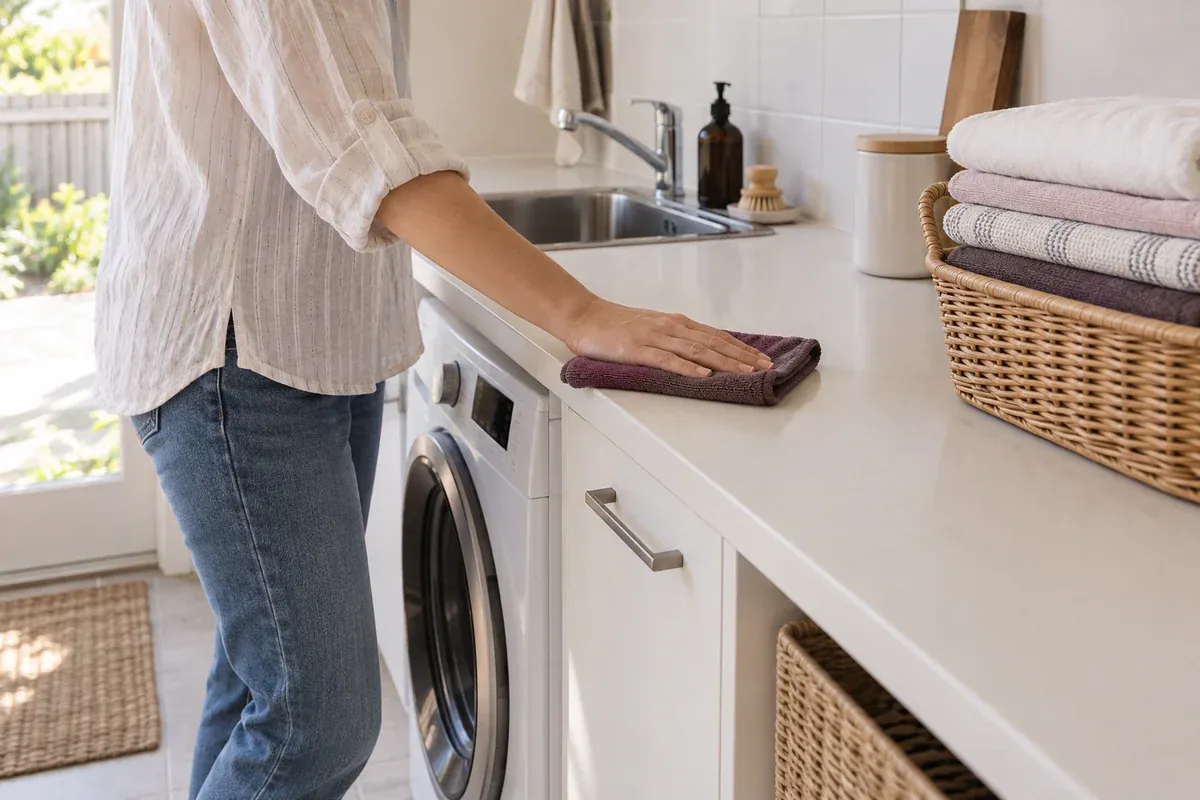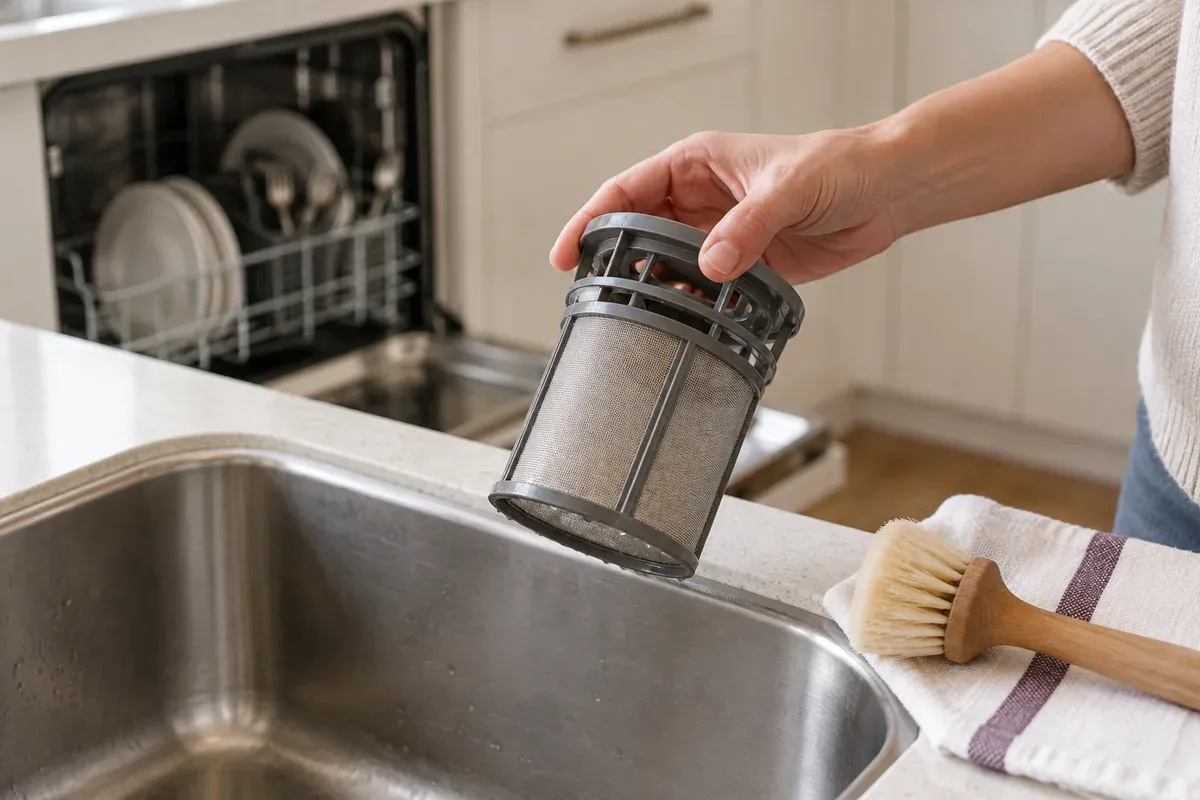
A smelly washing machine usually has a dirty door seal, detergent drawer or filter. Clean those by hand, then run the empty drum on a hot cleaning cycle.
Quick answer: Wipe the door seal's folds with hot soapy water, scrub the detergent drawer under the tap with an old toothbrush, and clear the filter (front loader: the pump filter behind the bottom flap; top loader: the lint filter). Then run the empty machine on its drum-clean cycle, or its hottest cotton programme with a little detergent. About 20–30 minutes hands-on. Check your manual before using vinegar: Bosch rules it out.
Vinegar, bicarb, bleach or a machine cleaner: what works
Method | Verdict | Why |
|---|---|---|
Hot empty cycle with a little detergent, or the machine's cleaning cycle | Use this | CHOICE's default, about once a month; it says most machines need no special cleaner. |
Washing-machine cleaner or anti-limescale powder | Where your brand asks | Fisher & Paykel top loaders take commercial cleaners only; LG pairs Tub Clean with anti-limescale. Samsung's Drum Clean takes nothing. |
Two cups of vinegar on a hot cycle | Only if your manual allows it | Bosch says vinegar damages rubber parts, and LG allows diluted vinegar only on a cloth, as a seal wipe. CHOICE says some makers rule it out, so check the manual first. |
Vinegar and bicarb together | Don't | They neutralise each other; the fizz adds no cleaning power. |
Bicarb on its own | Little point | It won't dissolve limescale (that takes an acid), and detergent does the cleaning. |
Bleach | Only a step your maker gives | Samsung allows a diluted-bleach seal wipe but warns it can deform the seal; Fisher & Paykel says soaking in bleach corrodes metal. |
A dishwasher tablet in the drum | Don't | CHOICE warns it's caustic enough to damage seals and hoses. |
The dishwasher has its own brand rules for vinegar, bleach and cleaners: see How to Clean a Dishwasher: Filter, Seal and Smell.
Find your brand's cleaning cycle
Brand | Cycle | What to add | How often |
|---|---|---|---|
Samsung | Drum Clean or Drum Clean+ (heats to 60–70 °C) | Nothing: no detergent or cleaner | Every 40 washes or about once a month |
LG | Tub Clean, empty | Anti-limescale powder in the drawer or a tablet in the drum | Once a month |
Fisher & Paykel | DRUM CLEAN, empty | A commercial washing-machine cleaner (septic-safe if you have a tank) | Front loaders remind you after 100 cycles |
Bosch | The cleaning programme in the manual | Bosch's recommended washing-machine cleaner | As the manual says |
Electrolux | Machine Clean, or Cottons 90 °C | Nothing named | Once a month |
Miele | Cottons 90 °C | Miele machine cleaner or a multi-purpose detergent | When the hygiene light comes on |
Brand unknown | The hottest cotton programme, empty | A little of your usual detergent | Once a month |
Safety Never mix cleaning products. Victoria’s Better Health Channel: “Do not mix bleach with ammonia, acids or other cleaners – this can release hazardous chlorine or chloramine fumes.” Ventilate the room during and after use. Wear gloves and eye protection. Follow the label's dilution and contact time. In an emergency call 000. For poisoning advice call the Poisons Information Centre on 13 11 26 — 24 hours, anywhere in Australia.
How to clean a front loader washing machine

Filter access and cleaning additives vary. Do not force parts or open a hot, full machine; stop for leaks, faults or uncertain drainage.
Read the illustration as text
- Seal and drawer
- Clear residue by the model’s permitted manual cleaning method.
- Accessible filter
- Cool and isolate first; follow the manual’s drainage procedure.
- Maintenance programme
- Refit parts and use only the cycle and additives specified for the model.
An empty cycle cannot wipe out the seal folds.
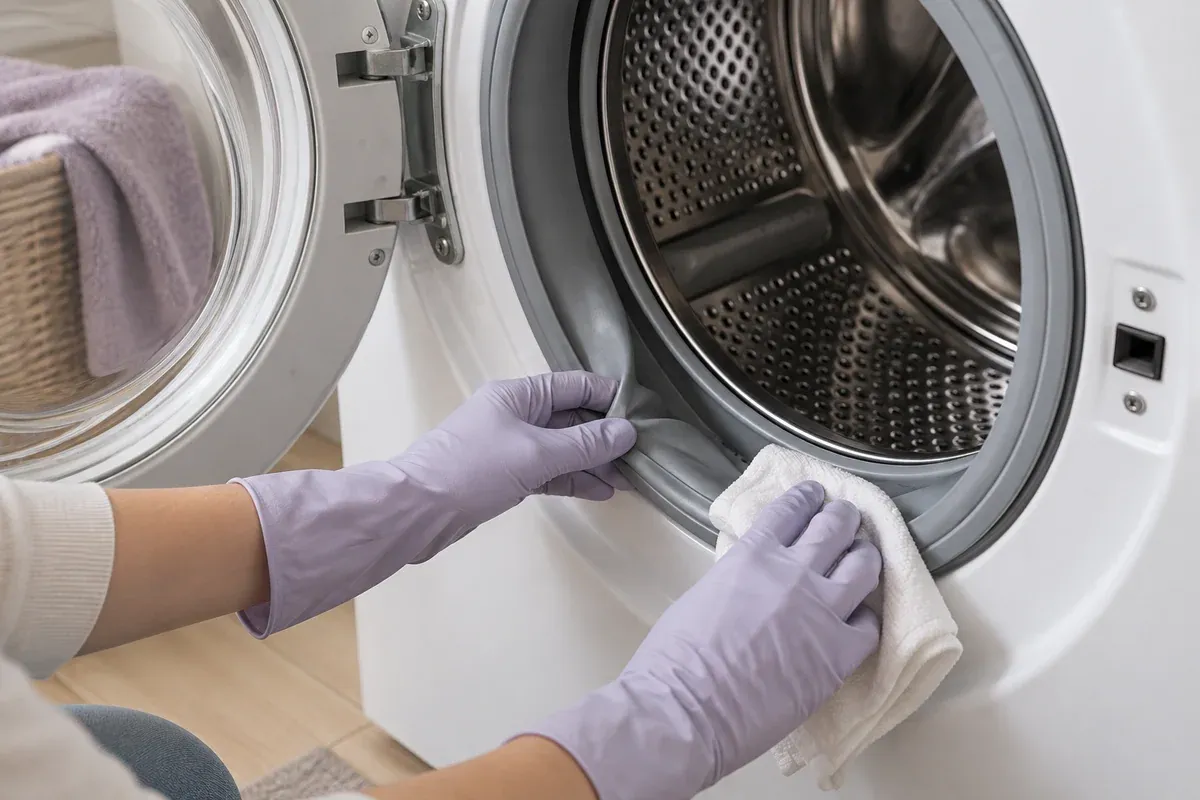
1. Wipe the door seal (about 5 minutes)
Fold back the rubber seal's lip and look into the bottom fold, where water, lint, hair and coins collect. Wipe it out with a cloth wrung out in hot soapy water, then dry it; no scourers or cream cleansers on the rubber. Black spots that stay: see the bleach row above. A split seal needs a replacement.
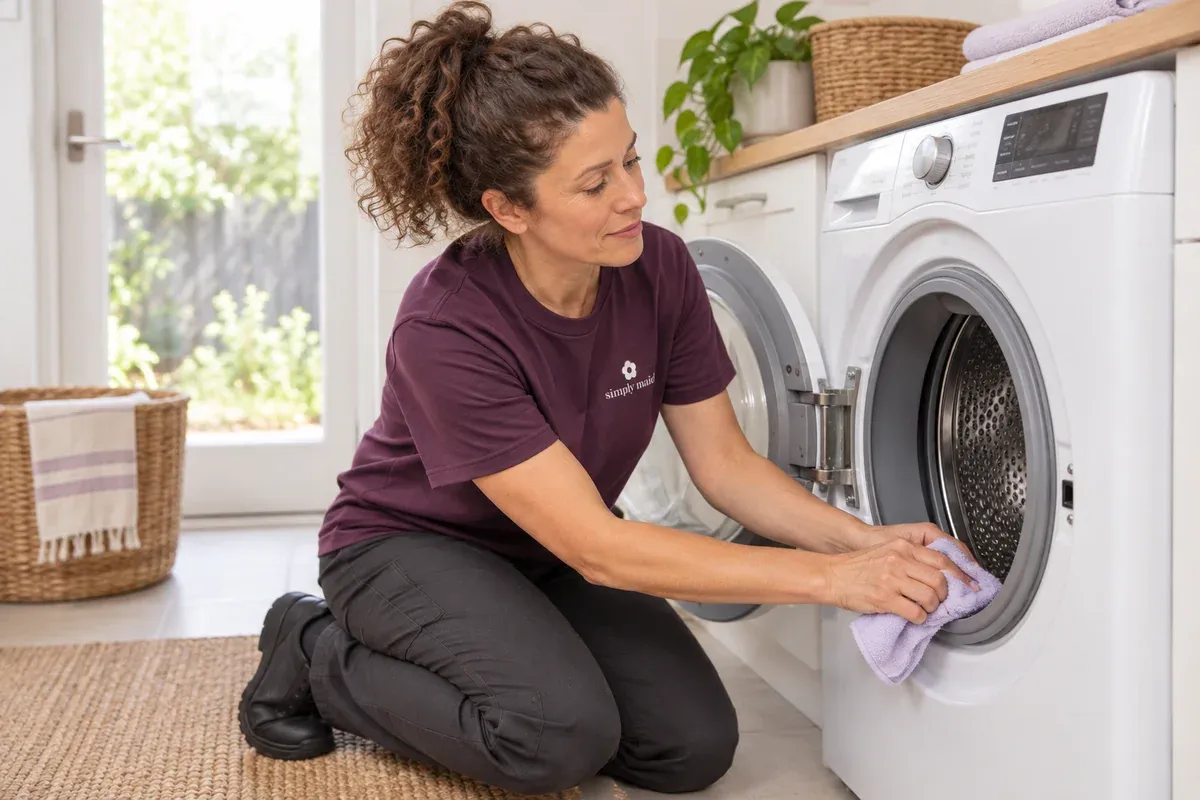
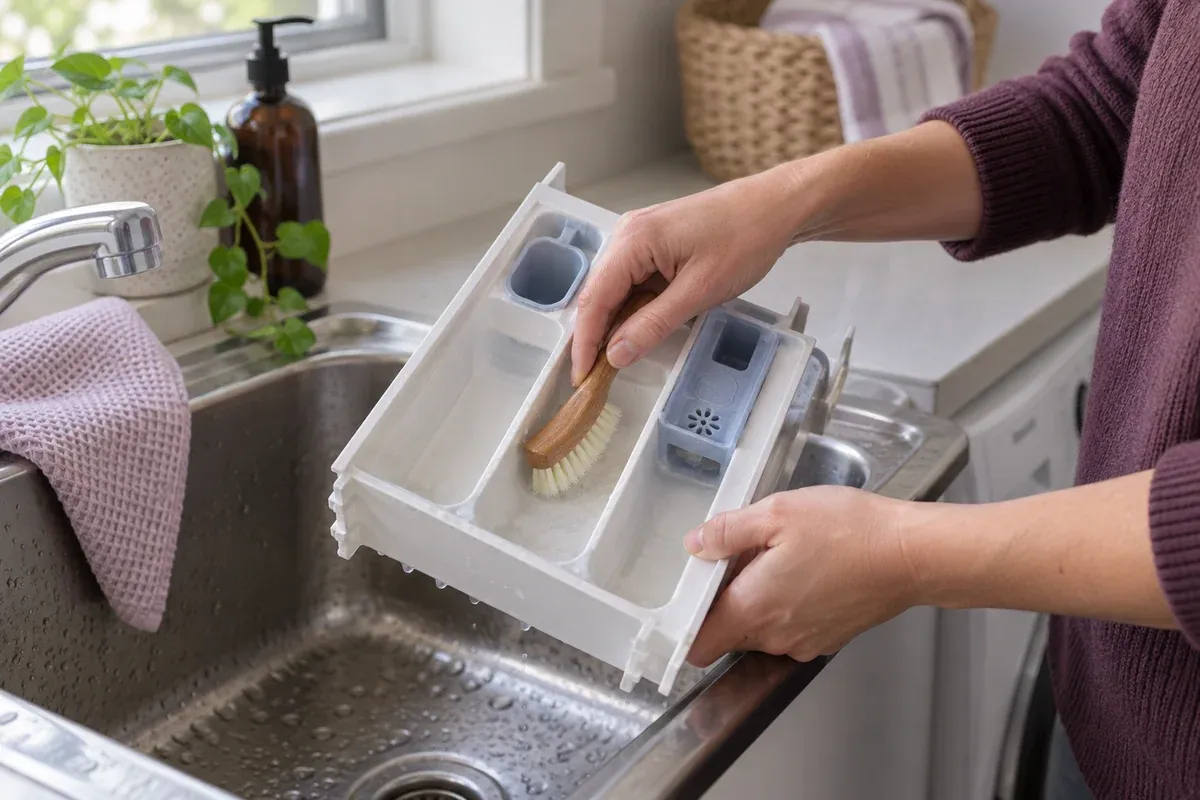
2. Clean the detergent drawer (5–10 minutes)
Pull the drawer out until it stops, press the release lever inside it and lift it out. Scrub every compartment under warm running water with an old toothbrush, then brush out the recess and wipe it dry. Auto-dosing tanks come out separately; rinse them too. Leave the drawer slightly open between washes.
3. Drain and clean the pump filter (10–15 minutes)
The pump filter sits behind a small flap at the bottom front and catches coins, hair ties and lint. For its exact spot, search your brand and model number (on a sticker inside the door) plus "pump filter".
- Let a hot wash cool, then turn the machine off and unplug it.
- Lay down a towel and a shallow tray. Pull out the small drain hose beside the filter, remove its cap and let the water run out. Fisher & Paykel front loaders hold about 250 mL; others hold more, so have a second container ready.
- Turn the filter anticlockwise, pull it out slowly, clear the debris (watch for sharp objects) and rinse it under the tap.
- Screw it back in firmly, cap and stow the hose, and check for drips on the next wash.
If the filter won't turn or water keeps coming, stop and call the maker's service line.
4. Run the empty cleaning cycle (hands-off)
Run your brand's cycle from the table with the drum empty, then dry the seal and leave the door ajar. Done looks like a clean seal fold, a drawer with no black film, a clear filter and a drum that smells of nothing.
How to clean a top loader washing machine
- Empty the lint filter after every wash (CHOICE; Fisher & Paykel's WL top loaders say every cycle). It's usually a mesh pouch on the drum wall or a filter atop the agitator.
- Wipe under the lid and around the rim with a cloth wrung out in hot soapy water, keeping water off the controls.
- Lift out the removable dispenser parts (on Samsung top loaders, the wing distributor and rinse cap) and rinse them.
- Run Tub Clean or Drum Clean empty, as your brand's row says, or the hottest programme with a little detergent.
Fisher & Paykel allows household bleach on a stained low-profile agitator, followed by DRUM CLEAN to rinse it out. Don't pause a full tub for a vinegar or bleach soak: Fisher & Paykel warns soaking corrodes the metal.
How often should you clean a washing machine?
- After every wash: wipe the seal, empty a top loader's lint filter and leave the door ajar where children and pets can't climb in.
- Once a month: the hot empty cycle.
- About every 2 months: the drawer and the pump filter (Electrolux says every two months, Samsung five or six times a year).
- On hard water: use your detergent's hard-water dose; Hard Water in Australia: Signs and Limescale has your city's hardness.
Why does my washing machine smell?
Check | Fix |
|---|---|
Seal fold, drawer recess, filter | Steps 1–3 (top loader: the lint filter) |
Only cool washes for weeks | Run the hot cycle; Miele's hygiene light comes on when nothing above 60 °C has run for a long time |
Door shut between washes | Leave it ajar; Fisher & Paykel says a closed door causes odours |
Too little detergent for dirty loads | Use the dose for the soil level; Fisher & Paykel links under-dosing to odour |
Clean washing smells musty | Take it out as soon as the cycle ends |
Still smells, leaks, won't drain or shows an error code? Call the maker's service line or an appliance technician with the model number. Simply Maid cleaners don't service or repair appliances, and a deep clean wipes the outside of the washing machine only: the seal, drawer, filter and drum aren't on its checklist. For the rest of the room, see How to Deep Clean Your Laundry.
Frequently asked questions
Isn't a hot wash enough to clean the machine?
Not on its own: lint and sludge in the seal fold and drawer stay until you wipe them out. In a 2019 German hospital case, bacteria survived in a domestic machine's drawer and seal despite 65 °C washes, and 13 newborns were colonised, not diagnosed with infection; a hospital ward, not a household risk. More in Hot or Cold Water: Which Actually Cleans Better?.
How do you clean a washing machine naturally?
Hot water and a little detergent do most of it, plus warm soapy water on the seal and drawer. For homemade sprays elsewhere, see How to Make Natural Cleaning Products: 10 Homemade Recipes.
Last reviewed 24 September 2026 · Update history
Sources
- CHOICE, How to clean your washing machine (9 Jan 2026): the default cycle, seals, lint filters.
- Samsung Australia, Clean the door and drum: Drum Clean, seal wipe.
- Samsung Australia, Washing machine maintenance tips: 40 washes, pump filter.
- LG Australia, Washing machine cleaning and maintenance guide: Tub Clean, seal wipe.
- Fisher & Paykel, front loader user guide 592886A (PDF): pump filter, reminder, odours.
- Fisher & Paykel, top loader user guide 431392B (PDF): cleaners, lint filters, agitator.
- Bosch Australia, Cleaning the washing machine with vinegar: why not.
- Electrolux Australia, Clean and maintain your washer: intervals.
- Miele Australia, Hygiene indicator: Cottons 90 °C.
- ABC News, Vinegar and baking soda: does it work? (Nathan Kilah, 2024): why they cancel out.
- Schmithausen et al., washing machine as a reservoir, 2019: the hospital case.
Related reading
Change log
Who wrote and edited this article, when its sources were checked, and what changed.
View all historyHide earlier history
Earlier entries record what was published at the time. Later corrections take precedence.
- Edited by
- Huy Hoang
24 September 2026: How to Clean a Washing Machine: the guide now gives numbered steps for front and top loaders (door seal, detergent drawer, pump or lint filter, then a hot empty cycle) and a brand-by-brand table of cleaning cycles. It adds verdicts on vinegar, bicarb, bleach and dishwasher tablets and a checklist for a smelly machine.
Sources and correction
The linked manufacturer documents describe particular products and models. They are examples to help you identify the right procedure, not reports of Simply Maid testing or a substitute for your manual.
- Edited by
- Huy Hoang
Editorial correction, 20 September 2026: Removed universal vinegar doses, hot-cycle and soaking recipes, unsupported smell diagnoses and guarantees about biofilm prevention. Corrected pump-filter access and drainage precautions, detergent dosing, bleach-mixing wording and the interpretation of hospital research. Added model-specific maintenance examples and child/pet precautions.