Finding mould in a coffee machine leaves you with a practical question: can you clean the affected part, or is the growth somewhere you cannot reach? Start there. A mouldy grounds container, a dirty milk system and mineral scale in the water circuit need different attention.
Quick answer: Stop using the machine if you find suspected mould. Identify the model and affected part, then follow the maker’s cleaning instructions for removable components. For growth in inaccessible tubing, persistent odour or recurring contamination, contact the manufacturer or a service technician before brewing again. A descaling cycle is not proof that mould has been removed. Do not run a generic vinegar or bleach recipe through the machine.
First, locate the problem
Let the machine finish its shutdown sequence, then disconnect power and allow hot parts to cool before inspecting or hand-cleaning it. Remove only components the manual identifies as user-removable. Keep the electrical body and plug out of water; do not open the casing or force out a brew unit.
Where you find the problem | What to do next |
|---|---|
Used grounds or capsules left in the waste container | Discard the waste and clean the removable container as directed. Check adjacent accessible parts before returning to use. |
Growth or a film in a removable water tank, lid or seal | Check the tank-cleaning instructions and contact support if growth cannot be removed or a seal is damaged. |
Growth behind fixed components, inside tubing, or a smell that remains after permitted cleaning | Keep the machine out of use and ask about inspection, servicing or replacement of the affected part. |
A descale warning, slow flow or bitter coffee without visible growth | Use the model’s troubleshooting guide. These signs can have several causes and do not diagnose mould. |
Photograph the affected area before cleaning and note where it is: in the waste tray, in the water tank or behind a fixed component. That gives support a much clearer starting point than “the coffee tastes funny”. Do not taste a drink to check whether suspected contamination has gone.
Cleaning, descaling and milk care are separate jobs

Routine maintenance does not establish that concealed mould has been removed. Keep suspected internal contamination out of use and ask the manufacturer about inspection or service.
Read the illustration as text
- Coffee residue
- Clean approved removable parts and use the specified cleaning programme.
- Mineral scale
- Follow the separate descaling method and rinse sequence.
- Milk system
- Use the instructions for the actual milk attachment.
Completing one task does not complete the other two.
Cleaning removes coffee residue from accessible parts and, where specified, uses a dedicated cleaning cycle. Descaling tackles mineral deposits in the water system. Milk systems have their own rinse and cleaning instructions. Finishing one task does not mean the other two are done.
For example, the Breville Barista Express BES870 instruction book assigns different meanings to its CLEAN / DESCALE light: flashing requests a cleaning cycle with a tablet in the filter; a solid light requests descaling with the specified powder in the tank. Match the instructions to your version of the machine. Putting a cleaning tablet in the water tank would confuse those two procedures.
Nespresso Australia’s descaling guidance explicitly excludes vinegar because it can damage the machine. Its descaler is for limescale removal. Neither that product description nor the Breville routine establishes a treatment for concealed mould.
Clean the parts you can safely remove
1. Read the instructions for each part
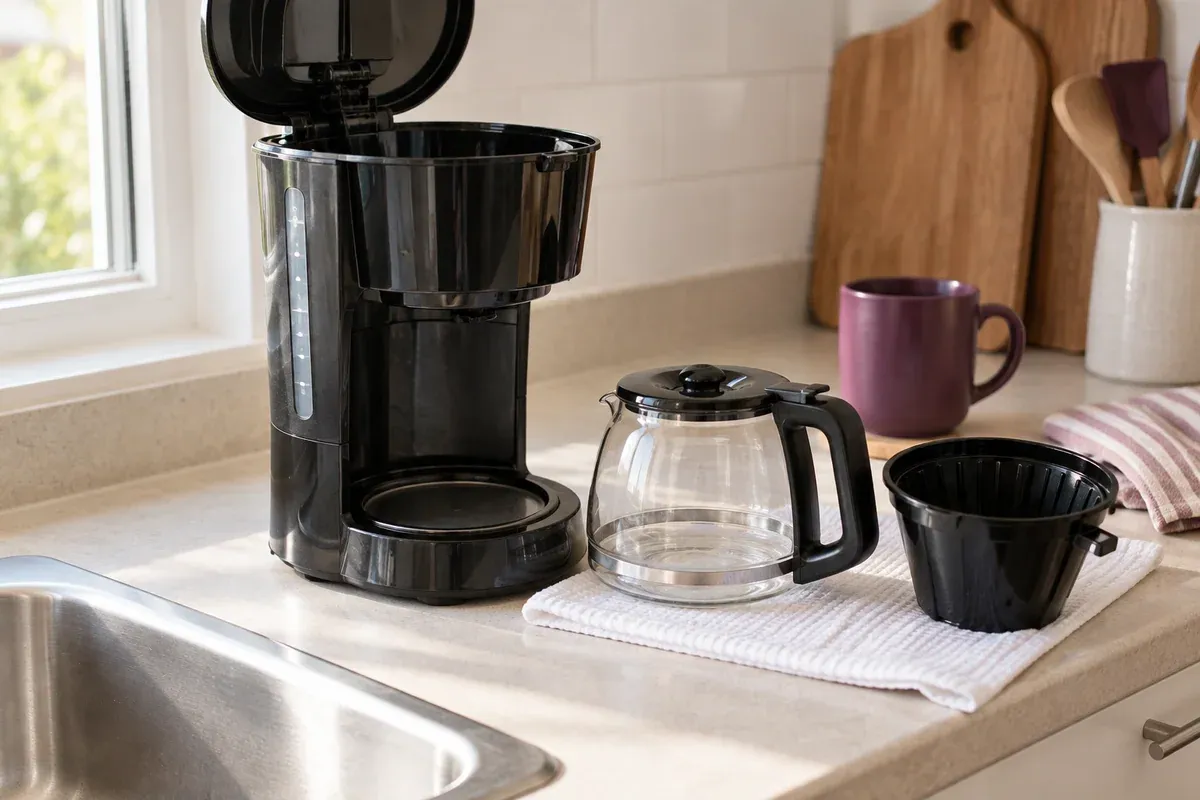
Find the model number on the machine and open its care section. Check the water tank, filter basket or brew group, carafe, waste container, drip tray and milk attachments separately. Record which parts can be hand-washed, which need water only, and which—if any—are dishwasher-safe. Removable does not automatically mean dishwasher-safe.
Gather the permitted cleaner, a clean soft cloth or suitable brush, fresh water and space for drying. Use only products approved for that component. Bathroom mould sprays, household bleach, essential oils and improvised acid mixtures are not substitutes for machine-care instructions. Never mix cleaners.
2. Empty waste and clean accessible surfaces
Discard used grounds, filters or capsules. Wash detachable parts using their specified method, reaching lid edges and corners with a permitted soft tool. Where mild washing-up liquid is allowed, use the stated amount and rinse thoroughly. Keep wash water out of the grinder, controls and fixed openings.
Do not put washing-up liquid into a reservoir to pump it through the machine. Washing a detached tank and running a solution through the internal water circuit are different procedures.
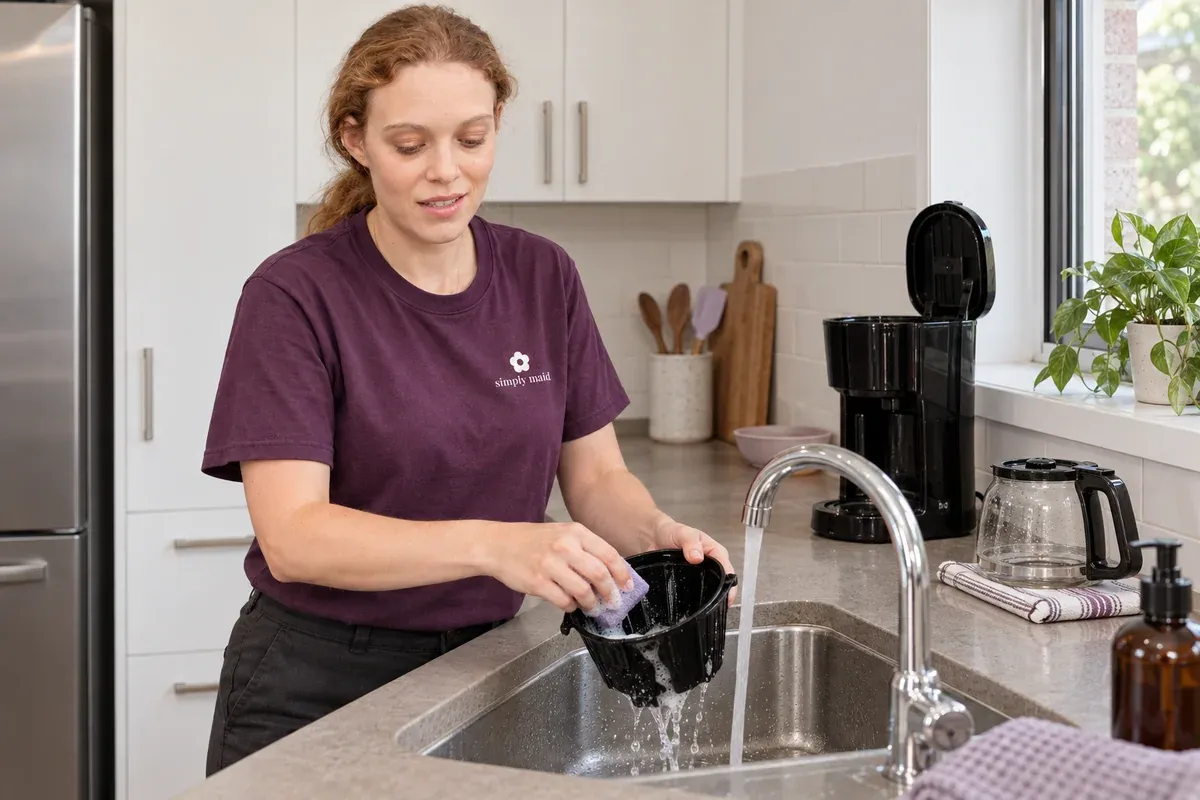
3. Treat the brew group and milk parts according to their own instructions
Philips’ brew-group guidance describes a lukewarm-water rinse and air-drying for the listed models, after the machine has shut down completely. Use that method only for a removable group covered by the instructions. A fixed brew unit needs a different maintenance route.
Philips’ maintenance guide also distinguishes LatteGo care after use from milk-carafe and classic-frother care. Identify the attachment before following a schedule. A water-only automatic rinse does not replace all the cleaning steps for parts that hold milk.
4. Dry, inspect and decide whether to reassemble
Dry cleaned parts as directed, then check for remaining growth, trapped residue or damage. If a part still looks contaminated or smells musty, ask the maker whether it can be cleaned further or replaced. Do not keep increasing the product strength or soaking time.
Reassemble only when the relevant cleaning, drying and inspection steps are complete and any suspected internal contamination has been resolved with support. Run any specified rinse or restart programme with the machine correctly assembled. Keep clear of hot discharge and discard rinse water. A clear rinse alone does not establish microbiological safety.
A habit that helps: check the waste container after the last coffee
In a discussion about mould returning in coffee grounds containers, one owner described what helped in their own setup:
I have the same problem with my setup (Phillips) and haven't found anything stops it besides daily emptying & washing.
u/DocHeinous, r/superautomatic — original discussion
The useful habit is checking the container frequently instead of forgetting damp grounds between deep cleans. The comment describes one person’s experience, not a guarantee or an instruction for every machine. Empty and wash your container using the maker’s procedure; some machines need a particular power state to register emptying.
For the models covered by the Philips maintenance guide above, the drip tray is emptied daily or when its indicator rises; the grounds container is emptied when prompted and cleaned weekly. If growth appears sooner, deal with it promptly and ask support about the recurrence. Do not wait for a calendar reminder to address visible contamination.
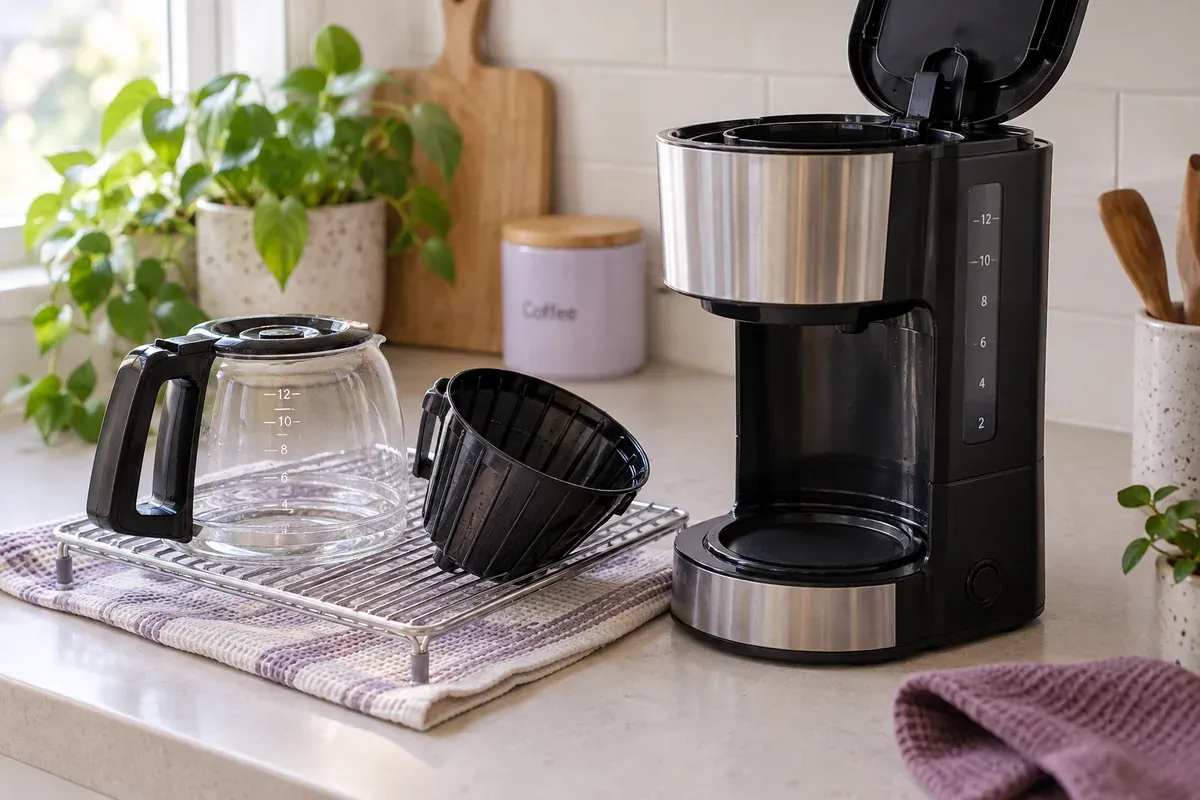
Make the routine fit the parts
- After use: deal with used grounds or capsules and the milk attachments as the model requires. Wipe spills when the surface is safe to touch.
- At the stated cleaning interval: wash the tank, tray, carafe and other covered parts. Use the separate brew-group or oil-cleaning procedure where applicable.
- When descaling is due: follow the model’s alert or water-hardness schedule, approved product, dilution and complete rinse sequence. Do not add an arbitrary hour-long pause.
- Before time away: follow the storage instructions for emptying, drying and any water-filter replacement. Check the restart procedure before using the machine again.
What the research can—and cannot—tell you
The 2011 NSF household study sampled 30 locations in 22 volunteer households around Ann Arbor, Michigan. It reported yeast/mould on 50% of sampled coffee reservoirs. This small US survey is not a current estimate for Australian machines and did not show that half of coffee drinkers become ill.
The 2015 Adelaide antifungal study tested two fungal isolates on agar. Its vinegar treatment inhibited one but not the other; it was not a coffee-machine cleaning trial. A 2020 acetic-acid study used specified laboratory tests, including a 15-minute fungal contact time. That test duration does not establish a minimum soak or an effective recipe for contaminated coffee-machine tubing.
Frequently asked questions
Can an off taste or a headache tell me the machine has mould?
No. Taste changes and symptoms have many possible causes. NSW Health’s mould factsheet explains that symptoms alone are not a reliable indicator of mould exposure. Seek medical advice for health concerns, particularly if you have asthma or weakened immunity; do not diagnose the cause from your coffee. The factsheet does not prescribe fortnightly coffee-machine cleaning.
Will hot water or a descaler make a mouldy machine safe?
Do not assume so. The routine instructions reviewed here do not validate either approach for every contaminated internal part. Follow a manufacturer-approved response to the actual contamination, including servicing or replacing affected components when needed.
Does finding mould mean I need a new machine?
Not automatically. A replaceable waste container is a different issue from contamination inside a sealed circuit. Ask what can be cleaned, inspected or replaced, and compare any service quote with replacement. Age alone—such as passing five years—is not a sound replacement rule.
Can I use vinegar if my drip-machine manual allows it?
Use it only for the task, dilution and cycle that manual permits. Permission to descale with vinegar does not prove that the same cycle removes mould from inaccessible components. Do not extend a drip-machine method to an espresso or capsule machine.
Related reading
Cleaning stainless-steel appliance finishes · Cleaning your kitchen · Mould on walls and ceilings
Sources and correction
Manufacturer guidance, original studies and the community discussion are linked beside the advice they inform. Model examples explain differences between procedures; they are not a universal mould-removal protocol.
Editorial correction, 20 September 2026: Removed the universal vinegar cycle and soak, unsupported internal-mould removal claims, health-department cleaning schedule, five-year replacement rule and unverified price range. Clarified the study populations and test methods, added model-specific care examples and separated routine maintenance from suspected contamination.
Change log
Who wrote and edited this article, when its sources were checked, and what changed.
View all historyHide earlier history
Earlier entries record what was published at the time. Later corrections take precedence.
- Edited by
- Huy Hoang
Editorial correction, 20 September 2026: Removed the universal vinegar cycle and soak, unsupported internal-mould removal claims, health-department cleaning schedule, five-year replacement rule and unverified price range. Clarified the study populations and test methods, added model-specific care examples and separated routine maintenance from suspected contamination.
Earlier updates
- Edited by
- Huy Hoang
Sources and correction
Manufacturer guidance, original studies and the community discussion are linked beside the advice they inform. Model examples explain differences between procedures; they are not a universal mould-removal protocol.