You can't wash a mattress, so cleaning one is mostly dry work: vacuum it, deodorise it, treat each stain with as little liquid as possible, then let it dry completely. Here's the full method, what to use on each stain and smell, and what to skip.
Quick answer: Strip the bed and vacuum the mattress with the upholstery tool, seams and sides included. Spot-clean stains with as little liquid as you can: cold water then 3% hydrogen peroxide for blood, an enzyme cleaner for urine, a damp white cloth for sweat. Sprinkle bicarb soda, leave it a few hours or overnight, vacuum again, and let it dry fully before you remake the bed.
What you need to clean a mattress
Job | What to use | Where to get it |
|---|---|---|
Routine clean | Vacuum with an upholstery tool, bicarb soda, a fan | Supermarket |
Light stains (sweat, drool, food, mud) | White cotton cloths, cold water, dishwashing liquid, a spray bottle | Supermarket |
Urine, vomit, pet accidents | An enzyme cleaner made for urine, rubber gloves, paper towel, old towels | Pet shop or the supermarket pet aisle |
Blood | Cold water, then 3% hydrogen peroxide (sold as 10 volume) | Supermarket or chemist |
Set aside most of a day. The hands-on work is about 45 minutes, but the bicarb and the drying take hours, so CHOICE suggests a warm, sunny day and somewhere else to sleep if you're doing the full clean.
Before you start: know your mattress type

Follow the exact mattress instructions, particularly for foam and latex. Do not assume steam or extraction is suitable; professional work requires a suitability assessment.
Read the illustration as text
- Read both care instructions
- A removable cover may have rules different from the mattress core.
- Control moisture
- Use only the cleaning method allowed for this mattress.
- Dry before remaking
- Keep bedding off until the cleaned material is fully dry.
A washable cover does not mean a washable mattress.
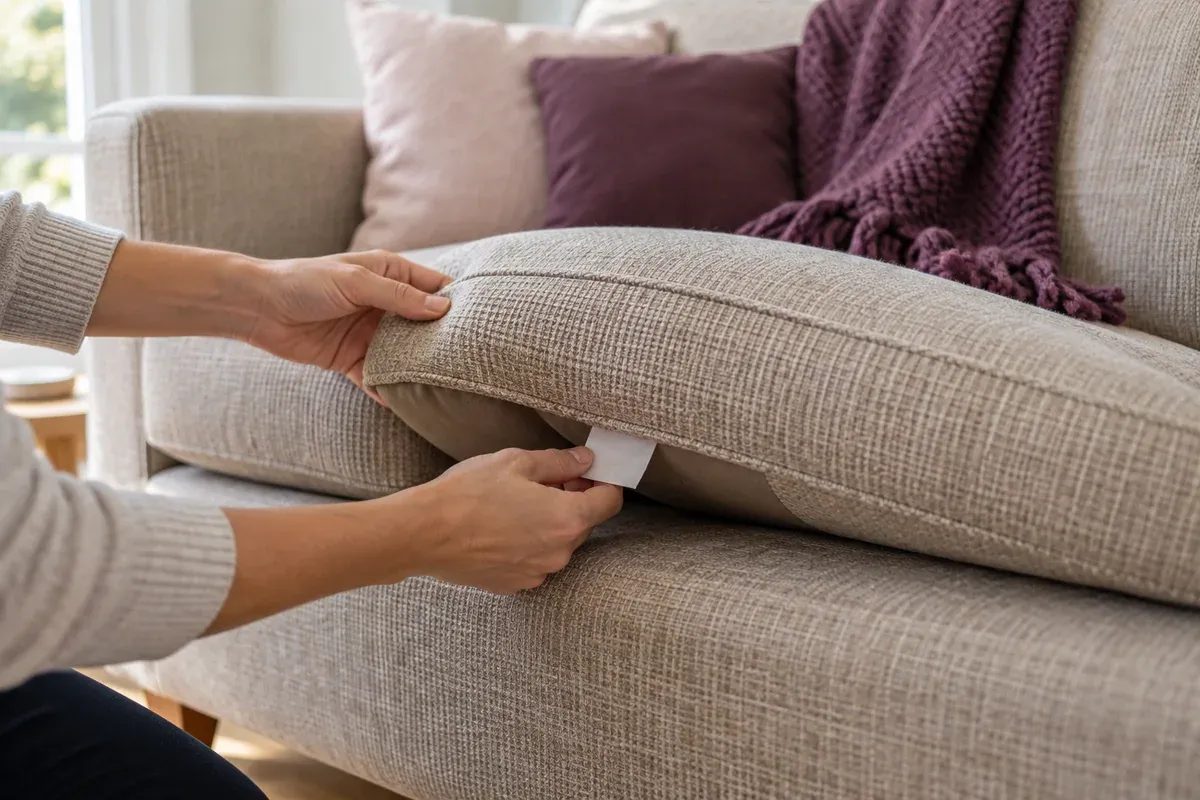
Check three things first. The care label or law tag says what the mattress is made of. Some mattresses have a zip-off cover you can simply wash, so look before you scrub. And the warranty: Sealy's excludes fabric stains and lets it refuse service on a stained mattress, so a protector pays for itself.
Mattress | Spot-clean with | Avoid |
|---|---|---|
Innerspring or pocket spring | A white cloth wrung out in cold water, then a drop of dishwashing liquid if water alone doesn't lift the mark (on a Sealy, water only) | Soaking, steam, carpet cleaners, stiff brushes |
Memory foam | A barely damp cloth, blotting only; it needs the longest drying time | Pouring on liquid, steam: TEMPUR says not to wash its foam |
Latex | As for memory foam | Pouring on liquid, steam |
Zip-off cover | Wash the cover at the temperature on its tag; spot-clean the core as for memory foam | Refitting the cover before it's completely dry |
Not sure | Treat it as memory foam: least moisture, blot only | Anything wet |
How to clean a mattress, step by step
- Strip the bed (5 minutes). Wash the sheets, pillowcases and mattress protector at the hottest temperature their labels allow. For the pillows themselves, see How to Wash Pillows by Filling, Step by Step.
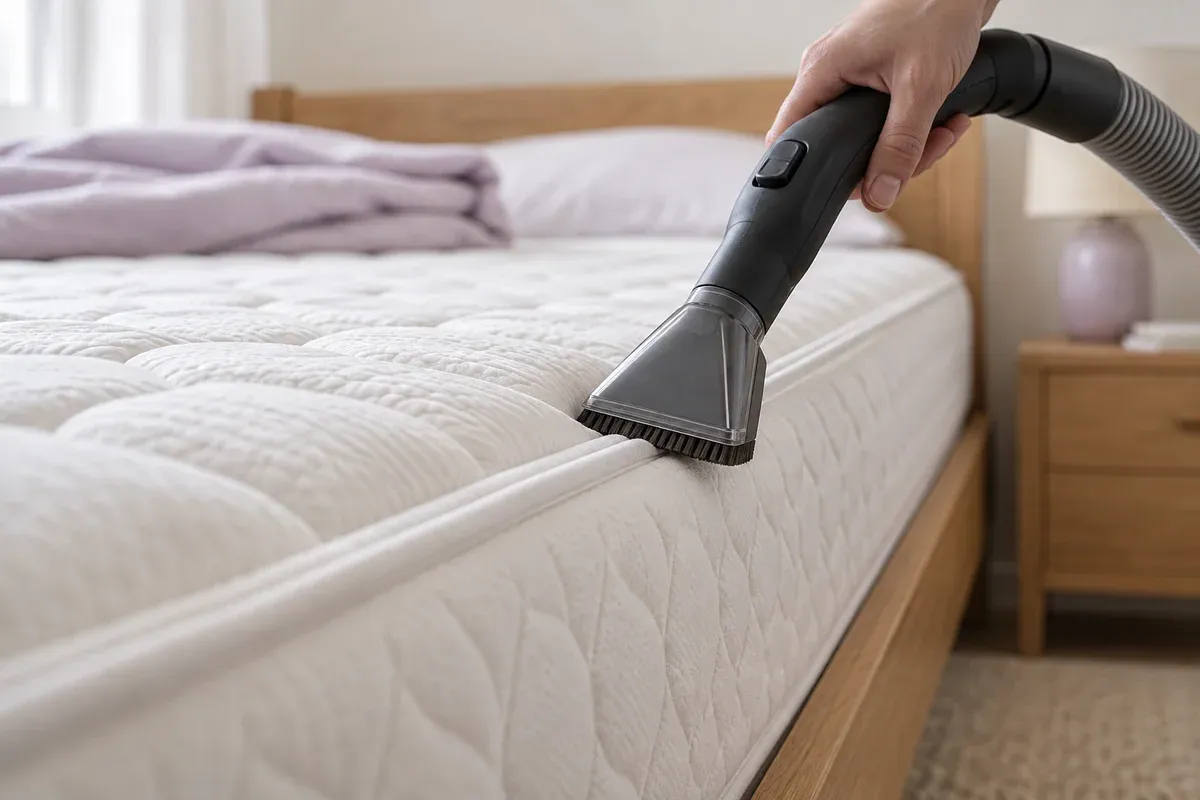
- Vacuum the top and sides (10–15 minutes). Use the upholstery tool, not the carpet turbo head, in slow, overlapping passes. Run the crevice tool along the seams, piping and any pillow-top grooves, where dust and skin flakes collect. If the label says not to vacuum the cover, use a soft brush instead.
- Do the underside and the base. Tilt the mattress against a wall, vacuum the underside, and vacuum the base or slats while they're exposed.
- Spot-clean stains with the methods below, and let each patch dry.
- Sprinkle bicarb soda. Cover the top in an even layer and leave it for at least a few hours; CHOICE suggests 24. On a delicate cover such as silk, test a small patch first: Sleepmaker notes bicarb is mildly abrasive.
- Vacuum again in slow, straight lines until no powder is left.
- Air it and rotate it. Open the windows and run a fan. If you can carry it outside on a dry, breezy day, a few hours in the sun on a clean sheet helps it air; sun through window glass doesn't do the same job. Then turn it head to foot while it's bare.
- Remake the bed only when it's dry: protector first, then sheets.
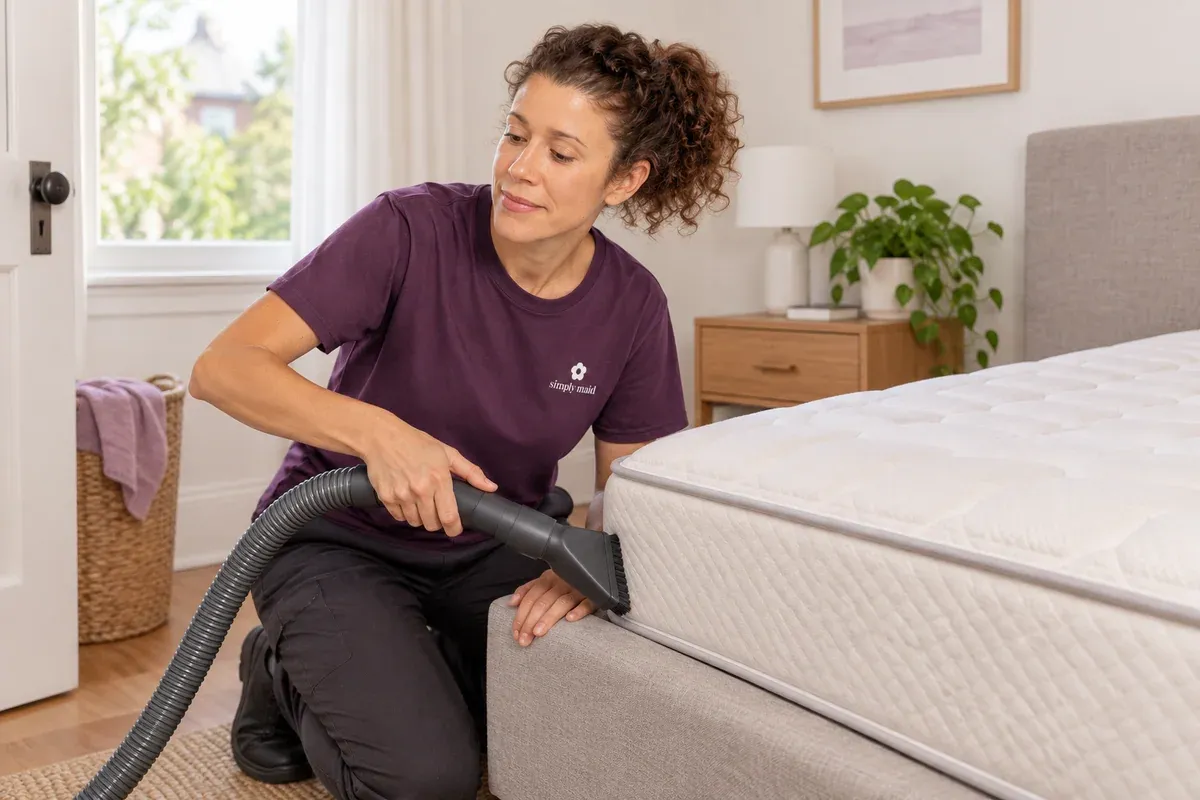
No vacuum? Take the mattress outside, stand it on its side and beat it with a broom or an old racket to shake out loose dust and the bicarb, then go over it with a soft brush. It shifts what's on the surface, not what's deep in the layers.
Done looks like: press a dry paper towel onto each cleaned patch for 30 seconds. If it comes away dry, the patch feels no cooler than the rest and nothing smells musty, remake the bed. Never put the protector or sheets back on a damp mattress: trapped moisture is how mould starts.
How to remove stains from a mattress
Treat stains before the bicarb step so they don't spread. Blot, never rub; work from the edge of the stain inwards; use white cloths so no dye transfers; and keep the liquid on the stain, not in the layers below it. A fresh stain lifts far more easily than a dried one, so act quickly.
Safety Never mix cleaning products. Victoria’s Better Health Channel: “Do not mix bleach with ammonia, acids or other cleaners – this can release hazardous chlorine or chloramine fumes.” Ventilate the room during and after use. Wear gloves and eye protection. Follow the label's dilution and contact time. In an emergency call 000. For poisoning advice call the Poisons Information Centre on 13 11 26 — 24 hours, anywhere in Australia.
How to get blood out of a mattress (including period blood)
- Blot with cold water. Wring a white cloth out in cold water and blot. Hot water sets blood, so keep everything cold.
- Test the peroxide. If a mark stays, dab 3% hydrogen peroxide (the 10-volume strength sold at supermarkets and chemists) on a hidden patch first. It can lighten coloured fabric.
- Dab it on and let it fizz. Apply a little to the stain, leave it until it stops bubbling, then blot with a cold, damp cloth. Repeat until the cloth comes away clean.
- Blot dry. Press a dry towel onto the patch and leave it to air.
Old, dried blood: for a stubborn mark, CHOICE suggests a paste of bicarb soda and cold water. Spread it over the mark, leave it for 30 minutes, lift it off with a damp cloth and repeat while the mark keeps fading. Wipe the paste off completely before you try peroxide; never mix the two.
How to get urine out of a mattress
- Blot straight away. Press old towels onto the wet patch and swap for dry ones until almost nothing comes up. Don't rub, and don't pour water on.
- Apply an enzyme cleaner made for urine (the pet aisle has them). Use enough to reach as deep as the urine went, no more, and leave it for the time on the bottle.
- Blot again, then dry. Blot out what you can and run a fan over the patch.
- Deodorise. Once it's dry to the touch, cover it with bicarb soda, leave it overnight and vacuum.
How to get dried urine and pee smell out of a mattress
A dried stain still holds the residue that smells, so bicarb alone won't fix it. Mist enzyme cleaner over the mark and a little past its edge, leave it for the full time on the bottle, blot and fan-dry; repeat if it still smells, then bicarb overnight. On memory foam use less liquid. If urine reached the core, cleaning from the top may not get it, and the smell tends to come back. For floors and rugs, see How to Get Pet Urine Smell Out of Tiles, Grout and Carpet. For a child who wets the bed, a waterproof protector saves the mattress next time.
How to get sweat and yellow stains out of a mattress
Yellow and brown marks are mostly sweat and body oils, sometimes an old urine or drink spill. Start with Sealy's method: blot with a white cloth wrung out in cold water, then let the patch dry fully. For a heavier mark, CHOICE suggests a small amount of dishwashing or laundry liquid in a cup of water, dabbed on and blotted off. Old yellowing may fade rather than disappear; a protector stops new marks.
How to clean vomit off a mattress
Wear gloves. Lift solids straight away with paper towel into a bag, then blot. Clean the patch with cold water and a drop of dishwashing liquid, blot, and use an enzyme cleaner for any smell. For illness clean-up and the bedding, follow How to Sanitise and Disinfect Your Home; if vomit has soaked into the mattress, call a specialist mattress cleaner.
How to get food, drink and mud marks off a mattress
CHOICE suggests a small squirt of dishwashing liquid in a cup of water: dab it on, blot it off, and repeat until the cloth stays clean. Finish with a cloth dampened in plain water so no soap is left behind to attract dirt, and keep it light on foam, which holds water for a long time.
How to get a smell out of a mattress
Most mattress smells come from moisture: sweat, a spill that never fully dried, or a mattress that can't breathe. Sealy points to trapped moisture and poor ventilation, and warns against masking the smell with fragrance sprays, which add moisture without fixing the cause.
- Find the source and treat it with the stain methods above.
- Dry it out: mattress on its side, fan on, windows open.
- Bicarb overnight, then vacuum.
- Check around it: wash the protector, and look for damp or mould on the base and the floor.
A musty smell that comes back after all that usually means mould inside the mattress; see when cleaning isn't enough, below.
The best thing to clean a mattress with: bicarb, vinegar, steam or sun?
Method | Verdict |
|---|---|
Bicarb soda | Works for smells: it's CHOICE's deodorising step. It doesn't kill dust mites or remove their allergen. |
Vinegar and water (1:1) | Works, but there's better: cold water and a drop of dishwashing liquid, without the smell. Never combine it with peroxide or bleach. |
Bleach | Don't. It's on Sealy's avoid list, it can strip colour and weaken fabric, and its fumes linger in something you sleep on. |
Peroxide, bicarb and dish soap mixed in a bottle | Skip the mix and use one product at a time. Peroxide on its own, tested first, handles blood. |
Diluted ammonia | Don't. No stain above needs it, and with bleach it releases toxic chloramine fumes. |
Carpet cleaner or spot cleaner | Only a small spot cleaner, gently, on a spring mattress (see the FAQ). |
Steam cleaner | Don't: Sealy says it's not recommended (see the FAQ). |
Sunlight | Works for airing, not for dust mites (see the FAQ). Keep it to a few hours: Sealy warns long sun fades fabric. |
What Reddit asks about cleaning a mattress, answered
A Reddit thread on r/internetparents sits near the top of Google for this search. The original post has since been deleted, but the title and replies point to a sweat-stained, smelly mattress and no vacuum to hand. Here's what the replies suggest, and our verdict.
- "There's not a good way to clean a mattress." Half right: you can't wash or rinse one, but the dry method above gets it noticeably fresher, and a barrier keeps it that way.
- Bleach or vinegar, then the sun? Vinegar is fine in small amounts, and its smell does go once it dries. Skip bleach, and never use it near vinegar.
- Spraying the whole mattress with vinegar and water. One reply suggests 1 part white vinegar to 2 parts water. A light mist on a spring mattress does little harm; on foam it's too much water. Treat the stains and use bicarb for the overall smell.
- "Smack it with a stick or some sort of racket." Fine outdoors for shaking out bicarb and loose dust; it won't reach the layers.
- Check for a "zip off cover" first. Good advice: wash the cover, spot-clean the core.
- Buy a "mattress encasement". A zip-up, usually waterproof cover around the whole mattress. It keeps old stains away from you and new spills, or a toddler's accident, off the mattress. Put a sheet over it.
- Raise it off the floor, "even on a couple of pallets". Agreed (see below).
- Put fabric layers between you and the mattress, not plastic. Right: plastic traps sweat.
How often should you clean your mattress?
Task | How often | Source |
|---|---|---|
Wash sheets and pillowcases | Weekly; hotter than 60°C if someone has a dust-mite allergy | ASCIA |
Wash the mattress protector | Every 4–8 weeks, and after any spill | Sealy |
Vacuum the mattress | Every 3–6 months; weekly with a dust-mite allergy | Sealy; Better Health Channel |
Full clean: vacuum, spot-clean, bicarb, air | Twice a year | CHOICE |
Rotate head to foot | Every 3 months (every 2 weeks for a new mattress's first 3 months) | Sealy |
Spills and accidents | Straight away | CHOICE |
For why it matters, and when a professional clean is worth paying for, see Is Professional Mattress Cleaning Worth It?.
Should you flip or rotate your mattress?
Rotate it head to foot to even out wear; flip it only if it's made to be flipped. Most mattresses sold now are single-sided, and Sealy says not to flip its mattresses. CHOICE gives every 3–6 months for spring mattresses and every 6 months for foam, latex and hybrids (Sealy's schedule is in the table above). If yours has no pillow top and the same layers on both faces, check the maker's site: some are meant to be flipped.
Should your mattress go on the floor?
Not for long. CHOICE and Sealy both warn that a mattress on the floor gets little air underneath, so moisture from sweat and condensation builds up, especially in humid weather, along with dust, grime and the risk of mould and pests. If it has to be on the floor for now, lift it regularly to air it and vacuum underneath, or put a slatted base or a couple of pallets under it.
Keep your mattress cleaner for longer
- Use a washable protector and wash it regularly and straight after any spill. For young children, choose one with a waterproof backing or a full zip-up encasement.
- Act on spills fast, and keep the mattress on a base that lets air move underneath.
When cleaning isn't enough
- Urine, vomit or a big spill soaked through to the core: a specialist mattress cleaner, quickly, or a new mattress.
- Mould spots, or a musty smell that keeps coming back: replace it. Mould inside a mattress usually can't be cleaned out.
- Bed bugs: a licensed pest controller, not a cleaner (see Natural Pest Control for Australian Homes).
- Sagging, lumps or morning aches: replace it. CHOICE puts the average mattress life at about 8 years.
Simply Maid offers cleaning for eligible fabric mattresses after a suitability assessment; some materials and care labels rule out wet cleaning. For when professional cleaning or replacement may be appropriate, see Is Professional Mattress Cleaning Worth It?.
Frequently asked questions
How do you sanitise a mattress without washing it?
There's no reliable way to sanitise a whole mattress at home. What works is vacuuming, deodorising, airing and fast spot-cleaning, plus a washable protector that takes the sweat and spills instead. For a dust-mite allergy, ASCIA recommends a dust-mite-resistant cover, washed at least every two months.
What does vinegar do to a mattress?
Diluted 1:1 with water, white vinegar can lift light stains (CHOICE lists it), and its smell fades as it dries. It won't clean deep inside, and as an acid it must never meet bleach or peroxide on the same patch.
Can you steam clean a mattress?
We'd skip it. Sealy says steam cleaning isn't recommended because the heat and moisture are hard to get back out, which risks smells and mould. Sleepmaker allows a handheld steamer on spring mattresses, held 5–7 cm above the surface with at least 3 hours' drying, but says never to steam foam. Check your mattress maker's care advice before you try.
Can you use a carpet cleaner on a mattress?
Not a full-size carpet cleaner: Sealy rules out carpet cleaners and wet vacuums because they soak the layers. CHOICE says a small spot cleaner with an upholstery nozzle can work if you're very gentle and don't over-wet the fabric. Keep it to spring mattresses, suck back as much water as you put in, and dry the patch with a fan.
How do you clean a mattress topper?
Check the tag. Many toppers have a removable cover that's machine washable, and some fibre or feather toppers can be washed whole if the label says so. A memory foam or latex topper isn't washed: vacuum it, spot-clean it as for a memory foam mattress, and air it until it's completely dry.
Does sunlight kill dust mites in a mattress?
Not reliably. The study usually quoted (Tovey and Woolcock, 1994) tested carpets, and Dyson's scientists point out that UV only reaches the surface of something as thick as a mattress. Sun is good for airing. For a dust-mite allergy, ASCIA recommends a dust-mite-resistant cover and hot washes for the bedding.
How long does a mattress take to dry?
A spot-cleaned patch usually dries in a few hours with a fan and an open window; memory foam and humid weather take longer. Go by the paper-towel test above rather than the clock.
Last reviewed 3 October 2026 · Update history
Sources and references
- CHOICE, How to clean a mattress (updated 23 July 2026): twice-yearly clean, bicarb for 24 hours, light-stain mixes, bicarb paste, 3% peroxide, spot cleaners, rotating, floors.
- Sealy Australia, How to clean a mattress (13 April 2026): blotting, the avoid list, smells, care schedule, rotating, bed bases.
- Sealy Australia, Warranty information: fabric stains excluded; service refused on stained mattresses.
- TEMPUR Australia, Quality guarantee and care: the foam itself isn't washed.
- Sleepmaker, How to clean a mattress: bicarb spot test on delicate covers; steam on spring mattresses only, never foam.
- Dyson Australia, How to clean your mattress (30 June 2022): UV reaches only a mattress's top layer.
- Tovey and Woolcock, Direct exposure of carpets to sunlight can kill all mites (J Allergy Clin Immunol, 1994): a carpet study.
- ASCIA, Allergen minimisation (April 2024): dust-mite-resistant covers washed every two months; bedding washed hotter than 60°C.
- Better Health Channel, House dust mite: vacuuming weekly where someone has a dust-mite allergy.
- CHOICE, 5 signs it's time for a new mattress: average mattress life of about 8 years.
- Reddit r/internetparents, How to clean mattress? (Sweat, etc.) (July 2024): the reader questions answered above.
Related reading
- How to Remove Couch Stains — Blood, Ink, Grease and More
- How to Remove Carpet Stains — Every Type of Spill
- How to Clean a Dog Bed: Covers, Cushions and Foam
- How to Get Rid of Dust — and Stop It Coming Straight Back
Put this task in a wider home-care plan
Our Healthy Home guide connects dust, damp, airflow, products and everyday maintenance. Use the free room-by-room checklist to record one task and any follow-up, keeping cleaning separate from building or health concerns.
Change log
Who wrote and edited this article, when its sources were checked, and what changed.
View all historyHide earlier history
Earlier entries record what was published at the time. Later corrections take precedence.
- Edited by
- Huy Hoang
3 October 2026: How to Clean a Mattress and Remove Stains: the whole-mattress clean now comes first, with what you need and how long it takes. New sections cover period blood, dried urine and pee smells, mattress smells, how often to clean, flipping versus rotating and mattresses on the floor, and answer common Reddit questions about bleach, vinegar sprays and cleaning without a vacuum.
- Edited by
- Huy Hoang
24 September 2026: How to Clean a Mattress and Remove Stains: removed the diluted-ammonia and mixed peroxide recipes and the vinegar surface spray, and stopped presenting a carpet study as proof that sunlight kills every mite in a mattress. Stains now get one product at a time (cold water, then tested 3% peroxide for blood; an enzyme cleaner for urine), with a safety note and a way to check the mattress is dry.