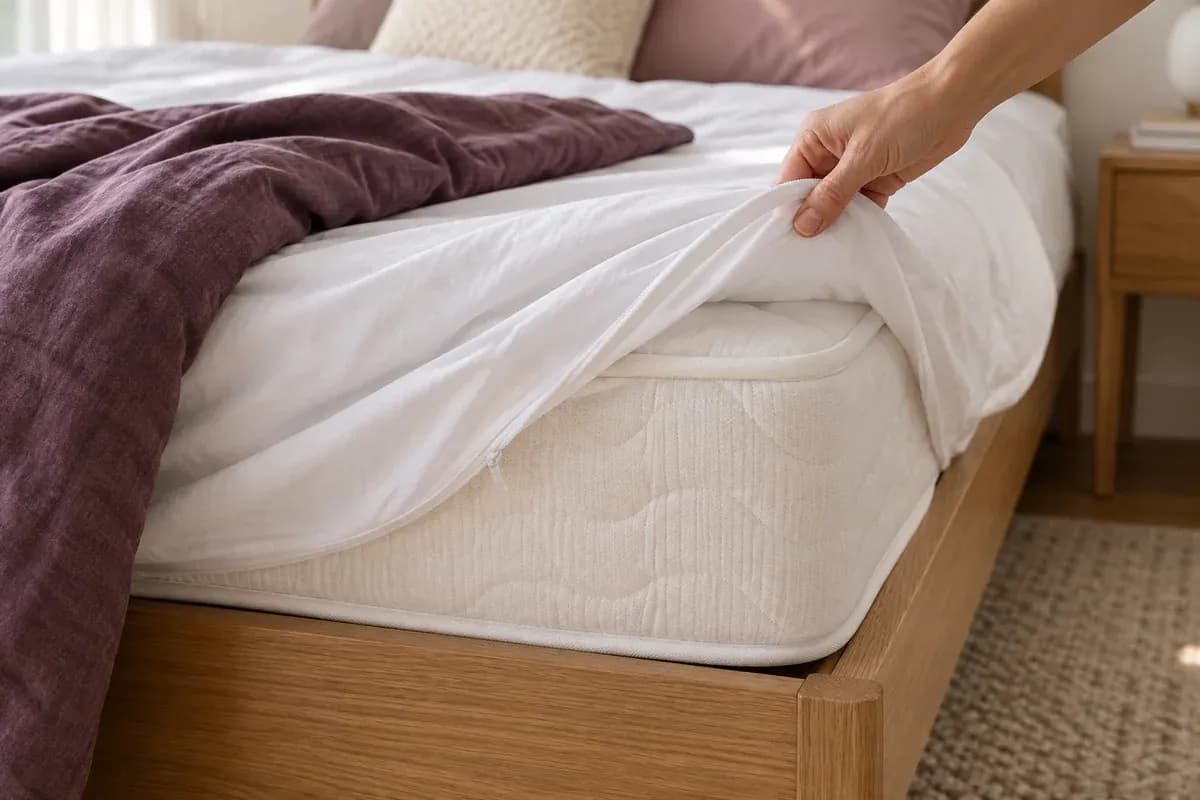
A mattress collects sweat, skin flakes and spills, and it's where people with a dust-mite allergy get most of their exposure. Here's how often to clean one, and when a specialist or a new mattress is the better spend.
Quick answer: Usually not for routine care. Vacuuming the mattress every 3–6 months, keeping a washable protector on it and washing the sheets weekly handle normal build-up. Professional mattress cleaning is worth paying for when urine or a spill has soaked past the protector, or before you sleep on a second-hand mattress. Replace the mattress instead if it sags, smells after cleaning or has mould inside.
Why a mattress needs cleaning: mites, skin and sweat
House dust mites live in mattresses and bed linen and feed on shed skin flakes, the main component of house dust (Better Health Channel). For anyone allergic to them, the bed matters most: "The greatest exposure to dust mites is from your bed," says the National Asthma Council. In a study of 616 Sydney homes, 68% of beds had mite-allergen levels above 10 µg per gram of dust, a level associated with a higher chance of becoming allergic (Mihrshahi and colleagues, 2002).
Sweat and spills add moisture and stains, and moisture trapped in a mattress can lead to mould (Sealy). For a household without a mite allergy, cleaning is mostly about smell, stains and the warranty: Sealy can refuse warranty service on a stained mattress. Mites settle in the rest of the room too; see How to Get Rid of Dust — and Stop It Coming Straight Back.
How often to clean a mattress
Job | How often |
|---|---|
Wash sheets and pillowcases | Weekly; hotter than 60°C if someone has a dust-mite allergy (ASCIA). Pillows themselves: How to Wash Pillows by Filling, Step by Step |
Wash the mattress protector | Every 4–8 weeks (Sealy); dust-mite-resistant covers at least every two months (ASCIA) |
Vacuum the mattress, seams included | Every 3–6 months (Sealy); weekly with a dust-mite allergy (Better Health Channel) |
Full clean: vacuum, bicarb, spot-clean, air | Twice a year (CHOICE) |
Spills and accidents | Straight away |
Rotate head to foot | Every 3 months; single-sided mattresses are never flipped (Sealy) |
The steps for each job are in How to Clean a Mattress and Remove Stains. If you're the one with the allergy, ask someone else to vacuum: it lifts mite allergen into the air for up to 20 minutes (National Asthma Council). Cleaning helps, but it isn't treatment; for ongoing symptoms, see your GP or an allergist.
Mattress myths: weight, mites, bicarb and steam
Claim | Verdict |
|---|---|
"A mattress doubles in weight in 10 years from mites and dead skin" | Myth. An Ohio State University entomologist told Live Science in 2011 there is "no scientific answer" to it, and the US mattress industry body knew of no study behind it. |
"A professional clean gets rid of the dust mites" | Not completely. ASCIA says house dust mites "cannot be completely removed from the home"; dust-mite-resistant covers and hot-washed bedding are its main steps. |
"Bicarb kills dust mites" | No. It deodorises. Washing hotter than 60°C kills mites and washes away their allergen (National Asthma Council), and a mattress can't be washed, which is why ASCIA recommends covers. |
"Steam cleaning is the only real deep clean" | Not for a home clean: Sealy says steam cleaning is not recommended. If a specialist uses steam or hot-water extraction, ask how they dry the mattress (below). |
When professional mattress cleaning is worth it, and when to replace instead
Situation | Best option |
|---|---|
Routine care, surface marks or a smell | Do it yourself: vacuum, bicarb and spot-clean |
Urine, vomit or a big spill soaked past the protector | A specialist mattress cleaner, booked quickly |
Second-hand or long-stored mattress | A specialist clean before anyone sleeps on it, or a new mattress |
Dust-mite allergy | Dust-mite-resistant covers and weekly hot washes first (ASCIA); a clean doesn't replace them |
Mould spots, or a musty smell that keeps coming back | Replace it: mould inside a mattress usually can't be cleaned out |
Bed bugs | A licensed pest controller, not a cleaner: see Natural Pest Control for Australian Homes |
Sagging, lumps or morning aches | Replace it. CHOICE puts a good mattress's average life at about eight years |
Simply Maid offers cleaning of eligible fabric mattress surfaces after checking the care instructions, construction and condition. Not every mattress can be wet cleaned, and cleaning is not a pest treatment or a guarantee of stain, odour or allergen removal.
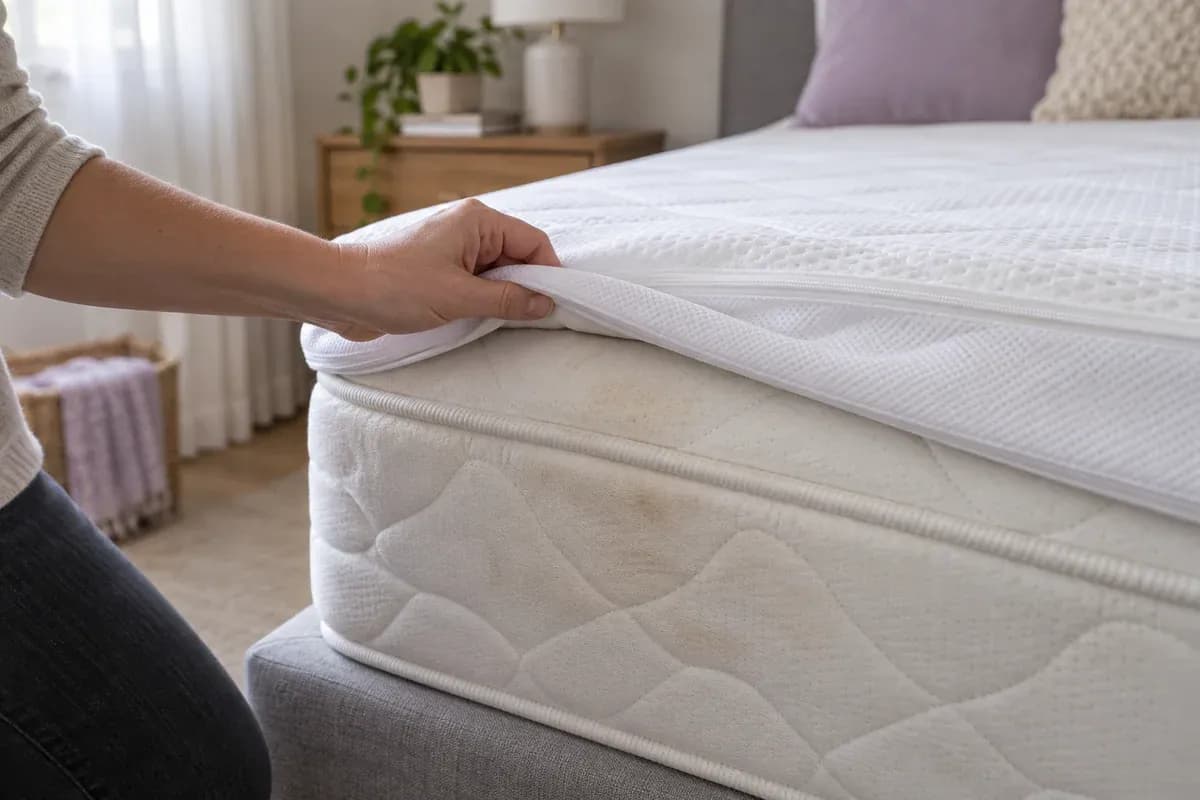
What to ask a mattress cleaner before you book

Simply Maid assesses eligible fabric mattresses for its surface-cleaning service. Blood, hazardous contamination, pests and unsuitable materials need different advice.
Read the illustration as text
- Suitability
- Does the proposed method fit the mattress’s care instructions?
- Drying
- How will the accessible surface dry before the bed is used?
- Scope and limits
- Which surface and items are booked, and what may remain?
Cleaning cannot repair a worn mattress or treat bed bugs.
- Method: dry or low-moisture, or hot-water extraction? Extraction puts water into the layers, so ask how they get it out.
- Drying time: when can you sleep on it, and what happens if a damp patch remains?
- Your mattress type: have they cleaned memory foam or latex before, and how?
- Warranty: Sealy excludes fabric stains from its warranty and can refuse service on a stained mattress, so ask whether the method suits your brand.
- Price: a fixed, written per-mattress quote that includes stain treatment.
Last reviewed 24 September 2026 · Update history
Sources and references
- Better Health Channel, House dust mite (14 July 2022): where mites live; weekly vacuuming with an allergy.
- National Asthma Council Australia, Dust mites trigger my asthma (6 May 2024): the bed as the main exposure; hot washing; vacuuming.
- ASCIA, Allergen minimisation (April 2024): hot washes, covers every two months, mites can't be removed completely.
- Mihrshahi and colleagues, Predictors of high house dust mite allergen concentrations in residential homes in Sydney (Allergy, 2002): 68% of 616 beds above 10 µg/g.
- Sealy Australia, How to clean a mattress (13 April 2026): vacuuming, protector and rotation intervals; no steam.
- Sealy Australia, Warranty information: fabric stains excluded.
- CHOICE, How to clean a mattress (updated 23 July 2026): twice-yearly cleaning.
- CHOICE, 5 signs it's time for a new mattress (12 June 2024): average eight-year life.
- Live Science, Does your mattress really gain weight over time? (7 March 2011): no study behind the doubling claim.
Related reading
Change log
Who wrote and edited this article, when its sources were checked, and what changed.
Current version
What changed
24 September 2026: Is Professional Mattress Cleaning Worth It?: removed dust-mite, sweat and skin statistics that no primary source supports and the claim that only professional steam or extraction reaches allergens, settled one cleaning schedule that matches the mattress-cleaning guide, and added when a specialist clean or a new mattress makes sense.