Most advice about dust starts at the shelf. That is the wrong end of the problem.
Researchers from the DustSafe program at Macquarie University, writing for CSIRO's Australian Housing Data, put a number on it: "About two-thirds of household dust comes from outdoors." It is an estimate they take from a US study of how soil and outdoor particles migrate indoors, not an Australian measurement, but the direction is well established. Garden soil, road dust carried in on shoes, vehicle exhaust, and — in an Australian summer — dust storms and bushfire particulates. Only the remaining third is generated inside: skin cells, pet hair, cooking, fibres shed by carpet and clothing.
That single ratio changes where the effort pays off. Wiping a shelf removes whatever has settled on it, wherever it came from — but it does nothing about the rate at which the next layer arrives. The households with visibly less dust are not necessarily dusting more often. They are letting less of it through the door.
Quick Answer: Cut what comes in first — shoes off at the door, a decent doormat, windows shut on windy and smoky days, and clean filters in your split system and vacuum. Then dust top to bottom, dry to wet: work from high surfaces down, use a damp microfibre cloth rather than a dry cloth or feather duster, and vacuum last. Wash bedding weekly in water hotter than 60 °C. Expect surfaces to need a wipe every week or so — dust never stops arriving.
What Household Dust Actually Is
Dust is not one substance. The CSIRO piece describes a mixture that includes "trace metals, radioactive elements, antibiotic resistant genes, microplastics and perfluorinated chemicals (PFAS)", alongside the familiar skin cells, hair, decomposing insects, food fragments and soil particles.
The indoor third comes from ordinary living: cooking, open fireplaces, skin shed by people and pets, and off-gassing from furniture, carpet and clothing. The outdoor two thirds arrives on shoes, on the breeze, and through gaps you cannot see.
It also arrives whether or not you open a window. As the authors put it, even in closed-up homes dust "will still settle from the indoor atmosphere, leak from the ceiling cornices and attic spaces, and seep into your living areas through cracks around windows and doors."
This is worth knowing because it sets a realistic goal. You are not trying to eliminate dust. You are trying to slow the rate at which it accumulates, and to remove it without flinging it back into the air.
Stop It at the Door
If two thirds of it comes from outside, the entry points are where the leverage is.
Take shoes off inside. Shoes carry road dust, soil and whatever was on the footpath. This is the single highest-return change in the whole article and it costs nothing.
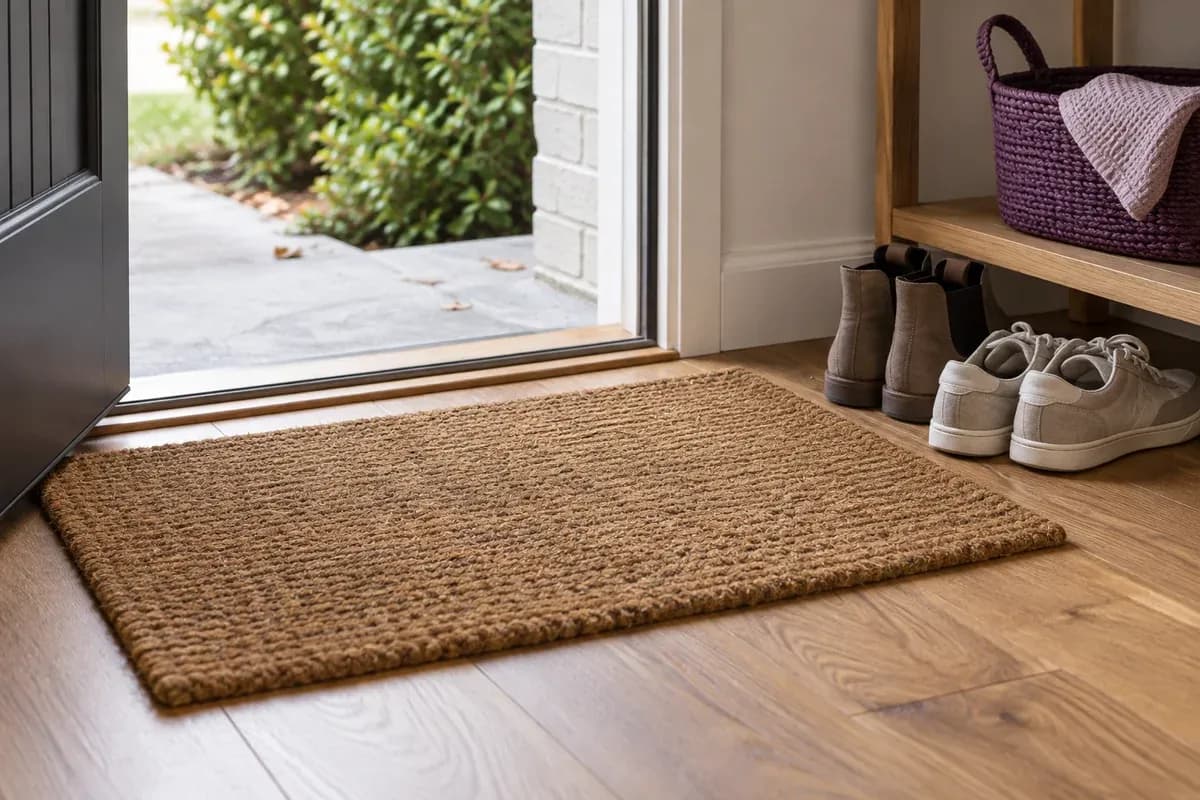
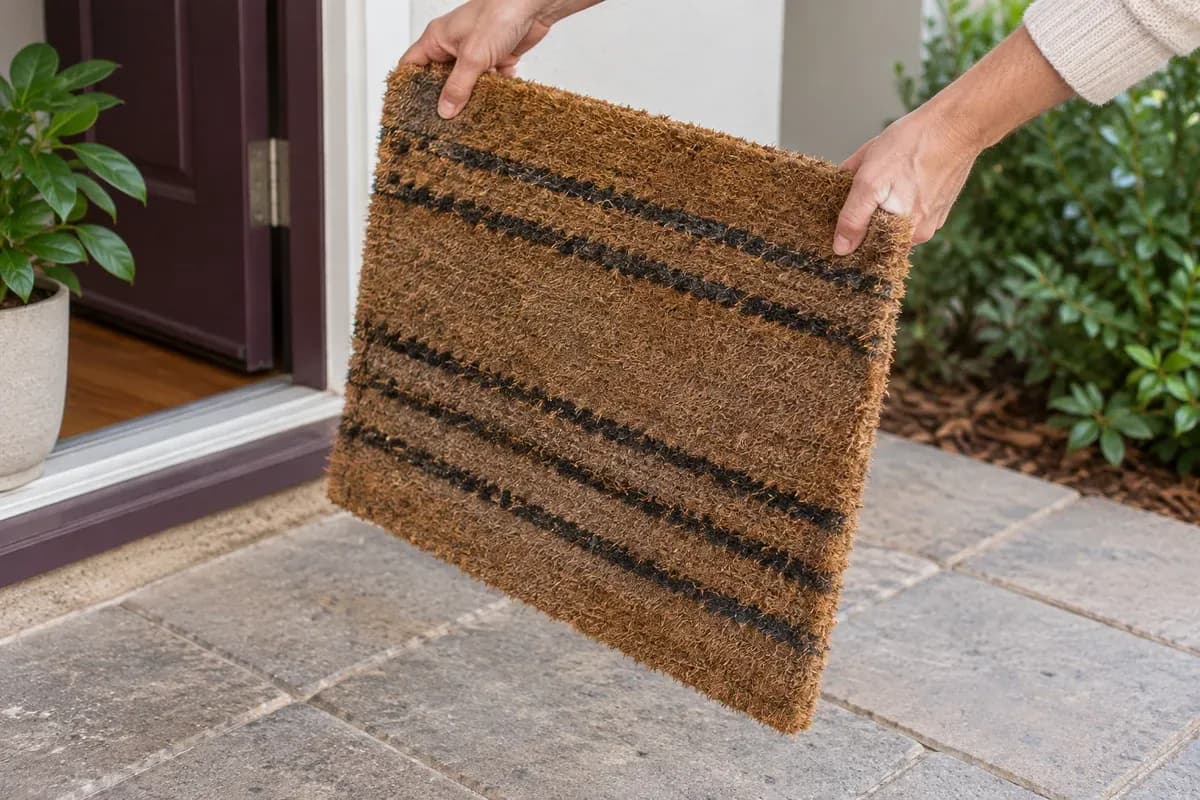
Use a real doormat, and use two. A coarse mat outside to knock grit off, a soft absorbent one inside to catch the fines. A single thin mat does neither job well. Shake or vacuum both weekly — a saturated mat is a dust reservoir, not a barrier.
Close windows on the wrong days. Windy days, dust-storm days, hazard-reduction burn days and bushfire smoke days all push outdoor particulates straight in. Check your state's air quality service before airing the house out. On clear, still days, ventilate freely.
Change the filters. The filters in your split system and your vacuum are the two devices in the house whose entire job is trapping fine particles. Both stop working when clogged. Our guide to cleaning a split system air conditioner covers the filter step in detail. For the vacuum, see how to use a vacuum cleaner properly.
Dust in the Right Order

Use a cloth and vacuum method that suits each finish. This order reduces repeated work; it is not an allergen-removal guarantee.
Read the illustration as text
- High, reachable surfaces
- Dust accessible shelves and upper surfaces first.
- Lower surfaces
- Collect the dust that lands on furniture below.
- Floors last
- Vacuum with the attachment suited to the flooring.
Finish at the bottom; avoid unsafe high access.
Order matters more than product. Dust falls. Working against gravity means doing the same surface twice.
- Top to bottom. Ceiling fans, then the tops of wardrobes and door frames, then shelves and picture rails, then benches and tables, then skirting boards. Floors last.
- Dry to wet. Loose dust first, then a damp wipe, then any polish or protectant. Reversing this turns dry dust into smeared grime.
- Vacuum after dusting, not before. Whatever you knock off high surfaces lands on the floor. Vacuuming first means vacuuming twice.
In a whole-house clean, that same logic scales up: finish the dusting in every room before you start on floors anywhere. Our house cleaning checklist sets out the full room order.
The Damp Cloth Rule
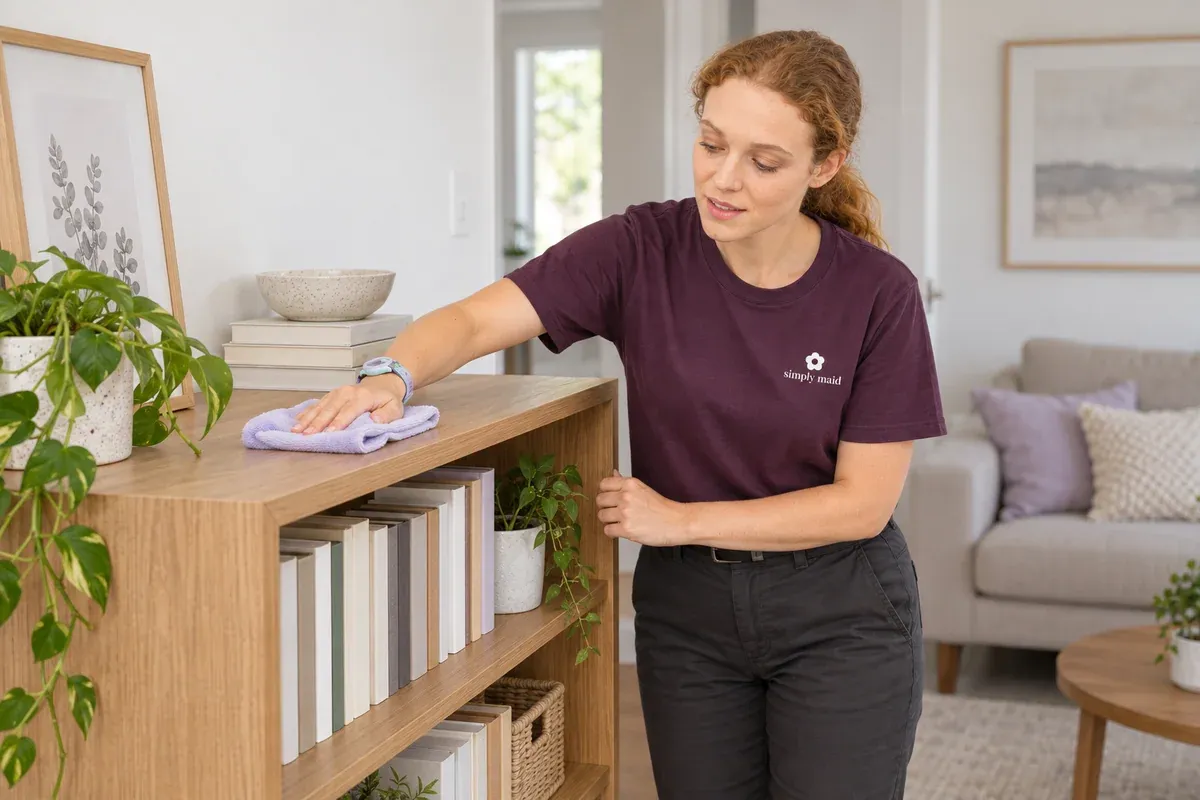
A dry cloth and a feather duster mostly move dust from the surface into the air. It circulates for a while, then settles somewhere else — often back where it started.
A lightly damp microfibre cloth holds it. Damp means wrung out until it feels barely cool, not wet. On timber and electronics, damp-then-dry: wipe, then follow immediately with a dry cloth so no moisture sits on the finish. For a desk, which is usually both, see How to Clean Your Desk and Keep It Organised.
Two surfaces need their own approach. Screens and laptops take a dry microfibre cloth only, never a damp one — see cleaning your laptop and How to Clean a Computer Screen. Plantation shutters and venetians have too many edges for a cloth; a vacuum brush head is faster, and our blinds guide covers the rest.
Rinse the cloth often. A loaded cloth stops collecting and starts redistributing.
Vacuuming: Filtration Beats Suction
For dust specifically, what matters is not how hard a vacuum pulls but whether the fine particles stay inside it. A powerful vacuum with a clogged or poorly sealed filter is a very effective dust-blower.
Wash reusable filters monthly and let them dry fully — 24 hours — before refitting. Empty the bin or bag at about two thirds full. Fine dust blocks the pores long before the container looks full.
Slow down. A single fast pass rides over the top of settled dust. Several slower passes, in more than one direction, actually lift it.
Soft Furnishings Are the Reservoir
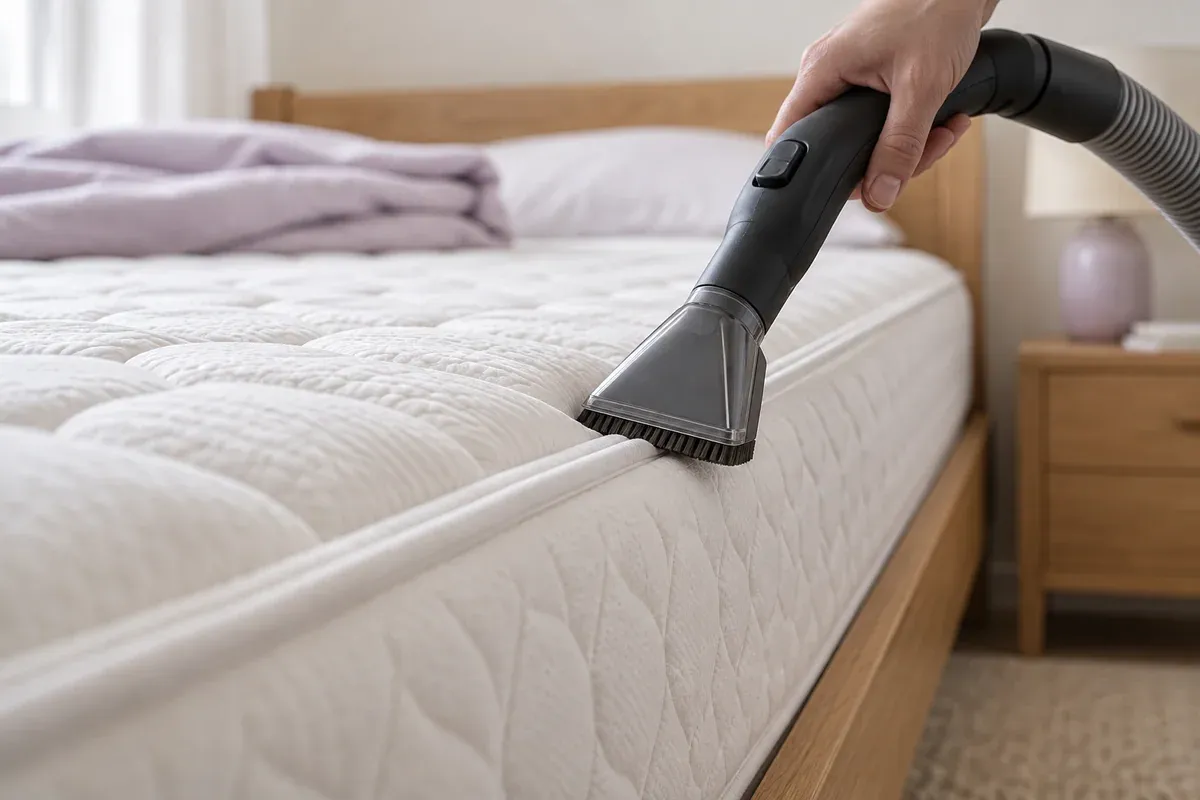
Hard surfaces show dust. Soft ones store it. Mattresses, upholstery, curtains, rugs and soft toys hold far more than the shelf you can see, and release it every time someone sits down.
This is also where house dust mites live. Better Health Channel, published by Victoria's Department of Health, lists their preferred homes as "mattresses and bed linen", "upholstered furniture", "shag-pile or long-fibred carpets" and "soft toys", and notes that "the main component of dust is shed skin flakes, which is the mite's preferred food source."
Their control advice is specific and worth following literally:
- "Wash sheets and pillowcases weekly in water hotter than 60 °C." Cooler washes remove some allergen but do not kill mites.
- "Vacuum weekly, including the seams of mattresses and upholstered furniture."
- "Reduce humidity – have a dry and well-ventilated house." Mites need warm, humid, dark conditions.
- Wash blankets and doonas every two months, and mattress and pillow covers on the same cycle.
One caveat from the same source that changes when you vacuum: "Vacuuming causes house dust mite allergens to become airborne for up to 20 minutes." If anyone in the house has asthma or a dust allergy, they should be out of the room while you vacuum and for a while afterwards.
For the bedroom specifically, we go deeper in how to clean a mattress and how to wash pillows.
Australian Conditions Change the Job
Three things make dust behave differently here than in most of the advice you will read online.
Smoke and hazard-reduction burns. Fine smoke particulates settle as a greasy film that a dry cloth smears. After a smoke event, Better Health Channel's advice is to "wash indoor surfaces with mild soap or detergent and water". For heavier soot they suggest "4 to 6 teaspoons of washing powder and one cup of household chlorine bleach added to 4 litres of water", with rubber gloves.
Never mix cleaning products. Healthdirect, the Australian Government health service, states: "Some cleaning products can produce dangerous gases when they're mixed." Bleach plus any acid — including vinegar — is the pairing to watch. NSW Health's advice when using bleach: "Make sure the area is well-ventilated while you are cleaning with bleach", with gloves and safety glasses. Follow the label's dilution and contact time. If someone inhales fumes, Healthdirect's advice is to "get fresh air straight away — go outside or open doors and windows" and "loosen tight clothing". In an emergency call 000. For poisoning advice call the Poisons Information Centre on 13 11 26 — 24 hours, anywhere in Australia.
Dust storms and dry inland air. Inland and western-suburbs homes take in far more mineral dust than coastal ones. Nothing is wrong with your cleaning; the supply is simply higher.
Coastal salt. Near the water, airborne salt combines with dust into a film that clings harder than dry dust and needs a damp wipe rather than a dry one.
What Doesn't Work
Being straight about this saves more time than another tip.
- Feather dusters. They redistribute dust rather than collecting it. A damp microfibre cloth does the job properly.
- "Anti-static" and "dust-repellent" sprays. Any effect is short-lived, and on timber the residue builds into a dull film. Regular wiping outperforms them.
- Air purifiers as a substitute for cleaning. A HEPA purifier genuinely helps with airborne fine particles, especially during smoke events. It does nothing about the dust already on your shelves, and it cannot compensate for a house where shoes come inside.
- Dusting more often. Past about weekly, frequency stops being the constraint. Entry points and filters are.
- Closing the house up permanently. Dust still gets in, and you trade it for stale, humid air — which suits dust mites nicely.
How Often
Weekly is the realistic baseline for surfaces you see and for bedding. Ceiling fans, door frames, wardrobe tops and skirting boards need attention roughly monthly. Filters — split system and vacuum — monthly. Curtains, blinds and upholstery a few times a year.
If a house is visibly dusty again within a day or two of a proper clean, that is a supply problem, not a technique problem. Look at shoes, mats, filters and which windows are open, in that order.
Frequently Asked Questions
Q: Why is my house so dusty even though I clean regularly?
Most likely because the supply is high, not because the cleaning is poor. Two thirds of dust comes from outside, so shoes worn indoors, a saturated doormat, open windows on windy days and clogged filters will all outpace weekly dusting.
Q: Should I dust or vacuum first?
Dust first, vacuum last. Anything you dislodge from high surfaces lands on the floor, so vacuuming first means doing it twice.
Q: Is a damp cloth safe on timber furniture?
Yes, if it is barely damp and you dry immediately after. Wring the cloth until it feels cool rather than wet, wipe, then follow with a dry cloth. Do not leave moisture sitting on the finish.
Q: Do air purifiers actually reduce dust?
They reduce airborne fine particles, which helps noticeably during bushfire smoke or a dust storm. They do not remove settled dust from surfaces and are not a replacement for cleaning or for controlling what comes in the door.
Q: What temperature kills dust mites in the wash?
Hotter than 60 °C, per Better Health Channel. Cooler washes rinse away some allergen but leave live mites behind. Wash sheets and pillowcases weekly at that temperature.
Correction, 22 September 2026: an earlier version said that dusting surfaces "manages a third of the supply". Dusting removes settled dust from every source; what the two-thirds figure changes is where prevention pays off. The wording was corrected, and a formatting fault in the safety note was repaired.
Related Reading
- How to Use a Vacuum Cleaner Properly
- How to Clean a Mattress and Remove Stains
- How to Wash Pillows by Filling, Step by Step
- How to Clean a Split System Air Conditioner
- The House Cleaning Checklist
Sources & References
- CSIRO — Australian Housing Data, Taylor, Isley, Fry and Gillings — What is dust? And where does it all come from?. Referenced for dust composition, the two-thirds outdoor proportion, and how dust enters closed-up homes. Draws on the DustSafe program at Macquarie University.
- Better Health Channel, Victoria Department of Health — House dust mite. Referenced for dust mite habitat and food source, the 60 °C wash temperature, weekly vacuuming of mattress and upholstery seams, humidity control, and the 20-minute airborne allergen window after vacuuming.
- Better Health Channel, Victoria Department of Health — Bushfire aftermath — safety tips. Referenced for washing indoor surfaces after smoke and the soot cleaning dilution.
- Healthdirect Australia — Inhaled substance or object. Referenced for the never-mix warning and the inhalation first-aid steps in the safety block.
- NSW Health — Mould. Referenced for ventilation and protective equipment when cleaning with bleach.
Smoke days in bushfire season, covered above, are a familiar part of summer in Canberra. If you are in Canberra, you can see what a regular visit covers on our house cleaning in Canberra page.
Change log
Who wrote and edited this article, when its sources were checked, and what changed.
Current version
What changed
Correction, 22 September 2026: an earlier version said that dusting surfaces "manages a third of the supply". Dusting removes settled dust from every source; what the two-thirds figure changes is where prevention pays off. The wording was corrected, and a formatting fault in the safety note was repaired.