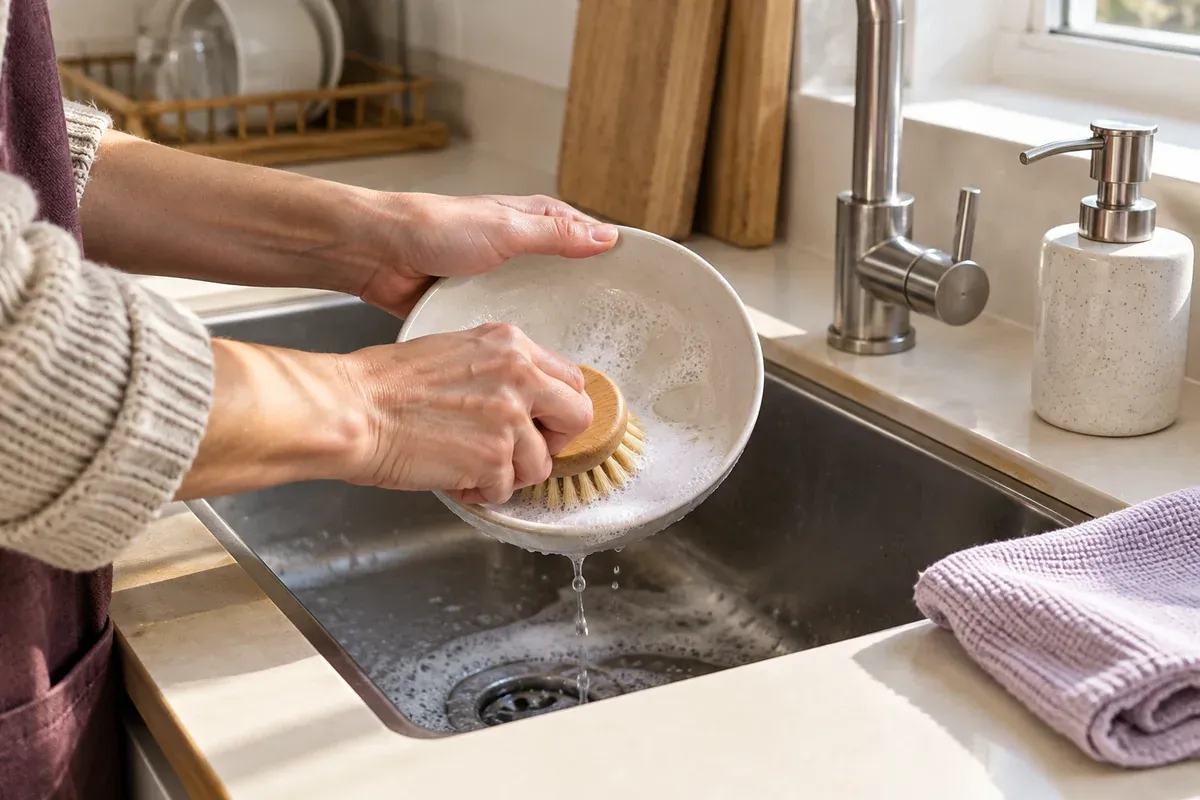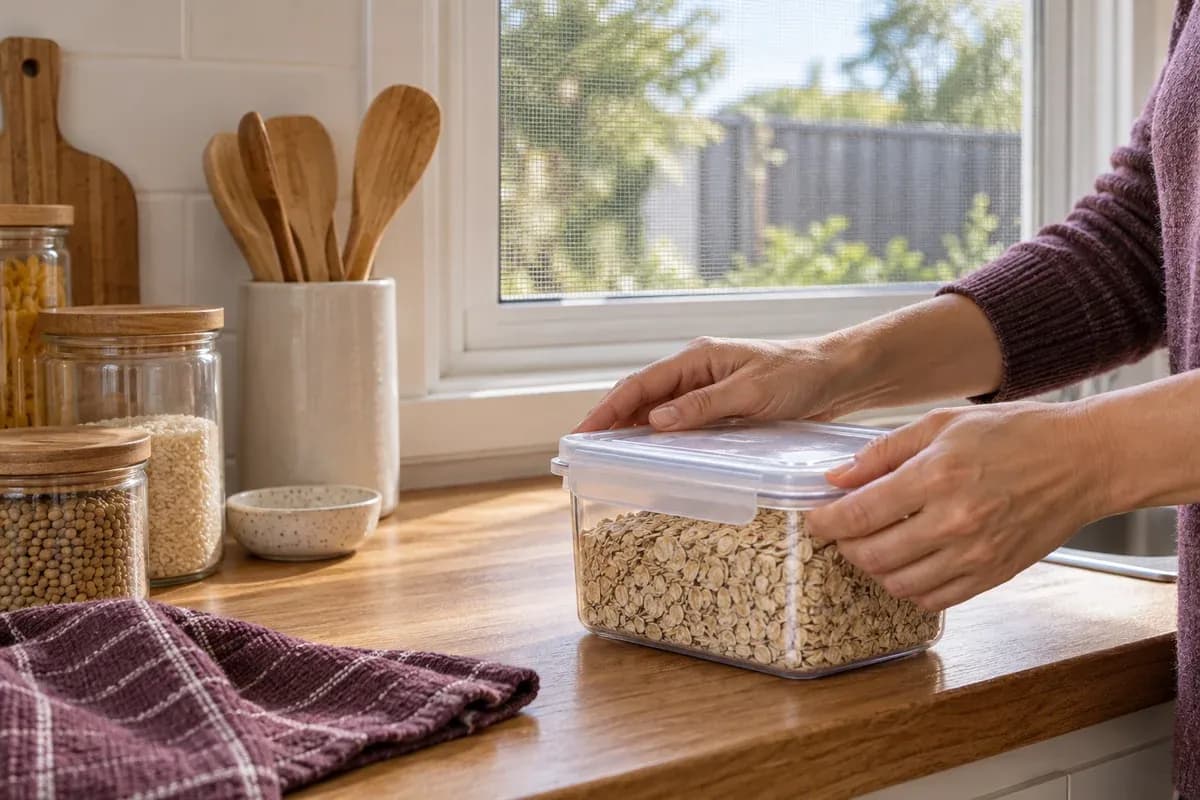
An ant trail to a sticky jar and little flies around a bathroom drain need different fixes. Before buying a repellent, look at where the pests gather and what keeps bringing them back. Often the useful first job is quite specific: clean the jar rim, repair a screen or remove the sludge inside a drain.
Quick answer: Identify the pest first. Remove accessible food, address leaks and close suitable entry gaps. Wipe ant trails, clean fly breeding sites and investigate repeated cockroach sightings. Get professional advice promptly for suspected bed bugs. Do not assume essential oils, borax or “food-grade” powders are harmless, or that a homemade repellent will clear an infestation.
Start with a short inspection

Cleaning can reduce food and shelter but does not guarantee pest control. Persistent activity, bed bugs or an uncertain species need appropriate professional advice.
Read the illustration as text
- Food
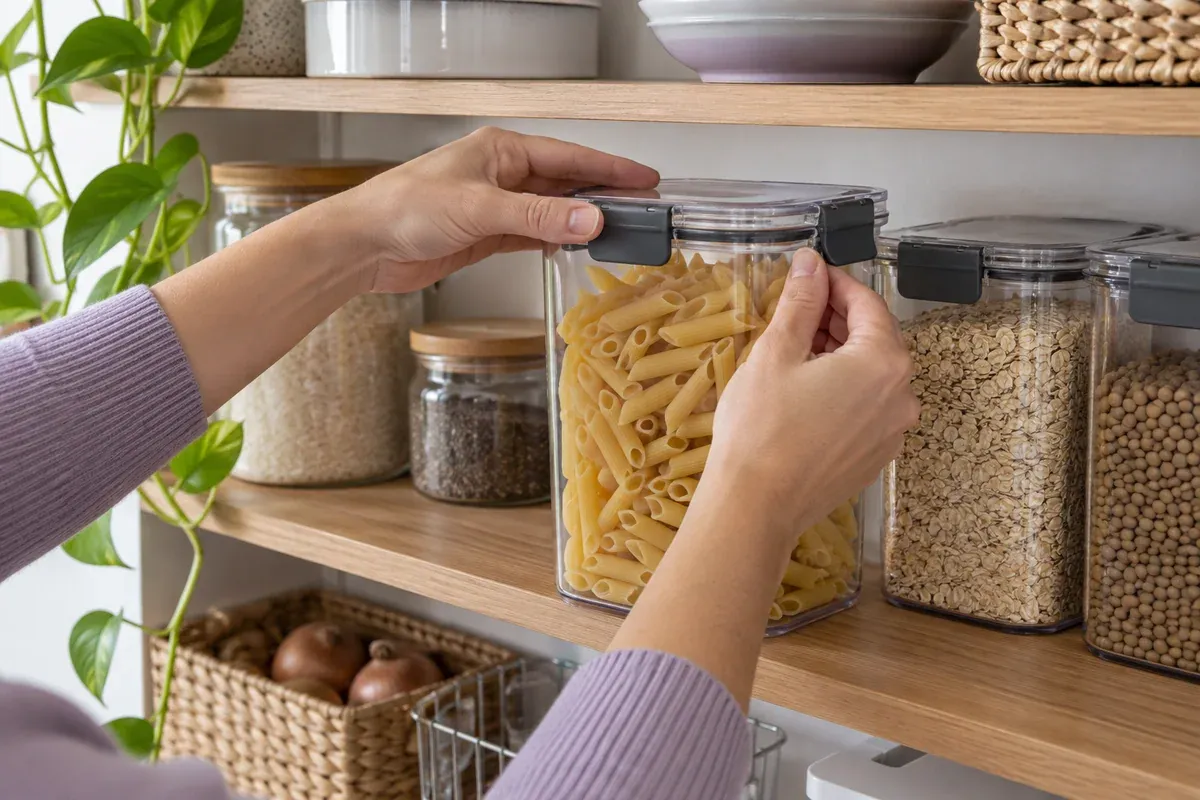
- Clear residue and close suitable food and waste containers.
- Water
- Arrange repairs for leaks or recurring dampness.
- Entry and shelter
- Check screens and reduce clutter without blocking ventilation.
Identify the pest before choosing a treatment.
Take a clear photo if you can do so without handling the pest. Note the room, time and exact location: “three beside the sink after dark” is more useful than “bugs everywhere”. Check the same spots after making a change. These notes can also help a pest controller identify the problem.
HealthyWA’s prevention guidance recommends food storage, waste control, flyscreens and reducing access to water. Turn that into a small, targeted check:
- Food: wipe sticky container rims and spills, close pantry containers, and clean food residue from bins before replacing their liners.
- Water: look beneath the sink and around taps for leaks or recurring dampness. Arrange repairs rather than repeatedly wiping the same puddle.
- Entry: inspect door seals and flyscreens. Repair suitable gaps, but do not seal ventilation openings, appliance clearances or building drainage paths.
- Shelter: clear unnecessary cardboard and clutter from the affected area so you can inspect and clean it.
Keep this manageable. Start where you have actually seen activity, rather than emptying every cupboard at once. Cleaning helps reduce some pests’ food and shelter; it is not a guarantee that a home will remain pest-free.
Ants: follow the trail before wiping it
Watch where the ants enter and what they are feeding on. Put the food away, then wipe the ants and trail with soapy water on a surface that tolerates it. Remove the residue as the surface instructions require. Avoid spraying electrical fittings or flooding gaps.
The University of California’s ant guide supports soapy wiping as temporary removal of foraging ants and their scent trails. It does not mean the nest has been eliminated. If ants return, check the entry point and food source again.
Persistent activity may need a suitable bait. Workers can carry a slow-acting bait back to the colony, but effectiveness depends on the species and product. Use an Australian-registered product for the stated pest and location, following its placement and child/pet precautions. Do not add insecticide sprays around an active baiting programme. If the bait is ignored, get advice on identification and placement rather than making it stronger.
House flies: check the bin and the screen
For larger flies entering from outside, look for accessible rubbish, food waste or pet droppings, and check doors and window screens. Clean residue from the bin itself, not just the bag. Keep its lid fitted and remove waste regularly. A flyswatter can deal with an occasional indoor fly.
These source-removal and exclusion steps are supported by University of Minnesota Extension. Repeated numbers need investigation; spraying the adults does not remove the place where larvae are developing. Tiny flies near a drain or fruit bowl may be a different problem, so identify them before choosing a treatment.
Eating outside? Use our guide to keeping flies away from food to arrange covers, serving dishes and waste before a barbecue or picnic. It also explains the limits of homemade spray advice.
Drain flies: remove the film they breed in
Drain flies are small and fuzzy, with a moth-like appearance. Virginia Cooperative Extension explains that they breed in the sludgy material in drains and overflow pipes. Removing that material matters more than pouring another kitchen ingredient over it.
Check how your waste fitting comes apart before removing a stopper or cover. Clean accessible hair and sludge with a suitable dedicated brush, including accessible overflow areas; do not force fixed parts. Follow the fitting’s care instructions and use a plumber for inaccessible build-up, leaks or a persistent blockage. Do not reach or brush into a waste-disposal unit.
One Reddit contributor described a useful way to keep the right tool ready:
I have a dedicated old toothbrush under my sink just for scrubbing that and the overflow hole.
— u/SimpleVegetable5715 in r/CleaningTips. This is a household tip, not evidence that every fitting can be dismantled or that brushing alone will solve every infestation. Keep a drain brush separate from washing-up tools, and clean and dry it after use.
Virginia Cooperative Extension advises physical removal of thick build-up and warns that vinegar or bleach does not reliably reach larvae within it. Skip the repeated kettle-and-vinegar routine. If flies persist after accessible areas are clean, have the source checked rather than adding more chemicals.
Cockroaches: investigate repeated sightings
A cockroach that wandered inside calls for a different response from repeated activity in cupboards. Photograph what you see and look for droppings, shed skins or egg cases around accessible hiding places. Do not pull apart appliances or electrical fittings to search for them.
The University of California’s cockroach guide recommends identifying the species and combining food and water control with reducing hiding places. Clean crumbs and grease, store food securely, fix leaks and remove unnecessary cardboard. Note where activity continues.
Baits can be part of treatment, but their position and suitability matter. Follow an Australian product’s directions rather than scattering homemade sugar-and-bicarb mixtures or loose powders around the kitchen. Repeated sightings, an unclear source or an established infestation are good reasons to consult a licensed pest controller. Ask how the treatment will be assessed and what preparation is needed.
Geckos: identify the visitor first
Not every gecko around an Australian home is an introduced Asian house gecko. Queensland Museum’s illustrated guide shows native species alongside Hemidactylus frenatus. It also shows geckos feeding on insects; it does not establish a fixed number eaten each night.
If you want to limit indoor visits, focus on intact screens and appropriate door seals. Keep essential ventilation clear. Ask a local museum or wildlife service for identification and handling advice if needed. Do not spray a gecko with cleaner, trap it on a glue board or assume it should be relocated because it is indoors. Eggshells and essential-oil cotton balls are not a dependable exclusion plan.

Bed bugs: seek help early
Suspected bed bugs need prompt identification and a treatment plan. Healthdirect recommends professional pest-control help and warns that delaying treatment can make the problem worse. Do not wait for an infestation to become “serious” while trying pantry remedies. A clean home can still have bed bugs.
Follow the controller’s preparation instructions. The US EPA’s bed-bug guidance recommends containing infested items. Bag them before moving them to treatment. Where advised, vacuum accessible seams, then seal and dispose of the vacuum bag outside; check the machine instructions for bagless models.
High-heat drying may help with suitable items: check the care label and agree the programme with the controller. Keep treated items separate. Washing bedding alone does not treat the room.
Do not rely on leaving a mattress in the sun. The EPA notes that improvised heat methods may fail, and warns against heating rooms with a thermostat, fireplace or propane heater. Never put kerosene, petrol or rubbing alcohol on a bed to kill bugs.
The 2011 Kells and Goblirsch heat study was published in Insects. It used controlled heating of bed bugs and eggs in vials, with temperature monitoring. Survival depended on life stage, temperature and exposure time. It does not validate a sunny-mattress method or a single household temperature threshold.
What “natural” does—and does not—tell you
Choose a pest-control product by its approved use and directions, not its origin. The APVMA’s label guide explains where to find the registration number, target pests, permitted uses and application instructions. Check the exact product, including precautions for children, pets, food areas and re-entry. A product suited to an outdoor crack is not automatically suitable beside a bed.
Borax and boric acid can cause harmful exposures; the National Pesticide Information Center describes ingestion, inhalation and skin or eye exposure. A household laundry powder is not a substitute for a labelled pest-control formulation. Do not improvise a bait concentration or dusting dose.
For bed bugs, the EPA specifically warns against food-grade and pool-grade diatomaceous earth. “Food-grade” does not mean dust is safe to breathe. Only consider an appropriately registered pest-control product for the labelled use, following all application and exposure precautions; ask the controller whether it belongs in the treatment plan.
Essential oils also need secure storage. WA Health warns that swallowing them can cause poisoning and that they can irritate skin. They are not an automatically safer alternative for a home with children, and a pleasant smell does not establish pest-control effectiveness.
Why the peppermint and cucumber claims changed
The 2016 peppermint paper studied spotted-wing drosophila, a crop pest, using oil-treated wicks in laboratory choice tests. A six-day repellent effect in that setup does not establish a weekly house-fly spray, a dose in drops or safety on kitchen surfaces. The previous article named the wrong journal and extended the result too far.
The 2021 cucumber paper’s abstract reports weak repellence in artificial conditions and questions its practical usefulness. That is no reason to replace cucumber with another unsupported recipe. We have removed the bicarb-and-sugar baits, oil barriers and scented kitchen-scrap remedies previously suggested here.
If the problem keeps coming back
Review the location and your notes. Did the same trail return, or did activity move? Is a drain still slow? Does a screen still have a gap? Take that information to the appropriate person: a plumber for drainage or leaks, a pest controller for identification and treatment, or a wildlife adviser for a gecko. More cleaning is not always the missing step.
For routine upkeep, see our natural cleaning products guide and family cleaning habits. A regular clean can help you keep food residue under control, but it should not be presented as pest treatment.
Editorial correction, 20 September 2026: Removed unsupported homemade pesticide recipes, broad family-safety claims and the sunny-mattress method. Corrected the scope and attribution of the fly and bed-bug studies, added source-specific prevention steps and a clearly attributed household tip, and clarified when professional help is needed.
Change log
Who wrote and edited this article, when its sources were checked, and what changed.
View all historyHide earlier history
Earlier entries record what was published at the time. Later corrections take precedence.
- Edited by
- Huy Hoang
Editorial correction, 20 September 2026: Removed unsupported homemade pesticide recipes, broad family-safety claims and the sunny-mattress method. Corrected the scope and attribution of the fly and bed-bug studies, added source-specific prevention steps and a clearly attributed household tip, and clarified when professional help is needed.