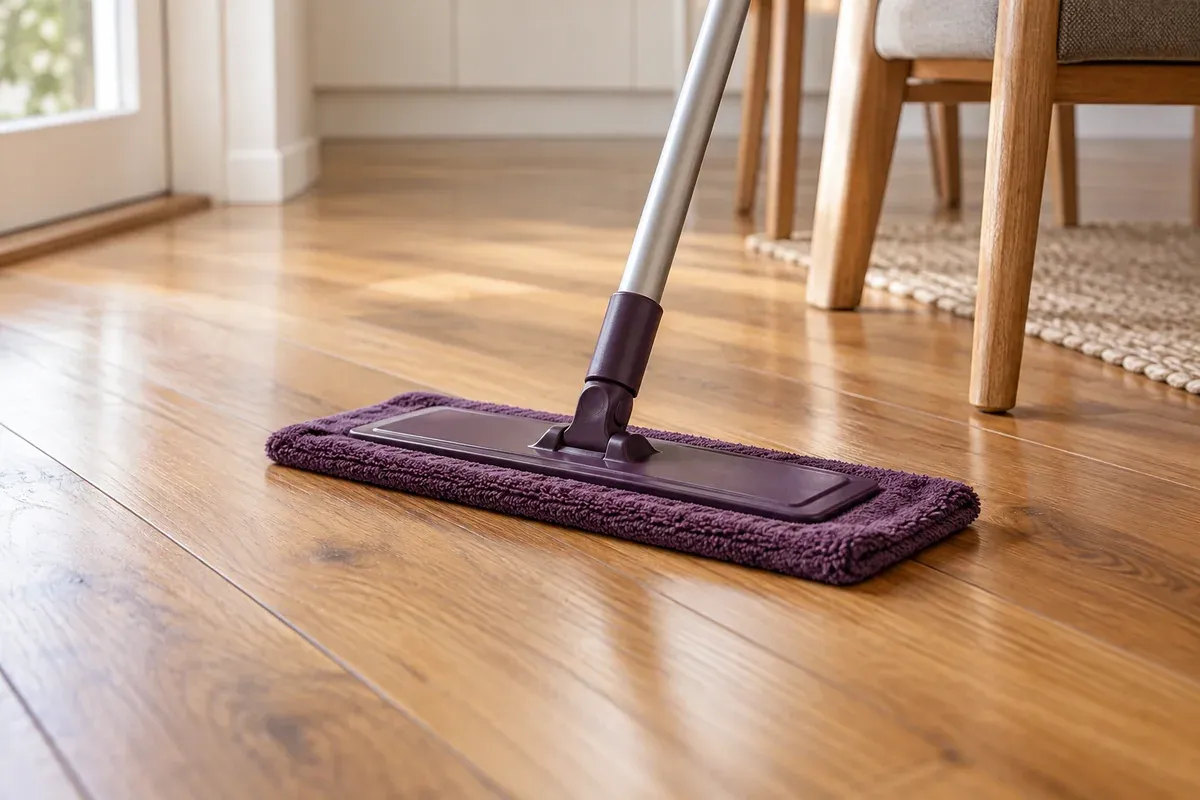
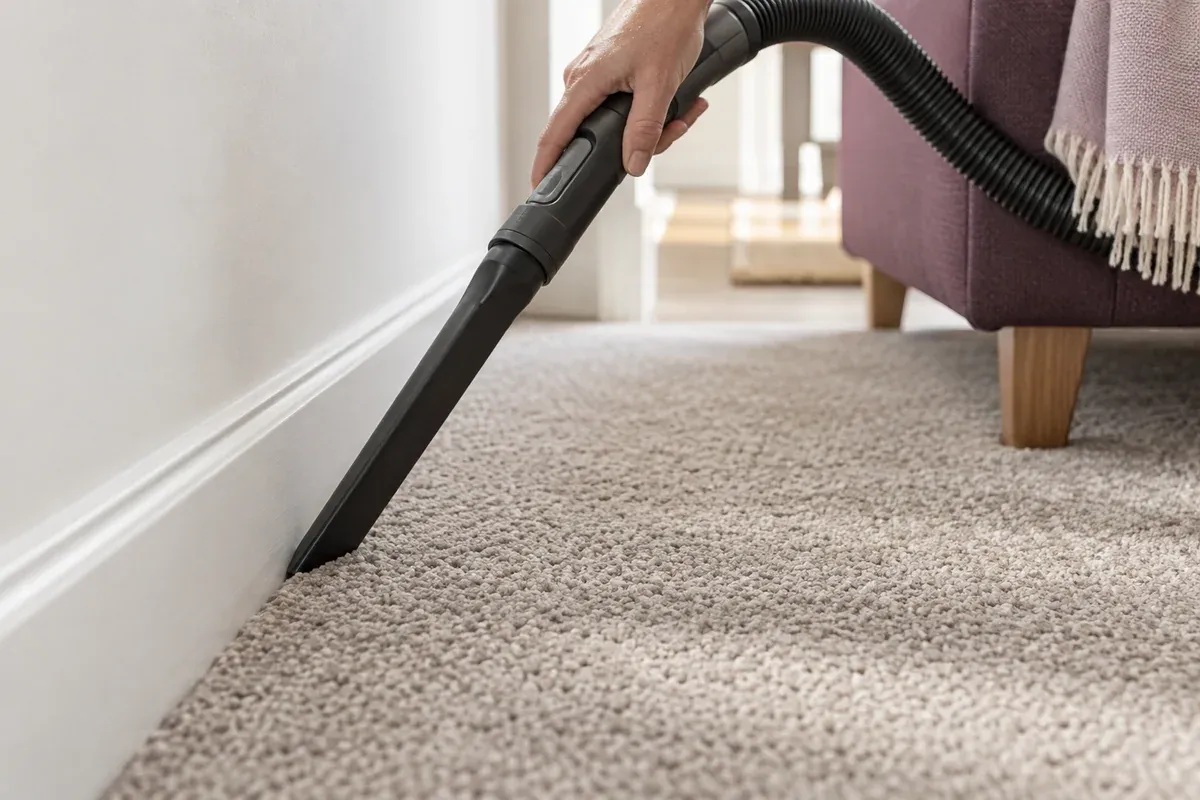
Most mopping problems come from too much of something: water, detergent, or dirty water going back onto the floor. A vacuum first, a well-wrung mop and a second bucket fix most of them.
Quick answer: Vacuum or sweep first. Fill one bucket with warm water, adding a little floor cleaner only if the floor is greasy, and a second with clean water. Wring the mop until it's damp, not dripping. Mop small sections from the far corner towards the door, rinsing and wringing the mop in the clean bucket before each re-dip. Let the floor dry before walking on it.
Which mop should you use?
Mop | Best for | Watch out for |
|---|---|---|
Flat microfibre mop | Most hard floors, and the easiest way to control water on timber, laminate and hybrid | Pads need rinsing often; wash them without fabric softener |
Spin mop (microfibre strands and a wringer bucket) | Tiles and vinyl, and timber or laminate if you spin it nearly dry | Costs more than a plain mop; choose a bucket with separate clean and dirty water sections |
Cotton string mop with a wringer bucket | Large tiled areas | Heavy when wet and leaves the floor wetter: in CHOICE's test the floor took almost 22 minutes to dry |
Sponge (squeeze) mop | Wringing with a lever, without touching the head | Can't go in the washing machine, and the sponge wears down |
Spray mop | Quick in-between cleans and fresh spills | Only put a cleaner the floor allows in the tank |
Steam mop | Sealed, glazed ceramic and porcelain tiles | Not on timber, laminate, hybrid or vinyl (see the table below) |
CHOICE found spray mops best for maintenance cleans and catching spills before they dry, and flat and spray mops need less water than a cotton mop.
What to put in the mop bucket
For routine mopping, warm water does most of the work. CHOICE's position is that all you need is hot water and a good mop, and it doesn't recommend any liquid floor cleaner it has tested.
When the floor is greasy or grubby, add a little cleaner:
- Glazed ceramic and porcelain tiles: a few drops of dishwashing liquid or a pH-neutral cleaner in a bucket of warm water (Beaumont Tiles).
- Timber, hybrid, vinyl and stone: the type of cleaner the floor needs, at the dose on the bottle (see the table further down).
More isn't better. The Natural Stone Institute warns that too much cleaner leaves a film and streaks, and Karndean lists detergent residue from over-concentrated products as a cause of slippery vinyl.
Safety Never mix cleaning products. Victoria’s Better Health Channel: “Do not mix bleach with ammonia, acids or other cleaners – this can release hazardous chlorine or chloramine fumes.” Ventilate the room during and after use. Wear gloves and eye protection. Follow the label's dilution and contact time. In an emergency call 000. For poisoning advice call the Poisons Information Centre on 13 11 26 — 24 hours, anywhere in Australia.
One product per bucket: don't add vinegar, bleach or a second cleaner to a floor cleaner.
How to mop a floor, step by step
You'll need a vacuum or broom, two buckets (or a bucket with two sections), a mop, and floor cleaner or dishwashing liquid if the floor needs it.
- Clear and dry-clean the floor. Lift rugs, chairs and pet bowls, then vacuum or sweep (How to Vacuum Properly (and Get More From Your Machine) covers hard floors). Grit left on the floor turns to mud under the mop and can scratch vinyl and hybrid.
- Fill two buckets. One holds the cleaning solution and the other plain rinse water: the two-bucket system the US Centers for Disease Control and Prevention describes for routine cleaning.
- Wring the mop until it's damp, not dripping. The Australasian Timber Flooring Association says moist; Unger, a cleaning-tool maker, says an overly wet mop leaves streaks and a slip hazard.
- Start in the far corner and work back towards the door, so you never have to stand on the wet floor. Do the edges of each section first, then the middle.
- Mop in overlapping figure-eight strokes, a small section at a time. Unger says the motion keeps the head on the floor and spreads less dirt around than pushing back and forth.
- Rinse before you re-dip. Swish the mop in the rinse bucket, wring it, then dip it in the solution. Change the rinse water once it's murky, and the solution once it looks dirty.
- Go over it with clean water if the floor feels tacky. Karndean says a rinse after its cleaner reduces residue build-up.
- Let it dry before anyone walks on it. All hard floors are slippery when wet, Karndean warns, so keep children and pets out until it's dry.
Done looks like: no streaks when you look along the floor towards a window, nothing tacky underfoot and no water left along the edges.
Why your floor is streaky after mopping
What you see | The usual cause | The fix |
|---|---|---|
A dull film or sticky patches | Too much cleaner | Mop again with plain warm water, wrung well |
Grey streaks or dirty corners | Dirty rinse water, or no vacuum first | Vacuum, change both buckets and go again |
Water marks or slow drying | The mop was too wet | Wring harder; finish with a dry microfibre pad on glossy tiles |
Haze or patchiness on timber | Detergent, or a cleaner that doesn't suit the finish | A neutral pH timber cleaner; see the timber guide below |
How to mop each type of floor
Floor | Mop and solution | Avoid |
|---|---|---|
Glazed ceramic and porcelain tiles | Any mop; warm water with a few drops of pH-neutral cleaner or dishwashing liquid | Acidic or alkaline cleaners used regularly, which Beaumont Tiles says can etch the glaze |
Cement grout between tiles | Neutral or alkaline cleaners only: ARDEX says cement grout corrodes in contact with acid | Vinegar, lemon and acidic bathroom cleaners |
Coated timber (polyurethane and similar) | Flat mop wrung until just moist, with a neutral pH timber floor cleaner | Vinegar, methylated spirits, steam; the timber flooring association warns even household detergent may damage some coatings |
Oiled or waxed timber | The finish maker's own cleaner, on a barely damp mop | Steam: Kmart's steam mop manual rules out wax and oil finishes |
Laminate | Vacuum or dry-mop first, then a microfibre pad wrung out thoroughly, using water sparingly | Steam (Quick-Step doesn't permit it on its standard ranges), excess water |
Hybrid | A slightly damp mop with a soap-free, non-abrasive cleaner | Soap-based detergents, abrasives and steam (National Tiles) |
Vinyl planks and sheet vinyl | A pH-neutral vinyl cleaner, such as Karndean Clean at 50 mL in 8–10 litres of water | Steam mops, and aerosol or silicone products that make it slippery (Karndean) |
Linoleum | A dust mop for routine cleaning, and a damp mop with a neutral detergent for marks (Forbo) | A soaking-wet mop |
Natural stone: marble, limestone, travertine, granite | A neutral stone cleaner or mild dishwashing liquid in warm water; rinse, then dry with a soft cloth | Vinegar, lemon and other acids, and scouring powders (Natural Stone Institute) |
Not sure | Vacuum, then a mop wrung almost dry with plain warm water; try a corner first | Steam, vinegar, bleach |
Timber floors need the most care, and the full method is in How to Clean and Polish Timber Floors. If the grout stays grey after mopping, see How to Clean Grout — and Keep It Looking Clean, and for walls and shower tiles, How to Clean Bathroom and Shower Tiles.
Mopping with vinegar, bleach or steam
Method | Verdict | Why |
|---|---|---|
Plain warm water | Works for routine mopping | CHOICE's recommendation |
A little dishwashing liquid | Works on glazed tiles and stone | Beaumont Tiles and the Natural Stone Institute both allow it; not on hybrid (National Tiles) |
White vinegar | Skip | It's an acid: it etches stone (Natural Stone Institute), corrodes cement grout (ARDEX) and is named by the timber flooring association as a cleaner that may damage coatings |
Bleach | Not for routine mopping | It's for cleaning up after gastro, on tiles and vinyl only; never mixed with another cleaner |
Steam mop | Sealed, glazed tiles only | Kmart's steam mop manual rules out unsealed timber and unglazed ceramic and says to follow the floor maker; timber, laminate, hybrid and vinyl makers rule steam out |
Routine mopping with detergent cleans a floor; it doesn't disinfect it. If someone has been sick on the floor, follow the steps in How to Sanitise and Disinfect Your Home.
How to wash a mop head (and when to replace it)
After every mop:
- Rinse the head in clean water until the water runs clear, then wring it out.
- Hang it up to dry in an airy spot out of direct sun, with the head off if it detaches (Oates). The CDC says mop heads should dry fully before they're stored or reused. Never leave a mop standing in the bucket: Vileda says not to.
- Empty, rinse and dry both buckets.
When the head looks grubby, machine-wash it:
- Microfibre heads and pads: wash them separately on a warm wash, no hotter than the maker allows (Vileda and Oates allow up to 60°C for their heads). Unger warns that high heat damages microfibre, fabric softener clogs the fibres and bleach breaks them down, and says to keep microfibre away from lint-shedding cotton. Air-dry, or tumble on low.
- Cotton string heads: most screw off for machine-washing (CHOICE). Wash them apart from microfibre, which picks up their lint.
- Sponge heads: rinse and air-dry only; CHOICE notes they can't be machine-washed.
Replace the head every 4 months (Oates) to 6 months (Vileda), or sooner if it's worn, stays dark after washing or still smells musty.
When mopping isn't enough
Grout that stays dark, timber that looks dull or patchy even when clean, and stone with dull etch marks are finish or surface problems that no mop will fix. A dull timber floor may need a maintenance coat or a recoat by a flooring professional, and etched marble a stone restorer.
A Simply Maid standard clean sweeps and mops all hard floors, and a deep clean adds a scrub of bathroom tile grout. Floor sanding and recoating, stone restoration and standalone steam cleaning aren't services we offer.
Frequently asked questions
How often should you mop floors?
Weekly suits most homes, with the kitchen and entry more often if they get busy, and spills wiped up when they happen.
How do you mop a floor without a mop?
With a bucket, a microfibre cloth and something to kneel on. Use the same two buckets and wring the cloth just as hard, wipe a small section at a time, and work back towards the door. It's slow, so keep it for small floors.
Last reviewed 6 October 2026 · Update history
Sources & References
- CHOICE, Which manual mop type is best? (updated 24 June 2024): mop types tested; hot water and a good mop; floor cleaners not recommended.
- US Centers for Disease Control and Prevention, Cleaning supplies and equipment (updated 19 March 2024): two-bucket system; dry mop heads fully.
- Unger, Commercial floor mop techniques (2024): figure-eight strokes, edges first, overly wet mops.
- Unger, How to wash microfibre cloths and mop heads: no softener or bleach; wash separately.
- Beaumont Tiles, How to clean porcelain and ceramic tiles: pH-neutral cleaner; acids and alkalis on glaze.
- ARDEX Australia, TB186: Cleaning and maintenance of ARDEX grouts (PDF): cement grout and acid.
- Australasian Timber Flooring Association, Floor care and maintenance (PDF, 2016): damp mopping coated timber; vinegar, detergent and steam.
- Premium Floors (Quick-Step Australia), Laminate maintenance: water sparingly; no steam.
- National Tiles, Hybrid Flooring Cleaning & Care (PDF): hybrid do's and don'ts.
- Karndean, Cleaning, maintenance and aftercare guide (PDF, Australia): vinyl dosing, rinsing, slip and steam advice.
- Natural Stone Institute, Care and cleaning of natural stone: neutral cleaners, acids, excess soap.
- Kmart Australia, 2 in 1 Floor and Hand Steamer manual (PDF): floors a steam mop shouldn't touch.
- Vileda Australia, Easy Wring & Clean Turbo refill: washing, storing and replacing.
- Oates, Spin & Clean Microfibre Mop Refill and Triple Action Flat Mop: replacing and washing.
Related Reading
Change log
Who wrote and edited this article, when its sources were checked, and what changed.