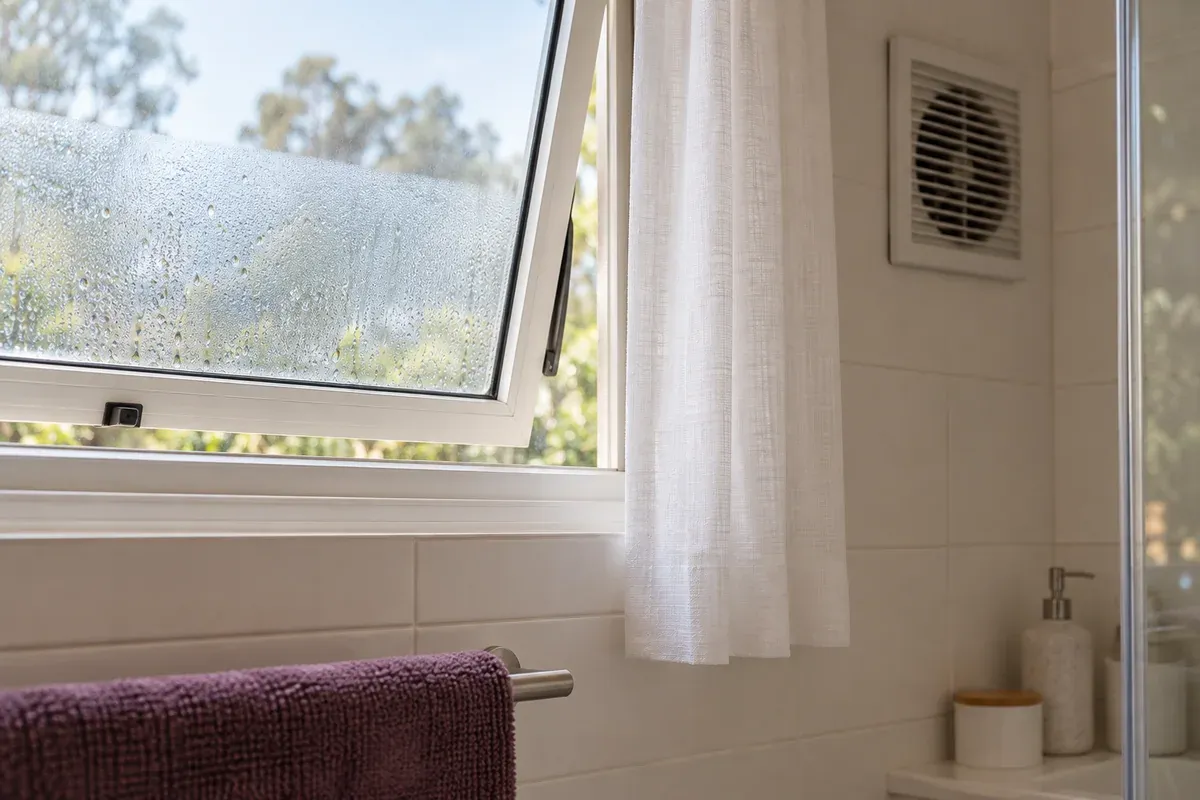
Cleaning a split system starts with knowing which parts are yours to maintain. The removable dust filters are often a straightforward job; a dirty fan, leaking drain or contaminated heat exchanger needs a different approach. Find the model number and care instructions before opening the filter cover.
Quick answer: Stop the unit normally, then isolate its electricity supply as the owner’s manual directs. Clean only the user-removable filters and accessible surfaces covered by that manual. Wash a filter only if it is washable, and refit it completely dry. Keep the outdoor airflow clear from ground level. Leave casing removal, internal washing, drain repairs and electrical or refrigerant work to an appropriately qualified service provider. Stop for suspected internal mould, leaks or electrical faults.
Before opening the cover
Read the safety and cleaning sections for your exact model. Mitsubishi Electric’s filter-care guide advises contacting a service company if you cannot locate the power-isolation switch. Switching off with the remote alone is not the same as isolating the supply.
NT WorkSafe’s split-system cleaning bulletin explains that removing covers can expose electrical parts. This guide stays with the owner-maintenance access described in your manual. Do not remove screwed service panels, open electrical compartments or try to test wiring yourself.
- Make sure you can reach the filter cover safely. Use suitable stable access equipment; do not balance on furniture or overreach. Arrange help if access is awkward or high.
- Keep hands dry when operating switches. Let moving parts stop and follow any waiting period in the manual. Keep children and pets away from the work area.
- Gather a clean soft cloth, a suitable vacuum attachment if permitted, and a place to dry removable filters. Add water and cleaner only when the filter instructions allow them.
- If you see suspected mould inside the unit, water near electrical parts, damaged wiring or a burnt area, stop and arrange service. Do not brush contamination into the room.
Identify the filter before washing it

Follow the model’s isolation instructions before opening the cover. Do not spray cleaners into the unit or work beyond safe reach.
Read the illustration as text
- Washable mesh
- Clean only the owner-removable filter as the manual permits.
- Special inserts
- Deodorising or disposable inserts may need different care or replacement.
- Internal components
- Coils, wiring and service panels belong with qualified service personnel.
Dry and refit permitted parts before restoring power.
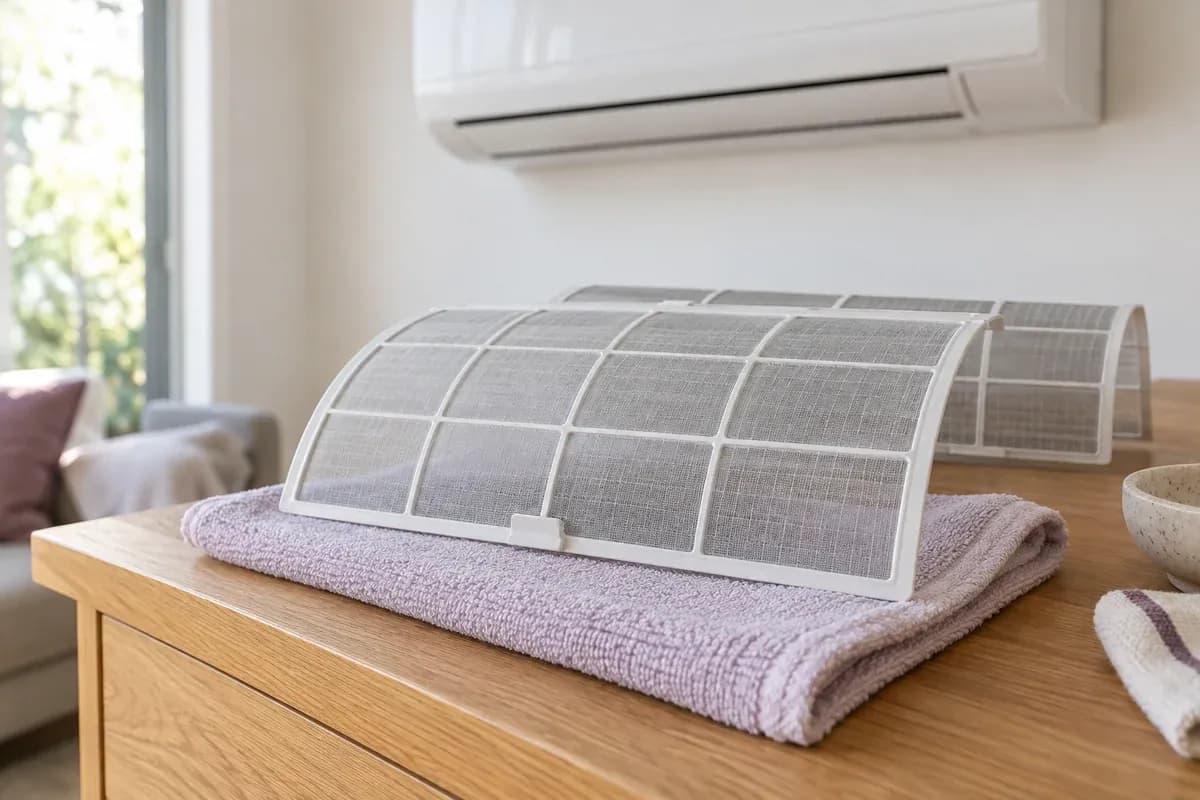
A split system can contain more than one type of filter. The large mesh screens and small deodorising or air-cleaning inserts may have different care instructions. Photograph their positions before removal, and check any part numbers against the manual.
What you have | What to check |
|---|---|
Reusable mesh dust filter | Whether vacuuming, rinsing or a diluted mild cleaner is allowed, plus the drying and refitting instructions. |
Small air-cleaning or deodorising insert | Its own washing restrictions, cleaning interval and replacement part number. Do not assume it can be treated like the mesh screen. |
Disposable or damaged filter | The correct replacement and fitting instructions. Do not wash a disposable filter or keep using torn mesh. |
One useful example is the Mitsubishi Electric MSZ-AP25–50VG(K)D2 manual (Cleaning, page En-12). It gives the main air filter a two-week cleaning interval, while the specified air-cleaning inserts have three-month cleaning and annual replacement instructions. That annual interval is not a rule to throw away every reusable mesh filter.
Clean the permitted removable filters
- Stop the air conditioner with its normal controls, then isolate the supply using the method specified for the installation. If you cannot identify that method, ask the installer or service provider.
- Open only the owner-access filter cover as shown in the manual. Support it and release the filters without forcing the clips. Keep tools and fingers away from internal metal fins and moving parts.
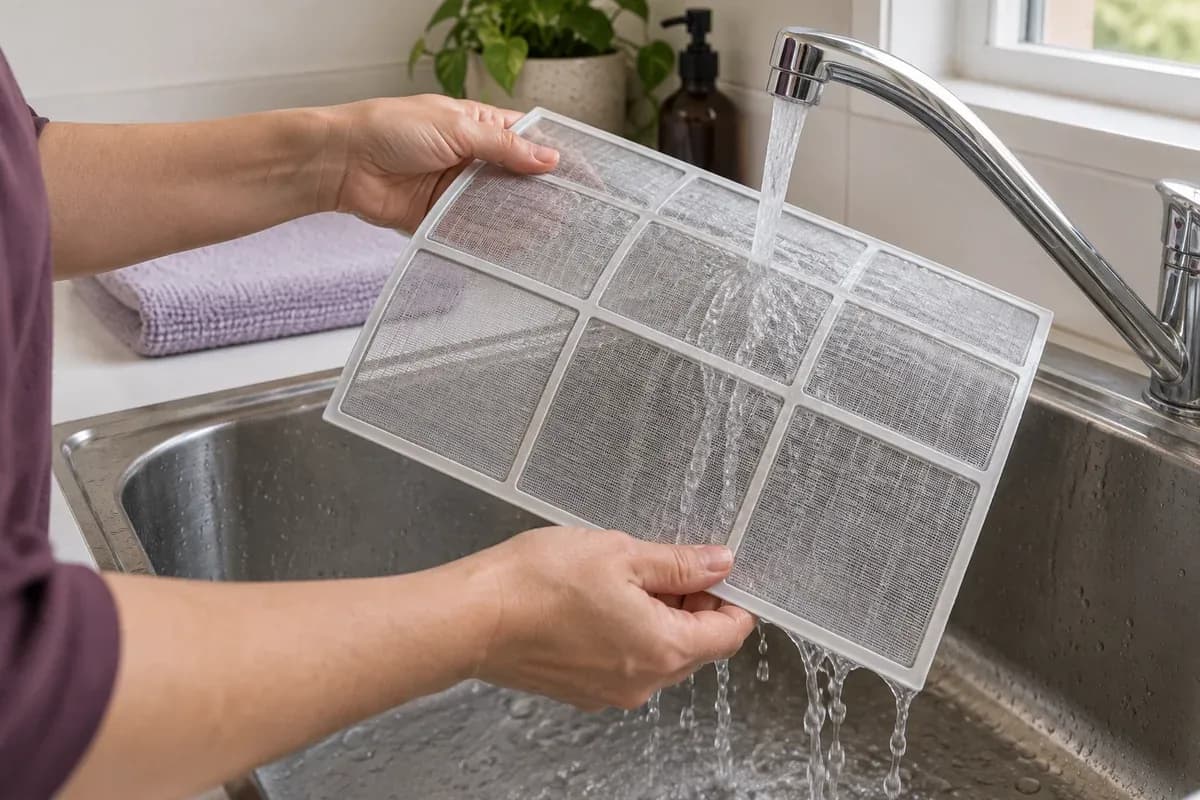
- For ordinary dust, use the permitted vacuum method gently. If washing is allowed, remove the filter from the unit first and clean it over a sink or tub, using the specified water temperature and product. Do not add bleach, disinfectant, essential oils or an improvised mixture.
- Rinse away cleaner if the instructions require it. Let the filter dry completely using the approved method; shaded air-drying is commonly specified. Do not speed it up with a heater or direct sun.
- Check for damage, refit each filter in its correct position and close the cover securely. Restore power only after the permitted cleaning is complete and everything that was washed is dry. Follow the restart instructions.
Daikin Australia’s filter-cleaning guidance allows vacuuming or washing with a diluted detergent and lukewarm water, followed by drying in shade. Use this as an example of a washable-filter procedure; your model and any additional inserts still need their own check.
Wipe the accessible casing with the cloth and method permitted by the manufacturer. Apply any allowed cleaner to the cloth rather than spraying into the unit. Do not soak a fitted panel, force motorised louvres or operate the air conditioner with its filters removed.
Keep the outdoor area clear
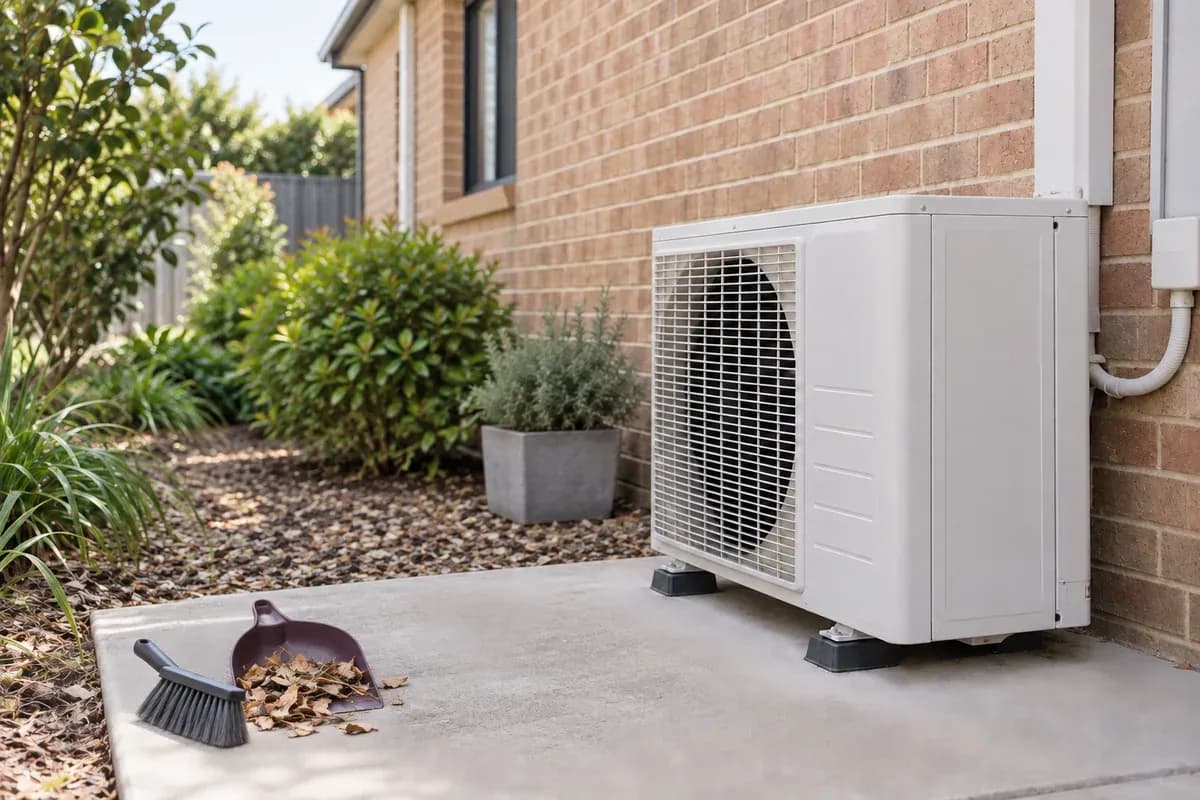
From a safe position at ground level, remove loose leaves and objects around the unit and keep plants clear of its air inlet and outlet. Sweep the surrounding ground without pushing debris through the grille. Use the installation manual’s clearances: they vary with the model, wall arrangement and neighbouring units.
Leave the casing and grille attached. Do not put a hose through the grille, reach towards the fan, straighten fins with a screwdriver or dust inside the electrical compartment. An outdoor unit is designed for outdoor conditions, but that does not make every cleaning direction or dismantling method safe. Ask the service provider to assess dirt trapped inside it, bent fins or corroded supports.
Why this guide does not include a coil-spray recipe
The Mitsubishi Electric owner’s manual warns users against washing inside the indoor unit. Cleaning chemicals can affect plastics and electrical components. A product described as a coil cleaner does not override the appliance instructions.
There are specific exceptions for authorised dry access. Mitsubishi Electric’s Quick Clean instructions describe particular vacuum attachments and limit the fan-access procedure to compatible Quick Clean Body models. They explicitly prohibit applying water to the inner workings. Follow such a procedure only when the manufacturer confirms it fits your unit and equipment; do not extend it to another split system.
For internal dirt, a blocked drain, recurring odour or suspected mould, ask for an inspection. Do not pour vinegar into the drain pan, seal a vacuum hose onto the drain or spray a generic “no-rinse” cleaner into the coils. The technician needs to identify the fault and use a compatible cleaning and drainage procedure.
“Dry” mode and internal drying are different
The DRY setting usually controls room humidity. It is not an instruction to wash the unit or a guarantee that internal parts are dry. Some models have a separate coil-drying or mould-prevention programme; use its exact name and operating instructions.
For example, Daikin’s MOLD PROOF operating instructions describe a drying operation after COOL or DRY stops and explicitly say it does not remove existing dust or mould. Its timing and conditions belong to the models covered by that manual. Do not substitute a universal 15–20 minute fan run or use a drying programme to treat existing contamination.
If mould is visible in the room as well, investigate the source of dampness using our household mould guide. Do not apply household surface-cleaning recipes inside the air conditioner.
Build a schedule around your model
Daikin Australia recommends checking and cleaning indoor filters every two weeks as a general rule, with more frequent attention in dusty conditions. Set a reminder that matches your manual and inspect sooner if dust builds up. A clean filter is one part of maintenance; it does not rule out an internal fault.
For professional servicing, General Airstage’s current guidance (formerly Fujitsu General) distinguishes light use from heavy use: generally one to two years, with annual attention for regular or heavy use and possible extra servicing in dusty or coastal environments. Follow your system’s requirements and arrange earlier help when symptoms appear.
Keep a short record: model and filter part numbers, date cleaned, date inserts were replaced, and any odour, leak or error code. For a service quote, explain the symptom and ask whether the price covers inspection, internal cleaning, drainage checks and any additional repairs. There is no reliable single price for every unit and access arrangement.
When to stop and arrange service
- Water leaking from the indoor unit, repeated breaker trips, a burning smell, abnormal noise or damaged electrical parts: stop using the system and contact the service provider. Do not repeatedly reset a tripping breaker.
- Suspected internal mould or a persistent musty smell: keep the unit off while arranging assessment. A smell alone does not identify mould or diagnose a health problem.
- Poor cooling after checking the ordinary controls, clean filters and unobstructed airflow: use the model’s troubleshooting guide, then seek service if it persists. Do not open the refrigerant circuit.
Use a provider qualified for the proposed work. The Australian Refrigeration Council requires a Refrigerant Handling Licence for activities involving a risk of regulated refrigerant emission. That is different from simply washing an owner-removable filter. Electrical repairs also need the appropriate electrical qualifications; ask the provider to confirm their scope.
Energy use: keep the advice realistic
The Australian Government’s heating-and-cooling guidance supports keeping filters and airflow clear, using the manufacturer’s maintenance guidance and arranging regular servicing. It gives a general estimate of 5–10% more energy for each extra degree of heating or cooling; this is not a promised saving from a filter wash.
Choose a comfortable setting suited to the people at home, and avoid cooling an empty room unnecessarily. Do not apply a fixed temperature or an away-setting change to every household. Cleaning will not correct an undersized system, a fault or a poorly insulated room.
Frequently asked questions
Should I replace washable filters every year?
Only if your particular filter’s instructions say so, or it needs replacement because of damage or condition. A mesh dust screen and a specialist air-cleaning insert can have different replacement schedules.
Can I restart after waiting 30 minutes?
Elapsed time alone is not the check. Washed removable parts must be dry and correctly refitted, and the manual’s restart requirements must be met. If water has entered electrical or other internal parts, leave the system off and get advice rather than waiting an arbitrary interval.
Why does it still smell after the filters are clean?
Filters are only one possible source. Dirt, drainage problems or odours absorbed from the room can also be involved. Persistent odour needs assessment; do not mask it with fragrance or keep applying stronger cleaners.
Is this included in a home clean?
Specialist air-conditioner servicing is a separate job from routine household cleaning. Arrange it with an appropriate service provider and clarify access and scope before booking. Do not assume a general cleaner will dismantle or wash the system.
Sources and correction
Manufacturer care instructions and official safety guidance are linked beside the relevant advice. The model examples illustrate why procedures differ; they do not replace your owner’s manual or report a Simply Maid equipment test.
Editorial correction, 20 September 2026: Removed DIY casing and electrical-compartment access, generic coil spraying, drain suction, hosing and fin-straightening instructions. Corrected filter replacement and service intervals, distinguished internal drying from DRY mode, and removed unsupported health-cost, price, completion-time and universal-clearance claims.
Coastal homes, such as those on the Gold Coast, can need their split systems serviced more often. If you are on the Gold Coast, you can see what a regular visit covers on our house cleaning on the Gold Coast page.
Change log
Who wrote and edited this article, when its sources were checked, and what changed.
View all historyHide earlier history
Earlier entries record what was published at the time. Later corrections take precedence.
- Edited by
- Huy Hoang
Editorial correction, 20 September 2026: Removed DIY casing and electrical-compartment access, generic coil spraying, drain suction, hosing and fin-straightening instructions. Corrected filter replacement and service intervals, distinguished internal drying from DRY mode, and removed unsupported health-cost, price, completion-time and universal-clearance claims.
Earlier updates
- Edited by
- Huy Hoang
Sources and correction
Manufacturer care instructions and official safety guidance are linked beside the relevant advice. The model examples illustrate why procedures differ; they do not replace your owner’s manual or report a Simply Maid equipment test.