Streaks form when the cleaning solution dries on the glass before you finish, and sun on hot glass is what dries it early. Clean in the shade with a few drops of dish liquid and a squeegee, and the glass dries clear.
Quick answer: Work in the shade. Add a few drops of dishwashing liquid to a bucket of lukewarm water, wet the glass with a microfibre cloth, then squeegee from the top in straight, overlapping strokes, wiping the blade after each one. Dry the edges with a lint-free cloth. Allow about 5 minutes a window, both sides. On single-glazed Low-E glass such as Viridian EnergyTech or SolTech, use a cloth on the coated inside face instead.
Which method suits your windows?
Your glass | How to tell | Method | Keep off it |
|---|---|---|---|
Plain glass (most windows) | No film edge, no coating on the paperwork | Bucket and squeegee; the vinegar spray for quick inside wipes | Blades, scourers, powder cleaners |
Tinted window film | A film edge 1–2 mm in from the frame | Soapy water with a squeegee or soft cloth; 3M says wait 30 days after fitting | Ammonia-based cleaners, scrapers, brushes, abrasive pads, paper towel |
Single-glazed Low-E glass (such as Viridian EnergyTech or SolTech) | Named on the builder's or glazier's paperwork; the coating is on the inside face | Inside face: the vinegar spray and a cloth. Outside face: bucket and squeegee | A squeegee on the coated face; alkaline or alcohol cleaners, which streak |
Double-glazed or laminated | Two panes in one sealed unit, or "laminated" on the paperwork | Either method, with the cloth well wrung near the edges. Low-E double glazing: ask your glazier which face is coated | Solution soaking into the edge seals |
Not sure | Nothing to go on | Soapy water and a cloth inside; if it streaks and there's no film, the vinegar spray | Blades, abrasives, ammonia |
Shower screens need a longer soak for soap scum and scale: see How to Clean Shower Glass (and Keep Soap Scum Off It).
How to clean windows without streaks, step by step
You'll need a bucket, dishwashing liquid, a large microfibre cloth or strip washer, a squeegee and two dry lint-free cloths.
- Pick the time. Clean on an overcast day or once the sun is off that side of the house. Viridian's glass cleaning guide warns that sun on hot glass dries the solution early and leaves streaks.
- Dust the frame, sill and track first with a dry brush or the vacuum's crevice tool, so the water doesn't turn dust into mud. Take off rings and watches, which can scratch.
- Mix the wash: a few drops of dishwashing liquid in 4–5 litres of lukewarm water.
- Wet the whole pane, working into the corners. On double-glazed or laminated glass, keep the cloth well wrung at the edges.
- Squeegee from the top. Start in a top corner and pull down in straight, overlapping strokes, wiping the blade on a dry cloth after each one. Not on the coated inside face of single-glazed Low-E glass: Viridian says the coating strips metal from the tool and leaves marks.
- Dry the edges and the bottom of the pane with a dry cloth, where the water gathers.
- Check from an angle and touch up any line with a barely damp corner of the cloth.
Done looks like: glass that's clear straight on and from the side, with no drips along the bottom. Streaks left? The solution probably dried before the squeegee reached it: wet a smaller area at a time, out of the sun, and go again.
The quick spray-and-wipe method for inside glass
For fingerprints, small panes and the coated inside face of single-glazed Low-E glass, use Viridian's mix of 1 part vinegar to 10 parts water.
Safety Never mix cleaning products. Victoria’s Better Health Channel: “Do not mix bleach with ammonia, acids or other cleaners – this can release hazardous chlorine or chloramine fumes.” Ventilate the room during and after use. Wear gloves and eye protection. Follow the label's dilution and contact time. In an emergency call 000. For poisoning advice call the Poisons Information Centre on 13 11 26 — 24 hours, anywhere in Australia.
- Mix 50 mL of white vinegar with 500 mL of water in a clean spray bottle, and mark the bottle.
- Spray the glass, and wipe any mist off timber sills and metal frames straight away.
- Wipe with a lint-free microfibre cloth and stop just before the glass is completely dry, Viridian's tip for a streak-free finish.
Keep it for window glass: acid can damage a mirror's backing, and tinted film gets soapy water.
The best way to clean windows: popular methods compared
Method | Verdict | Why |
|---|---|---|
Dishwashing liquid in lukewarm water | Works: the default | Window and film makers (Alspec, 3M, Solar Gard) name a mild detergent, and professional window cleaners use it |
Vinegar and water, 1 to 10 | Works; best on Low-E glass | Viridian's own mix. Stronger isn't better for routine cleaning |
Ammonia or alcohol-based spray cleaners | Skip on film and Low-E | Solar Gard rules out ammonia-based cleaners on tinted film; Viridian says alkaline or alcohol cleaners streak on Low-E coatings |
Newspaper or paper towel | Skip | Viridian and 3M advise against newspaper; Solar Gard says paper towel can scratch film |
Razor blade or metal scraper | Don't | Can scratch toughened glass; Viridian's warranty excludes blade damage |
Scourers, steel wool, magic eraser or bicarb paste | Don't | All abrasive; Viridian rules out abrasive materials and powder cleaners |
Vinegar and bicarb together | Don't | They neutralise each other |
How to clean window frames and sills
- Aluminium frames: Alspec's care guide says clean water and a mild, non-abrasive detergent on a soft sponge, then a fresh-water rinse; no abrasives, solvents or etching chemicals. Anodised and powder-coated finishes: How to Clean Aluminium Cookware, Frames and Furniture.
- Painted or timber frames and sills: a cloth wrung out in the same soapy water, then a dry cloth. Use a separate cloth from the one on the glass, so grit never reaches it.
- Black spots on frames and seals are usually mould fed by condensation: see How to Get Rid of Mould in Your House.
How to clean window tracks and sliding door tracks
Allow about 5–10 minutes a track.
- Loosen and vacuum the grit. Brush packed dirt out of the corners with a dry old toothbrush, then vacuum it up with the crevice tool.
- Wash the channel with the toothbrush or a cloth dipped in soapy water. For a narrow channel, wrap the cloth around a butter knife.
- Clear the drainage slots, the small openings along the outer track that let rainwater out. Alspec says to check them regularly so they stay free of grit; a pipe cleaner clears them.
- Wipe the track dry.
Done looks like: no grit in the corners, open drainage slots, and a window or door that slides without grinding.
How to clean fly screens (window screens)
Do screens before the glass. Prowler Proof's method:
- Lift the screen out and mark which window it came from with masking tape.
- Prop it outside and hose it gently. Too much pressure can stretch insect mesh or pull it loose. Metal security mesh can take a high-pressure hose from at least 30 cm, kept off the frame.
- Scrub both sides of the mesh and frame with warm soapy water and a soft brush.
- Rinse, let it dry and refit it.
Fixed screens: close the window behind them, then brush and wipe in place.
Keeping windows clean for longer
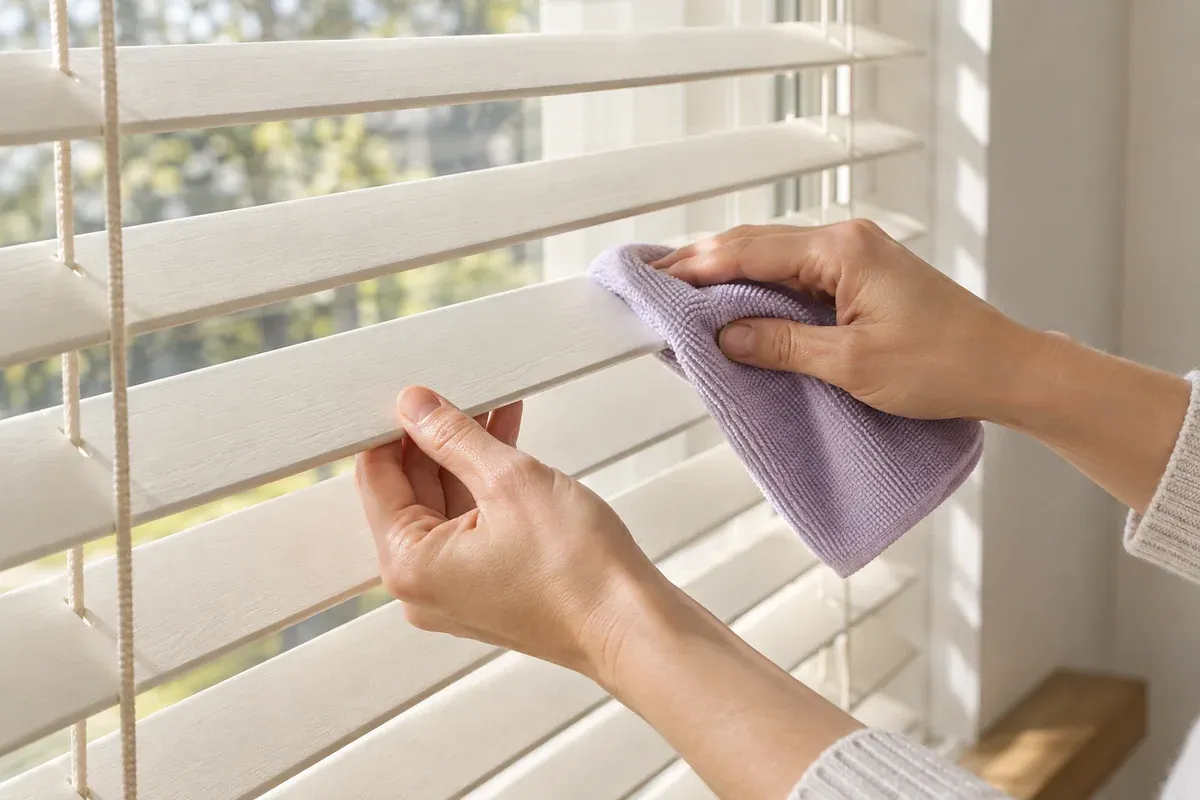
- Brush out tracks and sills during the weekly dusting, and clean blinds before the glass, not after.
- Wash aluminium frames at least every 3 months, monthly near the coast (Alspec); glass in sea spray needs more frequent cleaning too (Viridian).
Outside windows, ladders and second storeys
Use the bucket method on outside glass you can reach from the ground. Ladders are the risk: over 5,600 Australians were admitted to hospital after ladder falls in 2017–18, and 36 died in 2020 (Better Health Channel). On a step ladder at a ground-floor window:
- Set it on dry, firm, level ground, never in front of a window or door that opens outwards.
- Climb no higher than the second step from the top, and keep one hand on the ladder.
- Have someone else home, and skip wet, windy or hot days.
Second-storey windows, glass above a balcony edge or a drop, and anything you'd lean out to reach are a job for a professional window cleaner with height equipment. Fogging between double-glazed panes (a failed seal) and cracked or etched glass need a glazier.
Simply Maid doesn't clean exterior windows. Interior windows are a bookable extra on a standard or deep clean (glass, frames and sills, from inside); a deep clean includes window sills and tracks, and end of lease cleaning includes all interior window glass, tracks and frames.
Frequently asked questions
How do you get hard water spots off windows?
White sprinkler or bore-water spots are limescale. On plain glass (not tinted film), wipe on equal parts white vinegar and warm water, keep it wet 10–15 minutes, then rinse and squeegee. More in Hard Water in Australia: Signs and Limescale.
How do you get paint or sticker residue off window glass?
Not with a blade, which damages glass (Viridian). Soak sticker residue with warm soapy water and roll it off with a fingertip; for paint, use a remover sold as safe on glass, kept off the frame. On tinted film, ask the installer first.
Last reviewed 6 October 2026 · Update history
Sources & References
- Viridian, Glass Cleaning Guide (PDF, 2024): the 1:10 mix; sun, newspaper, blades, Low-E coatings, edge seals.
- 3M, Care and Cleaning Instructions for 3M Window Films (PDF, January 2022): soapy water and a squeegee; no scrapers; 30 days before washing.
- Solar Gard Australia, Window film care guide: no ammonia cleaners or paper towel on film.
- Alspec, Care and Maintenance (PDF, 2024): frames, intervals, drainage slots.
- Prowler Proof, How to clean your security and flyscreens (April 2020): cleaning screens.
- Better Health Channel (Victoria), Ladder safety: ladder-fall figures and safe use.
- ABC News, What are the best ways to clean your windows? (21 November 2024): what professional cleaners use.
Related Reading
Change log
Who wrote and edited this article, when its sources were checked, and what changed.