If your laundry room has become that room you rush in and out of — tossing clothes into the machine, grabbing detergent, and closing the door behind you — you're not alone. It's one of the hardest-working rooms in the house, yet somehow the last one to get a proper clean.
Quick Answer: To deep clean your laundry room, work from top to bottom: dust all surfaces, clean behind and under your washer and dryer, scrub countertops and the sink, wipe out cabinets, and finish by mopping the floor. Allow roughly 60–80 minutes, or tackle it in two shorter sessions.
Why Your Laundry Room Needs a Deep Clean
The laundry is more than a room that gets dusty. It's a warm, damp space where mould, lint, and bacteria quietly build up.
NSW Health warns that inhaling mould spores can cause runny nose, eye irritation, wheezing, and can trigger asthma attacks — especially concerning if young children are in the home. Mould spores are microscopic, so by the time you see visible growth, the problem has been developing for a while.
Then there's lint. QBE Australia's research found that 61% of Australians don't clean their dryer lint filters regularly, and 28% sometimes leave the dryer running when they go out. Lint is combustible, and a blocked filter or duct makes a dryer overheat — Fisher & Paykel's user guide calls accumulated lint a fire hazard, and the lint filter is on every fire service's home safety checklist.
A regular deep clean tackles both problems. Here's how to do it, step by step.
What You'll Need
- Microfibre cloths (3–4)
- Spray bottle
- White vinegar
- Liquid dish soap
- Multipurpose cleaner
- Scrubbing brush or sponge
- Vacuum with crevice attachment
- Mop and bucket
- Old towels or rags
- P2/N95 mask (if you spot mould)
- Rubber gloves
Most of these are available at Bunnings, Coles, or Woolworths for just a few dollars.
How to Deep Clean Your Laundry Room
Step 1: Declutter First (5 Minutes)
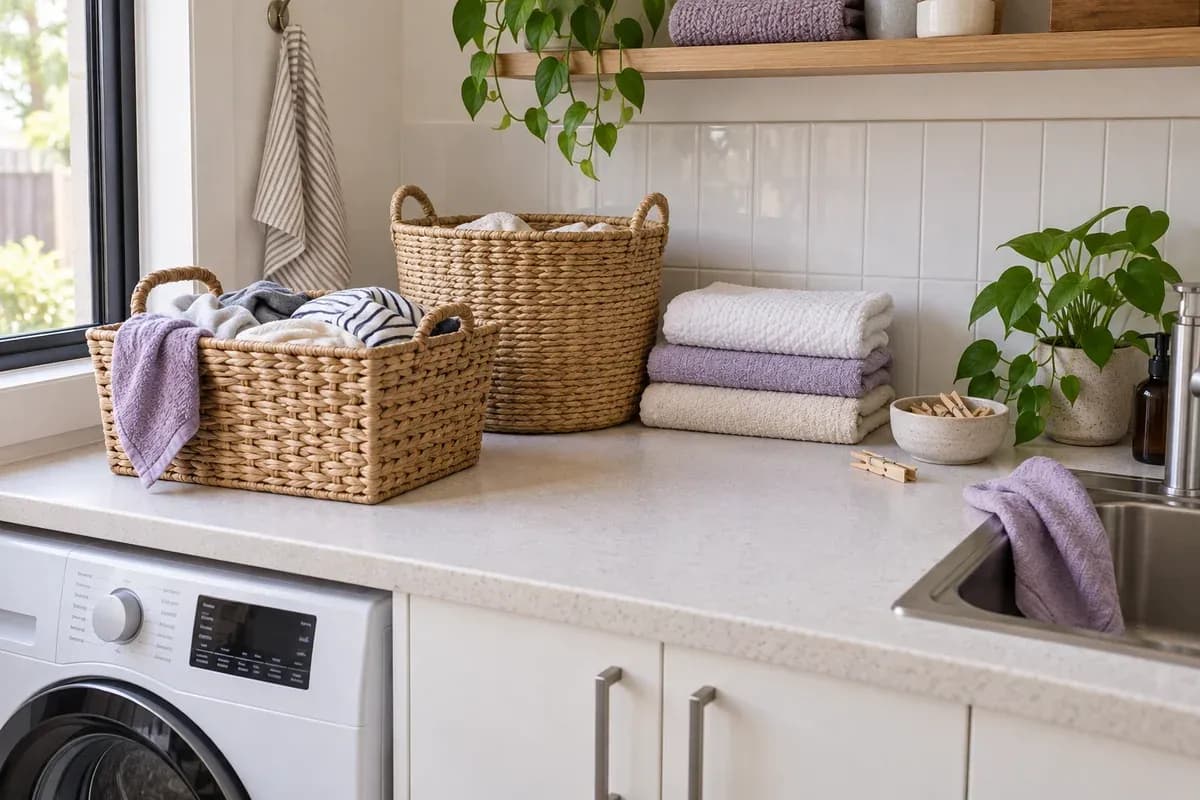
Before you clean anything, clear the decks. Remove everything from countertops, shelves, and the tops of your machines. Check expiry dates on detergents and stain removers — toss anything old or empty.
This is also a good time to round up stray socks, misplaced pegs, and that collection of coins from trouser pockets.
Step 2: Dust From Top to Bottom (10 Minutes)
Laundry rooms collect more dust than you'd expect. Fine fibres shed from clothing and towels during washing and drying, mixing with regular household dust to coat every surface.
Start at the ceiling and work down:
- Ceiling and ceiling corners
- Exhaust fan (if fitted)
- Cabinet tops and shelves
- Light fittings
- Washer and dryer exteriors
- Countertops
- Window frames and sills
- Skirting boards
A microfibre duster with an extendable handle makes this faster. One pass usually picks up everything.
Step 3: Clean Behind and Under Your Appliances (10 Minutes)
Clean only safely accessible areas around the washer and dryer. Do not pull a heavy or connected appliance by its hoses or cables. If the space behind needs access, follow the manufacturer’s moving instructions and arrange suitable help.
You'll likely find clumps of lint, dust, lost items, and possibly mould growing on the wall or machine backs.
⚠️ Safety note: NSW Health's mould fact sheet gives the routine method for mouldy surfaces as mild detergent or diluted vinegar (4 parts vinegar to 1 part water); for mould that won't shift it suggests diluted bleach (250 ml in 4 litres of water) with gloves, safety glasses and good ventilation, and it says absorbent materials such as carpet may need professional cleaning or replacement. Never use bleach and vinegar on the same surface without rinsing in between.
- Absorb any dampness with old towels.
- Vacuum the walls, backs of appliances, floor, and corners using the crevice attachment.
- Wipe all surfaces with a damp cloth and multipurpose cleaner.
- Let the area dry fully before pushing machines back.
Step 4: Deep Clean Your Washing Machine (5 Minutes Active + Cycle Time)
Your machine can harbour mould in the rubber door seal, detergent drawer, and drum — and that musty smell transfers directly to your clothes.
Ashley Iredale, CHOICE's laundry expert, put it this way in 2022: "You should always leave the door or lid of your washing machine open so it can air out after a wash. Closing the door traps moisture in the seals and can lead to mould and mildew forming."
To clean your machine:
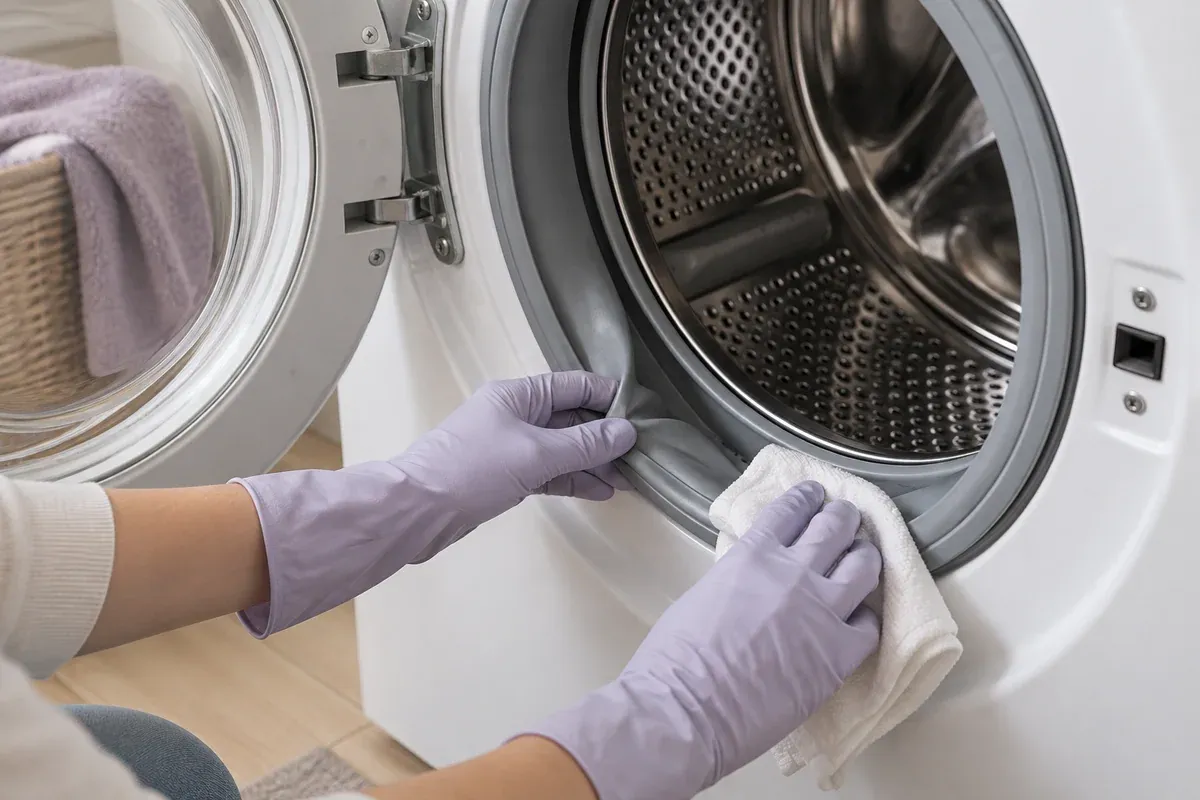
- Release the dispenser drawer the way your manual shows (auto-dosing models have a release lever and separate compartments), rinse it under warm water with a soft brush — Miele suggests hot water and dishwashing liquid — brush out the recess, dry it and refit it.
- Wipe the rubber door seal with a damp cloth — check the folds where moisture and lint hide.
- Run the empty maintenance cycle your manual names — Drum Clean, Tub Clean, Machine Clean or, on some brands, a hot Cottons wash — with the product it specifies: a washing-machine cleaner, an anti-limescale powder, or nothing at all. Don't add vinegar. Bosch says it damages the rubber parts, Samsung says to add no cleaning agent of any kind to Drum Clean, and Fisher & Paykel, LG, Electrolux, Westinghouse and Miele each name their own cycle and product. Our washing machine guide lists them brand by brand.
- Wipe down the exterior with a damp cloth.
Step 5: Clean Your Dryer and Lint System (10 Minutes)

Cool and isolate the appliance as instructed. Do not assume filters can be washed or that internal components are safe to access.
Read the illustration as text
- User-accessible filter
- Remove lint using the method specified for that dryer.
- Duct or heat exchanger
- Follow the separate maintenance instructions for the actual dryer type.
- Inside the appliance
- Internal lint, faults or uncertain access need service support.
Vented, condenser and heat-pump dryers have different maintenance.
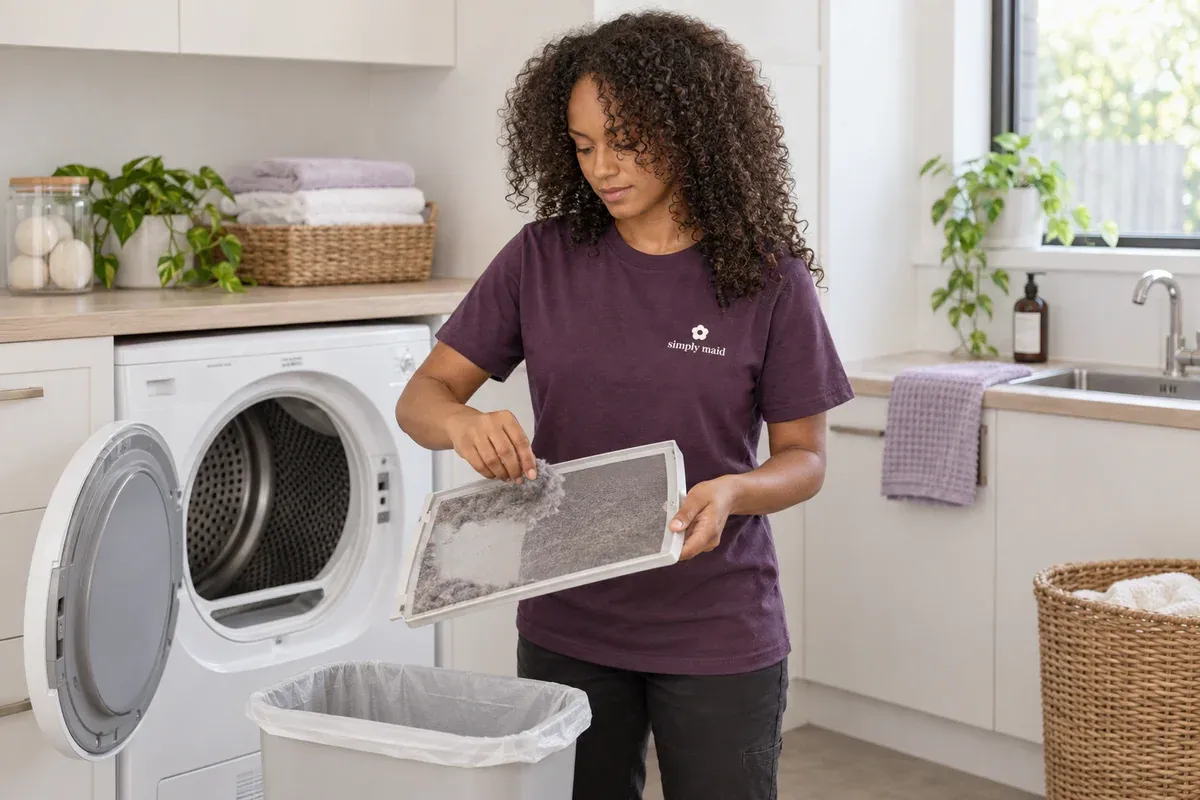
Start with the lint filter — pull it out and clear the lint by hand before or after every load (a vacuum helps with fine lint). Only rinse the screen in water if your dryer's manual says so; Electrolux's heat-pump dryer manual says to avoid water on the filter. A clogged filter forces the dryer to work harder and increases the risk of overheating.
If your dryer is ducted outside, follow the manual for the duct: Fisher & Paykel says exhaust ducting should be inspected and cleaned periodically, and that lint inside the dryer itself is a job for a service technician. Condenser and heat-pump dryers have no vent hose — vacuum their airflow slots and clean the heat exchanger or condenser as the manual describes.
Wipe down the drum interior with a damp cloth and clean the exterior.
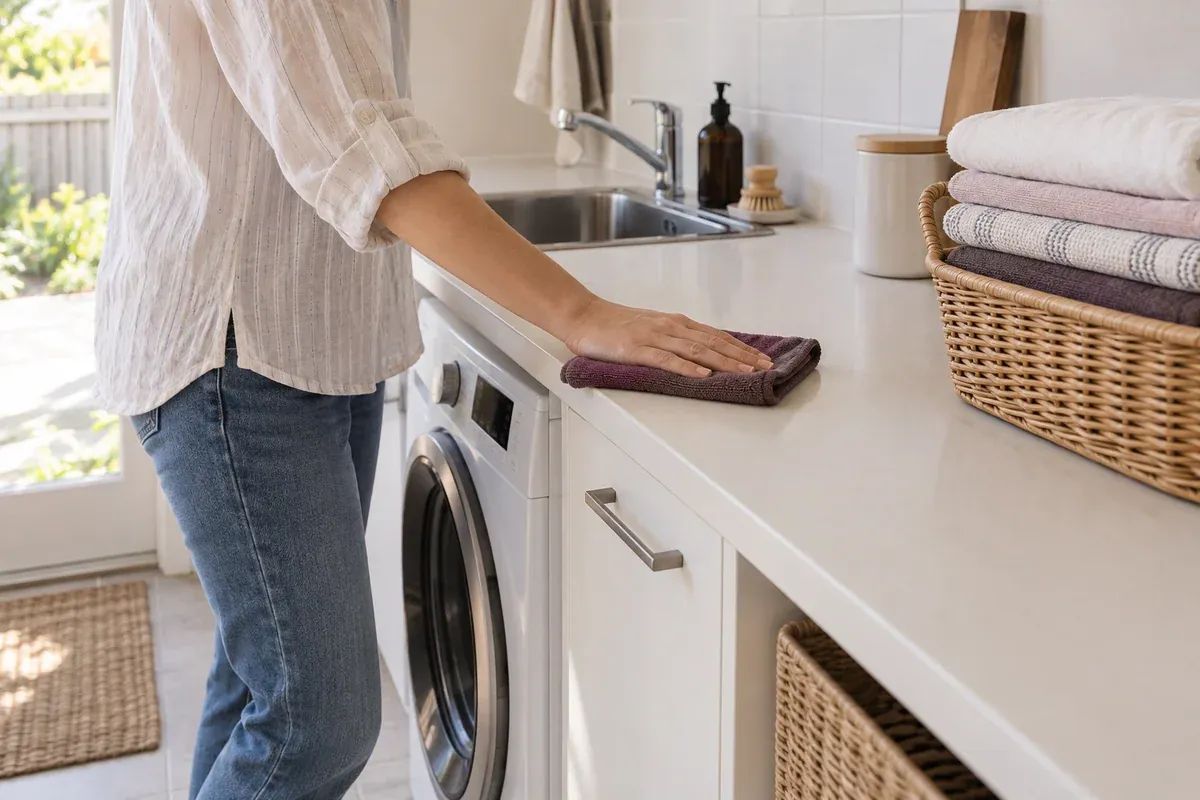
Step 6: Scrub Countertops and Surfaces (10 Minutes)
Detergent drips harden on countertops and attract dust and grime. The longer they sit, the tougher they are to remove.
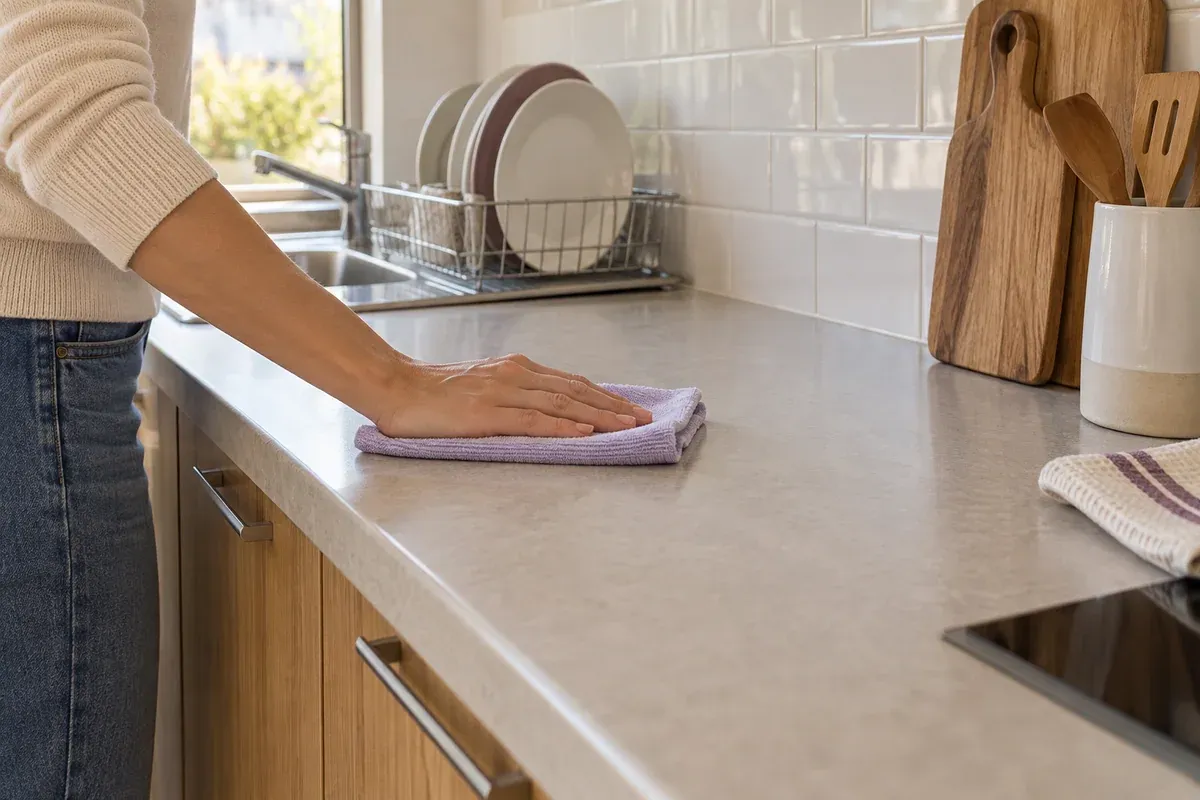
Make a cleaning spray for laminate or tiled benches: mix two parts warm water, one part white vinegar, and a few drops of dishwashing liquid in a spray bottle and shake well. Spray, let it sit for two minutes, then wipe with a damp cloth. Not on stone: acids can dull or etch marble, limestone and travertine, and stone suppliers advise a neutral cleaner or mild dishwashing liquid on granite too.
Note: Vinegar is a mild acid that cuts soap scum and mineral deposits. It's a cleaner, not a disinfectant — it isn't tested or approved to kill germs. If you need a surface disinfected, use a product labelled for that purpose and follow its contact time.
Safety Never mix cleaning products. Victoria’s Better Health Channel: “Do not mix bleach with ammonia, acids or other cleaners – this can release hazardous chlorine or chloramine fumes.” Ventilate the room during and after use. Wear gloves and eye protection. Follow the label's dilution and contact time. In an emergency call 000. For poisoning advice call the Poisons Information Centre on 13 11 26 — 24 hours, anywhere in Australia.
Step 7: Clean Inside Cabinets (10 Minutes)
Laundry room cabinets are easy to forget. You wipe the fronts but rarely open them up for a proper clean.
In a room that generates heat and humidity, enclosed cabinets are prime spots for mould growth. Damp, still air is what mould needs; NSW Health lists running the exhaust fan when doing laundry and drying clothes among its prevention steps.
- Remove everything from each cabinet.
- Discard expired products and empty containers.
- Wipe interiors with multipurpose cleaner.
- Replace shelf liners if they're stained or peeling.
- Return items neatly — leave some space for airflow.
Step 8: Tackle the Sink and Taps (5 Minutes)
If your laundry has a sink, it's probably seen its share of soaking, rinsing, and pre-treating. Spray the basin with your vinegar cleaning spray or multipurpose cleaner, let it sit for a minute, then scrub with a sponge and rinse.
Don't forget the taps and any other fittings — a quick wipe with soapy water and a soft cloth keeps them looking fresh.
Step 9: Wash the Windows (5 Minutes)
If your laundry room has a window, start by vacuuming the tracks to remove built-up dust and debris. Then clean the glass with your preferred glass cleaner or a simple mix of equal parts water and vinegar.
Wipe the handles and frame as well. Clean windows let in more light and make the whole room feel brighter.
Step 10: Vacuum and Mop the Floor (10 Minutes)
The final step. By now, dust and debris have settled on the floor from all the cleaning above.
- Vacuum thoroughly, paying close attention to corners and behind baskets or trolleys.
- Spot-treat any stubborn stains with warm water and floor cleaner. Warm water helps break down dried spills more effectively than cold. (Avoid very hot water on vinyl or laminate — it can cause warping.)
- Mop the entire floor and open a window or turn on the exhaust fan to help it dry quickly.
Short on Time? Try the 5-Minute Reset
Some days, 80 minutes just isn't happening. If you only have a few minutes, focus on these three things:
- Clear the lint filter — takes 30 seconds and reduces fire risk.
- Wipe benchtops and the machine tops — removes detergent residue before it hardens.
- Leave the washing machine door or lid ajar so the drum can dry — but only where children and pets can't climb in.
Even this small reset makes a noticeable difference. You can tackle the deeper jobs when time allows — or leave the full deep clean to the professionals.
How to Keep Your Laundry Room Fresh Between Deep Cleans
A few simple habits prevent the worst buildup:
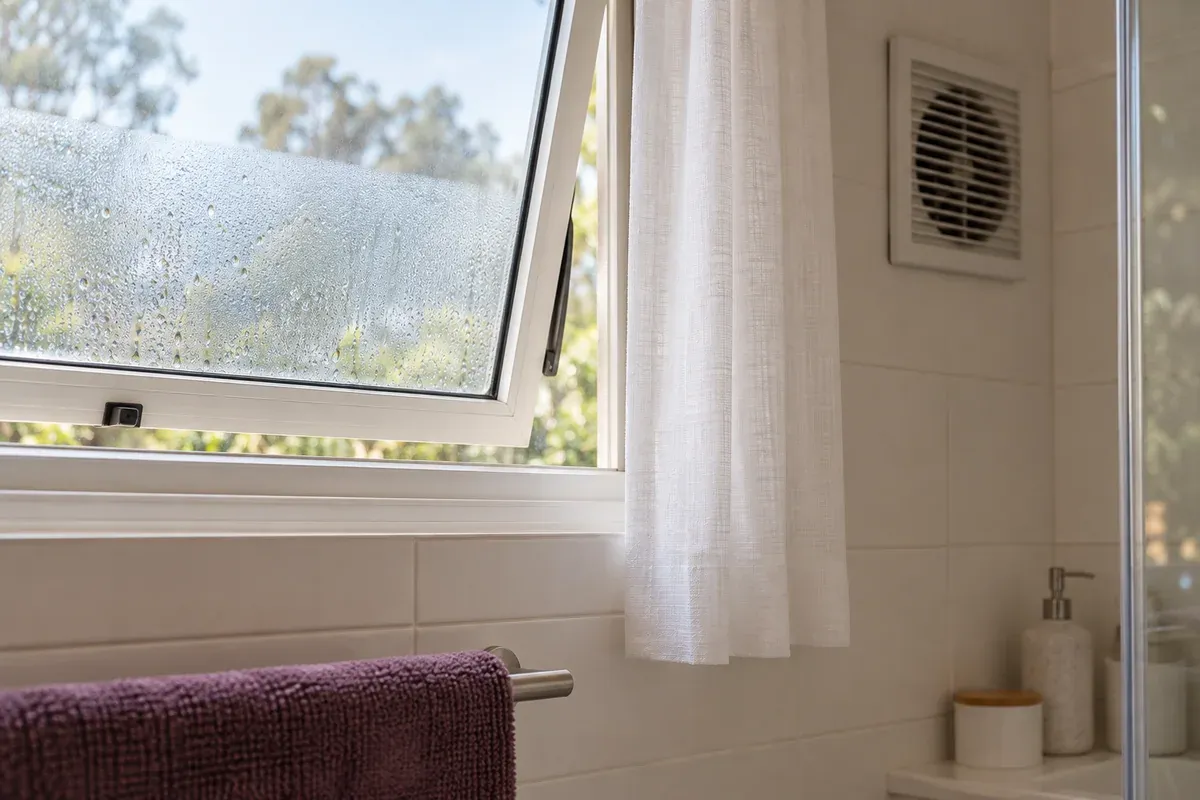
- Run the exhaust fan while you wash and dry and for a while afterwards, and open a window when the weather allows — NSW Health lists both as ways to reduce the dampness mould needs.
- Wipe the rubber door seal after each wash. Moisture and lint sit in the lower fold, and manufacturers name that as a common source of mould and odour.
- Empty the lint filter after every dryer load. No exceptions.
- Keep cabinet doors slightly ajar to allow airflow, especially in winter when rooms are less ventilated.
- Store opened detergent bottles upright on a small tray to catch drips before they harden.
Frequently Asked Questions
Q: How often should you deep clean a laundry room?
A light clean — wiping surfaces, emptying lint — should happen weekly. A full deep clean including behind appliances, inside cabinets, and floors is best done every one to two months, or more often if your laundry room lacks good ventilation.
Q: Can mould in the laundry room make my family sick?
Yes. NSW Health confirms that mould exposure can cause respiratory symptoms including runny nose, wheezing, and eye irritation. People with asthma or allergies are especially sensitive. Children and those with weakened immune systems are at higher risk.
Q: Can dryer lint actually start a fire?
Yes. Lint is combustible, and build-up in the filter or the exhaust duct restricts airflow and makes the dryer overheat. Clean the filter after every load, and have the duct inspected and cleaned as your dryer's manual describes.
Q: Can I use vinegar to clean everything in my laundry room?
Vinegar works well as a general cleaner on most non-porous surfaces, but it's not a true disinfectant. Avoid using it on natural stone (it can etch marble and granite), and check your washing machine manual — some manufacturers advise against it. For heavy mould or bacteria, use a product specifically labelled as a disinfectant.
Q: Is it worth deep cleaning my laundry room if I'm going to hire a professional cleaner?
A deep clean covers the laundry as part of the whole home, and you can add Inside Cabinets & Drawers as an extra. Check the current inclusions on the deep cleaning page — moving appliances to clean behind them isn't part of a standard visit.
Correction, 22 September 2026: the two-cup vinegar hot cycle was replaced with the maintenance cycle and product each machine maker names, because Bosch, Samsung, Fisher & Paykel, LG, Electrolux, Westinghouse and Miele all exclude vinegar or say to add nothing. The QBE statistic, the NSW Health mould note, the dryer filter and vent steps, the CHOICE attribution and the humidity figures were corrected against their sources.
Related Reading
- 10 Types of Stains You Can Get Out From Clothes
- A Comprehensive Guide to Mould Removal
- Green Cleaning 101: How to Make and Use Natural Cleaning Solutions
- A Systematic Way to Clean Your Kitchen
- Easy, Effective and Everlasting Cleaning Habits for the Whole Family
Sources & References
- NSW Health — Mould. Health effects of mould, the routine and stubborn-mould methods, ventilation.
- Better Health Channel (Victorian Department of Health), Mould removal at home: the never-mix warning in the Safety box.
- CHOICE — Things CHOICE's laundry expert would never do. Ashley Iredale on leaving the door or lid open after a wash.
- QBE Australia — Fire safety at home: your room by room guide (November 2024). 61% of Australians don't clean lint filters regularly; 28% sometimes leave the dryer running when out.
- Bosch Home Appliances Australia — Cleaning the washing machine with vinegar. Bosch advises against vinegar because it damages the machine's rubber parts.
- Samsung Australia — Cleaning the door and drum. Drum Clean with no cleaning agents or detergents.
- Fisher & Paykel — WL top loader user guide and WH front loader user guide. DRUM CLEAN with a commercial washing-machine cleaner; door left open only where children and pets are safe; lint as a fire hazard.
- LG Australia — Washing machine cleaning and maintenance guide. Monthly Tub Clean with anti-limescale powder or tablet; wipe the seal after each wash.
- Electrolux Australia — How to clean and maintain your washer. Monthly maintenance wash on Cottons 90 °C or Machine Clean; drawer and drain-pump filter every two months.
- Miele Australia — Hygiene info indicator. Cottons 90 °C with Miele machine cleaner or a multi-purpose detergent.
- Electrolux — EDH803CEWA tumble dryer user manual. Clean the lint filter by hand or with a vacuum; avoid water on the filter.
- Fisher & Paykel — Vented clothes dryer user guide. Periodic inspection and cleaning of exhaust ducting; internal lint removal by a trained technician.
- Natural Stone Institute — Care and cleaning of natural stone. Acids may dull or etch calcareous stone; use a neutral cleaner or mild dishwashing detergent.
- Zinn & Bockmühl (2020), BMC Microbiology — Did granny know best? Evaluating the antibacterial, antifungal and antiviral efficacy of acetic acid for home care procedures. Household-strength vinegar is not a disinfectant; the disinfecting effect reported needed 10% acetic acid with added citric acid.
Change log
Who wrote and edited this article, when its sources were checked, and what changed.
Current version
What changed
Correction, 22 September 2026: the two-cup vinegar hot cycle was replaced with the maintenance cycle and product each machine maker names, because Bosch, Samsung, Fisher & Paykel, LG, Electrolux, Westinghouse and Miele all exclude vinegar or say to add nothing. The QBE statistic, the NSW Health mould note, the dryer filter and vent steps, the CHOICE attribution and the humidity figures were corrected against their sources.