
Simply Maid research
Housework and domestic labour in Australia
How much housework do Australians do, and what counts as domestic labour? This guide explains unpaid household tasks using ABS 2024 Time Use Survey results and a separate Census 2021 snapshot. The sources measure different activities and periods; neither describes Simply Maid bookings.
A quick reference
Key findings
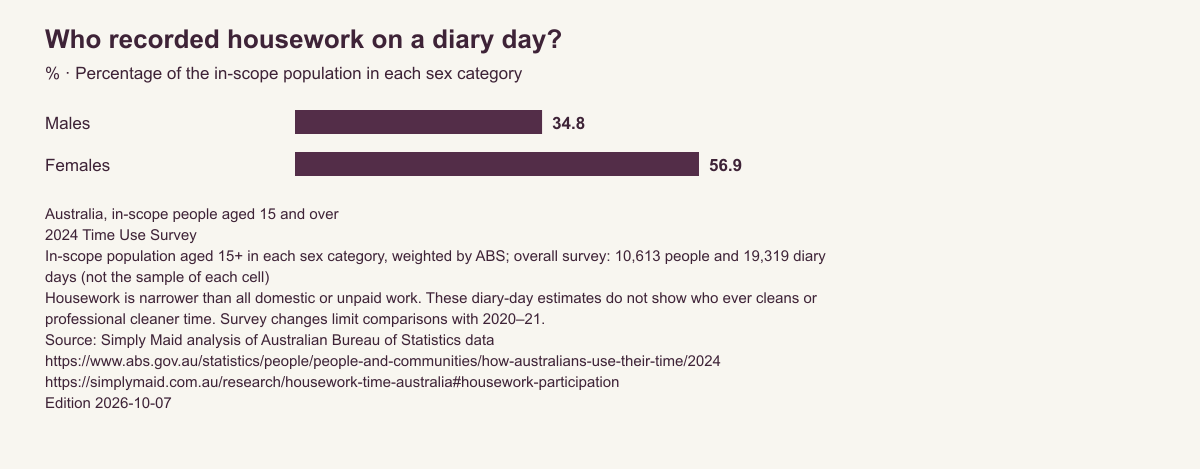
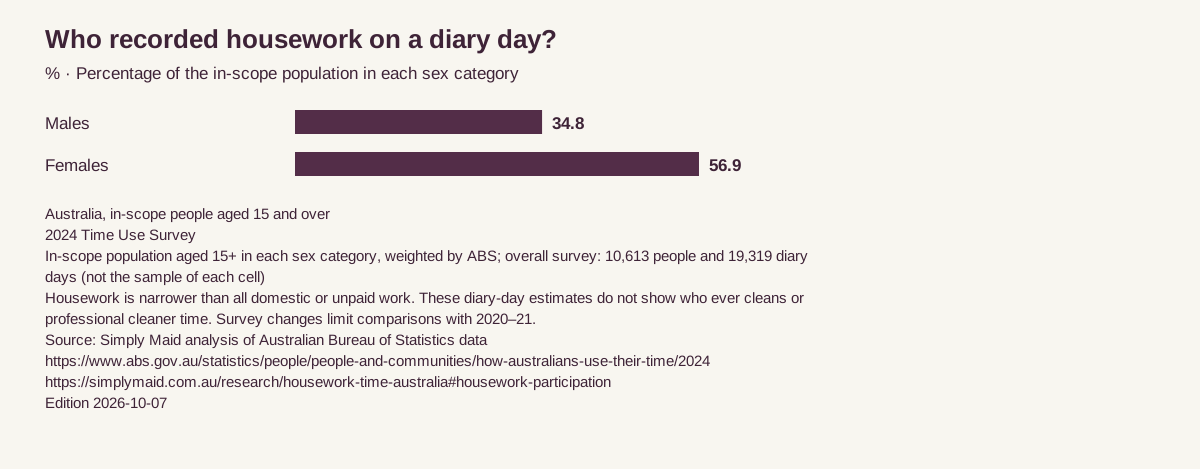
In the ABS 2024 survey, 34.8% of males and 56.9% of females aged 15+ in Australia recorded housework on a diary day; these are weighted population estimates, not household subscription rates.
View supporting tableAustralia, in-scope people aged 15 and over · 2024 Time Use Survey. In-scope population aged 15+ in each sex category, weighted by ABS; overall survey: 10,613 people and 19,319 diary days (not the sample of each cell).
Housework is narrower than all domestic or unpaid work. These diary-day estimates do not show who ever cleans or professional cleaner time. Survey changes limit comparisons with 2020–21.
Original source: Australian Bureau of Statistics — How Australians use their time, 2024 — domestic activities tables. Calculation and limitations.
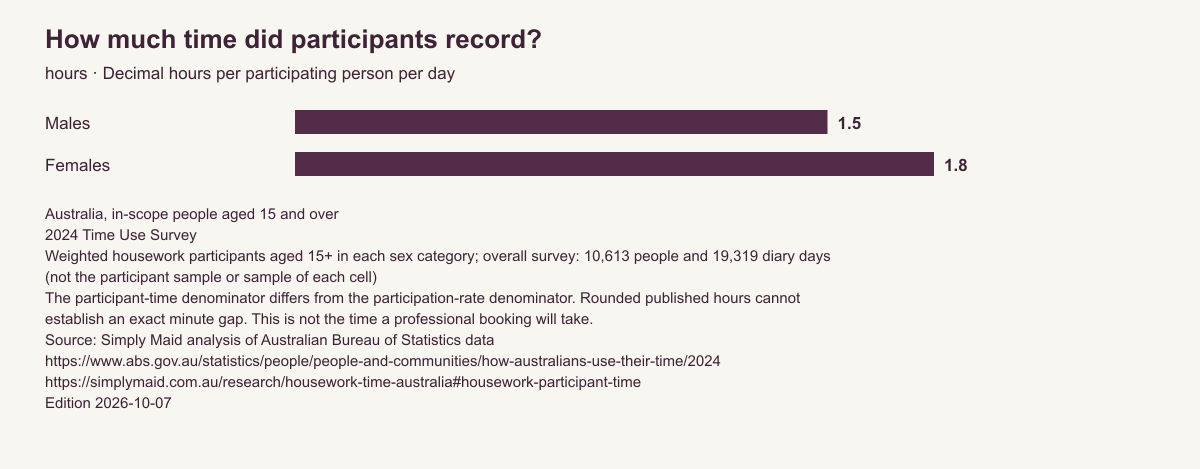
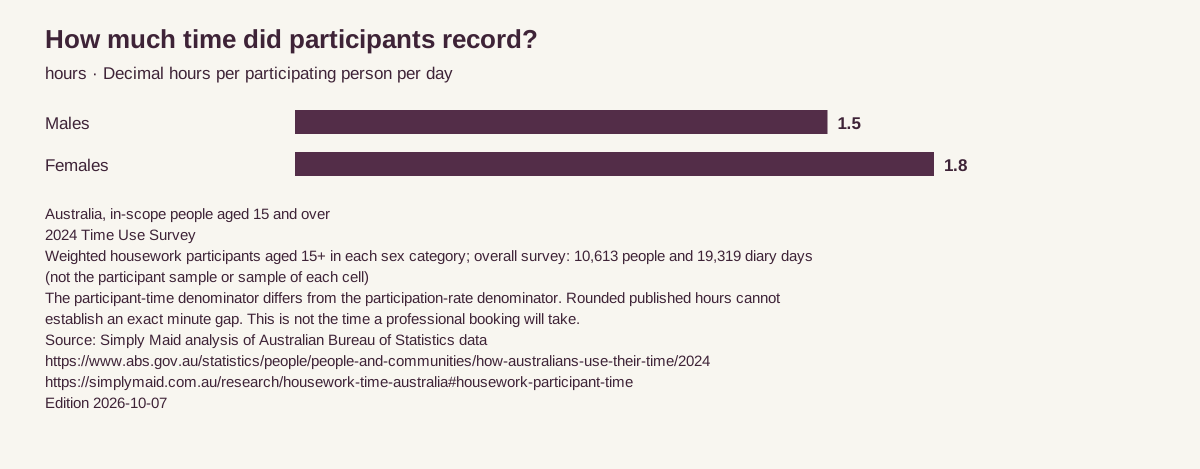
Among ABS 2024 housework participants aged 15+ in Australia, males averaged 1.5 hours and females 1.8 hours on a diary day. People recording no housework that day are outside these time averages.
View supporting tableAustralia, in-scope people aged 15 and over · 2024 Time Use Survey. Weighted housework participants aged 15+ in each sex category; overall survey: 10,613 people and 19,319 diary days (not the participant sample or sample of each cell).
The participant-time denominator differs from the participation-rate denominator. Rounded published hours cannot establish an exact minute gap. This is not the time a professional booking will take.
Original source: Australian Bureau of Statistics — How Australians use their time, 2024 — domestic activities tables. Calculation and limitations.
What is domestic labour?
Domestic labour is the work involved in running a home. In this guide, we use it to describe unpaid household tasks, including cleaning, cooking, laundry, shopping and household administration. We identify the ABS measure behind each statistic because these tasks are not grouped identically in every dataset.
In the 2024 Time Use Survey, housework is one category within the broader group of domestic activities. Cooking, shopping and gardening have separate categories. Childcare, caring for adults and volunteering are other forms of unpaid work; they are not included in the housework figures below. See the ABS activity definitions and results.
The Census measure of unpaid domestic work is broader than cleaning. It includes meal preparation, laundry, gardening, maintenance, shopping and managing household finances. Direct care for children or adults is measured separately, although cooking or cleaning for them counts as domestic work. Read the Census 2021 definition.
Who recorded housework on a diary day?
| ABS sex category | Housework participation (%) |
|---|---|
| Males | 34.8 |
| Females | 56.9 |
Australia, in-scope people aged 15 and over · 2024 Time Use Survey. In-scope population aged 15+ in each sex category, weighted by ABS; overall survey: 10,613 people and 19,319 diary days (not the sample of each cell).
Housework is narrower than all domestic or unpaid work. These diary-day estimates do not show who ever cleans or professional cleaner time. Survey changes limit comparisons with 2020–21.
Original source: Australian Bureau of Statistics — How Australians use their time, 2024 — domestic activities tables. Calculation and limitations.
How this table was made
- Calculation
- Transcribe the Housework row from ABS ‘Participation in domestic activities by sex’. Participation requires at least five minutes on that diary day. The difference is 56.9 − 34.8 = 22.1 percentage points; no causal or statistical-significance claim.
- Unit and denominator
- Percentage of the in-scope population in each sex category. In-scope population aged 15+ in each sex category, weighted by ABS; overall survey: 10,613 people and 19,319 diary days (not the sample of each cell)
- Missing fields
- Published aggregates only; subgroup raw sample counts unavailable in the displayed source tables.
- Weighting
- ABS person and diary-day weights, calibrated to the in-scope population; no Simply Maid reweighting.
- Exclusions
- ABS scope excludes non-private dwellings, very remote areas and discrete Aboriginal and Torres Strait Islander communities. Only the main activity was collected.
- Disclosure threshold
- Use ABS published national aggregates and reliability guidance; no Simply Maid microdata or small-cell estimates.
- Data cutoff
- 2024 survey; source checked 7 October 2026
- Edition
- 2026-10-07
How much time did participants record?
| ABS sex category | Mean housework hours per day (participants) | Approximate minutes from rounded hours |
|---|---|---|
| Males | 1.5 | 90 |
| Females | 1.8 | 108 |
Australia, in-scope people aged 15 and over · 2024 Time Use Survey. Weighted housework participants aged 15+ in each sex category; overall survey: 10,613 people and 19,319 diary days (not the participant sample or sample of each cell).
The participant-time denominator differs from the participation-rate denominator. Rounded published hours cannot establish an exact minute gap. This is not the time a professional booking will take.
Original source: Australian Bureau of Statistics — How Australians use their time, 2024 — domestic activities tables. Calculation and limitations.
How this table was made
- Calculation
- Transcribe the Housework row from ABS ‘Average time spent per day by domestic activity and sex’. Multiply its rounded decimal hours by 60 for approximate minutes (1.8 hours is about 108 minutes, not 1 hour 80 minutes).
- Unit and denominator
- Decimal hours per participating person per day. Weighted housework participants aged 15+ in each sex category; overall survey: 10,613 people and 19,319 diary days (not the participant sample or sample of each cell)
- Missing fields
- Published aggregates only; subgroup raw sample counts unavailable in the displayed source tables.
- Weighting
- ABS person and diary-day weights, calibrated to the in-scope population; no Simply Maid reweighting.
- Exclusions
- ABS scope excludes non-private dwellings, very remote areas and discrete Aboriginal and Torres Strait Islander communities. Only the main activity was collected.
- Disclosure threshold
- Use ABS published national aggregates and reliability guidance; no Simply Maid microdata or small-cell estimates.
- Data cutoff
- 2024 survey; source checked 7 October 2026
- Edition
- 2026-10-07
Two denominators, two questions
Participation uses the in-scope population as its denominator. Participant time includes people who recorded the activity that day. Applying a participant mean to every Australian would overstate the population’s daily time. Adding activity participation percentages also double-counts people who did more than one activity.
The 22.1-percentage-point participation difference is a descriptive subtraction, not a claim about motivation or equal circumstances. The rounded time values differ by about 18 minutes; they cannot support an exact minute estimate. Neither table measures the prevalence of people who ever do housework.
Cooking is a separate domestic activity in these ABS tables. Caring and volunteering sit elsewhere in unpaid work. An all-unpaid-work headline cannot be relabelled as house cleaning time. No comparison with paid cleaner labour is implied.
Unpaid domestic work in Australia: Census 2021
In Census 2021, 14,077,657 people aged 15 and over (67.7%) reported unpaid domestic work in the week before Census Night. The national hour bands were:
Less than 5 hours: 4,117,135 people (19.8%).
5–14 hours: 5,663,904 people (27.3%).
15–29 hours: 2,511,024 people (12.1%).
30 hours or more: 1,785,591 people (8.6%).
Source: ABS Census 2021 Australia QuickStats. Percentages use all people aged 15 and over, including those reporting no hours or not stating their hours. These four bands therefore do not total 100%; published counts and percentages are also subject to rounding and Census confidentiality adjustments.
These weekly, self-reported Census 2021 bands are not comparable with the 2024 diary-day housework figures as a time trend. The open-ended 30+ band cannot establish an exact average. They describe unpaid household work, not professional cleaning duration or Simply Maid customers.
Scope and method
ABS collected diary data in two 2024 windows: 22 July–3 September and 16 September–29 October. Its achieved sample was 10,613 people providing 19,319 diary days from 6,899 households. These overall totals are not the sample size of each displayed subgroup. ABS weights the records to the in-scope population aged 15+.
This is Simply Maid’s explanation of published ABS aggregates; ABS owns the source research. Tables transcribe the Housework rows; minutes are calculated from rounded decimal hours. We do not hold the survey microdata, test significance or infer causes. The survey changed between 2020–21 and 2024, so we do not join them into a trend.
ABS source tables · ABS definitions, scope and reliability. Sources checked and this explanatory edition published: 7 October 2026. Observation year: 2024. Prepared as AI-assisted Simply Maid editorial analysis; no named independent review asserted.
Census 2021 national figures were transcribed from ABS Australia QuickStats and checked on 8 October 2026 against the DOMP definition. They were not calculated by adding suburb totals. Sources are linked beside the Census section; the frozen 2024 survey downloads remain the 7 October 2026 edition.
Change log
Who wrote and edited this article, when its sources were checked, and what changed.
Current version
What changed
8 October 2026: Expanded the guide to explain domestic labour, housework and unpaid care; added a separately labelled Census 2021 national snapshot. Renamed the title and URL, with a permanent redirect from the original address. The ABS 2024 tables and frozen 7 October 2026 downloads are unchanged.
View all historyHide earlier history
Earlier entries record what was published at the time. Later corrections take precedence.
- Edited by
- Huy Hoang
First explanatory edition: 7 October 2026. Frozen source table transcription and metadata. Corrections will be logged here rather than silently changing the frozen data.