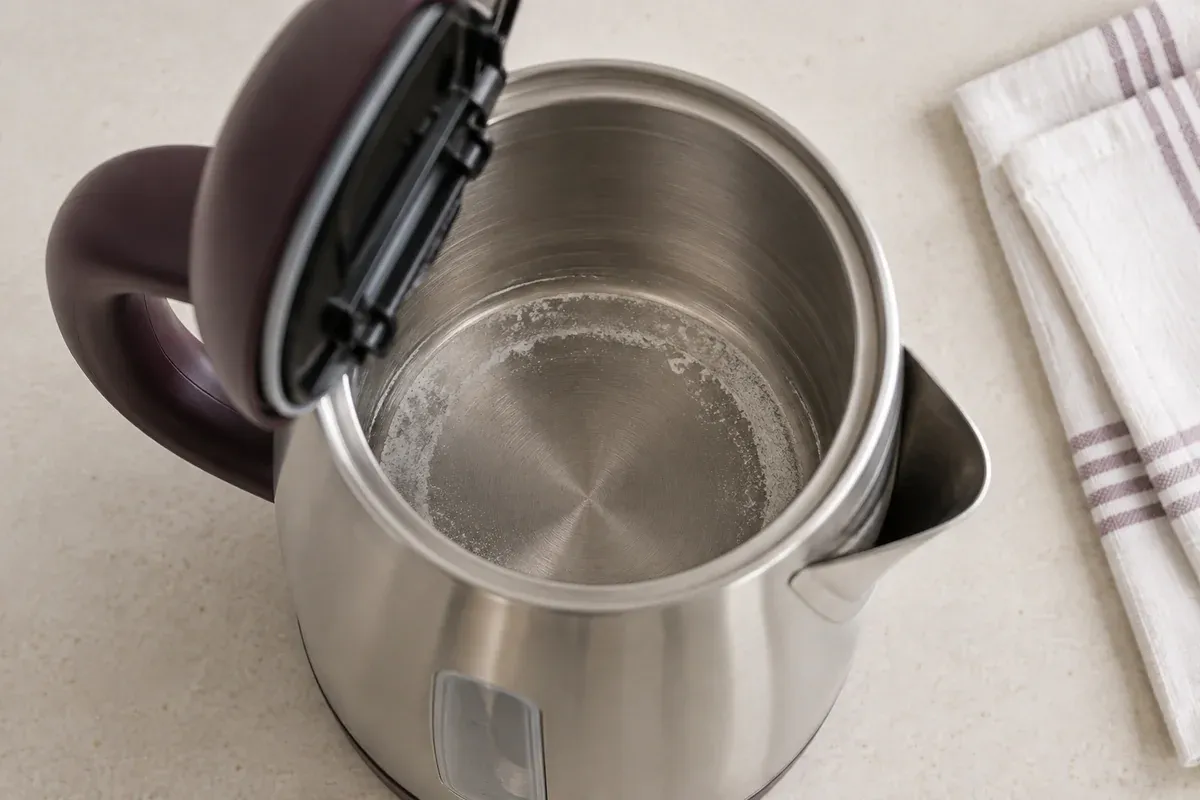
A chalky ring or loose white flakes often mean a kettle needs descaling. The useful first step is finding its model number: the right cleaner, fill level and heating sequence can differ even between kettles that look alike.
Quick answer: Switch off, unplug and let the kettle cool before handling or cleaning it. Check the model’s descaling instructions and the cleaner’s label. Measure the specified solution, use the stated fill level, and heat it only if that method requires heating. Empty and rinse as directed, including any fresh-water boils. Keep the electrical base, plug and connector dry; never immerse the kettle. Clean and refit a removable filter according to its instructions. Stop using a leaking, cracked or electrically damaged kettle.
Start with the kettle and its instructions
Look for the model number on the cool, empty appliance or its paperwork. Find the manufacturer’s manual and its cleaning or descaling section. A stainless-steel body does not tell you what its seals, window, coating or filter can tolerate. A stovetop kettle also needs its own material and care guidance; do not transfer an electric-kettle recipe to aluminium or enamel.
- Check the approved cleaner and its strength, the amount of water, and whether the solution is heated or left cold.
- Check the descaling fill level, contact time, rinsing and any repeat-cycle instructions. Do not assume that filling only to MIN suits every method. Never run the appliance below its operating minimum or above its maximum.
- Gather a measuring jug, the approved descaler and a soft cloth. Use a removable-filter brush only where the maker allows it. Follow the cleaner’s handling precautions.
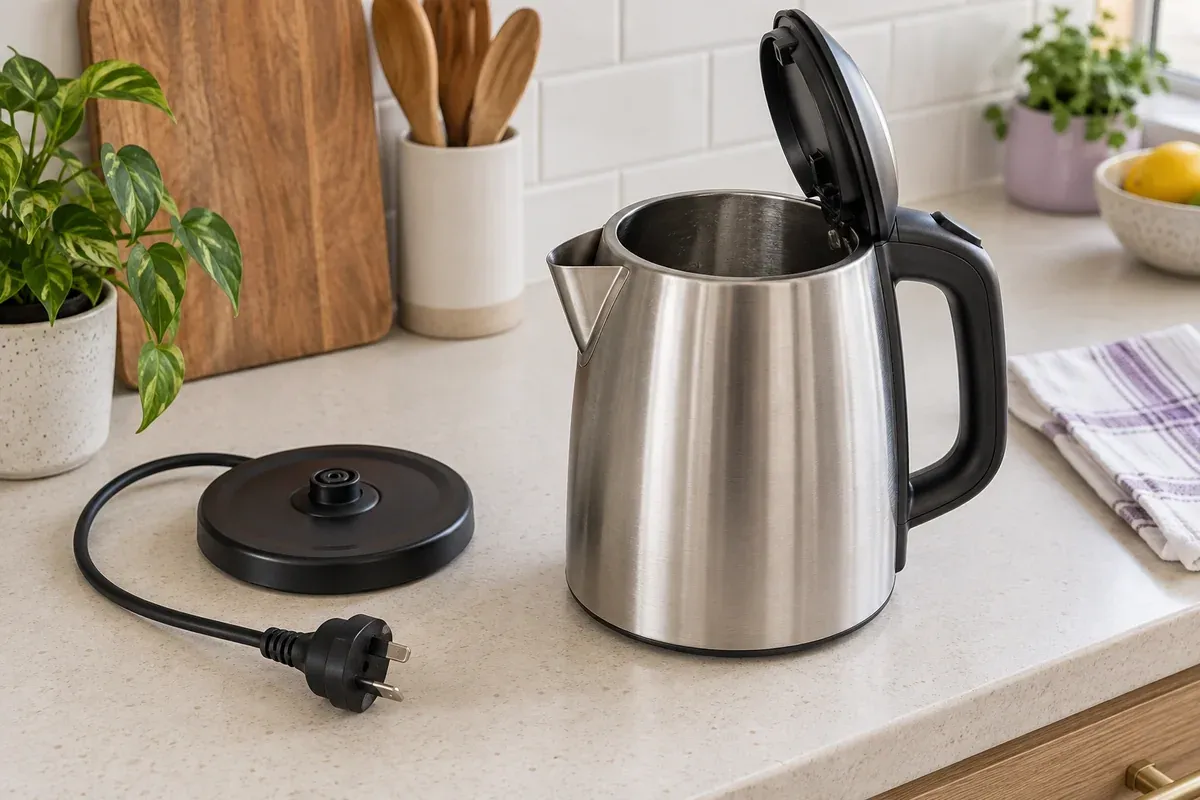
Vinegar, citric acid and descalers: what the manuals actually say
These examples show why a single internet recipe cannot cover every kettle. Use a row only when it matches your exact model, regional instructions and cleaner. They are not comparative tests or product endorsements.
Model and source | Method and limits |
|---|---|
Kmart LD-K3044C, Australian manual, p8 | Mix one part vinegar with three parts water separately. Fill to this model’s MIN mark, 0.7 L. Leave about one hour, then boil and rinse thoroughly with fresh water. The manual does not state vinegar acidity. Do not assume concentrated cleaning vinegar is equivalent; ask Kmart if the available product is unclear. |
Tefal KO371811, global support page | Its vinegar option specifies 500 mL of white vinegar labelled 8°, left for one hour without heating. Empty and rinse five or six times. This is a cold-soak instruction for the listed model, not a reason to boil vinegar in another kettle. |
Breville BKE840, ANZ instruction book, 2019 file, p13 | Its named Breville Kettle Cleaner routine uses 60 mL with 1 L water: boil, stand 30 minutes, boil again and empty; then boil and discard fresh water. The dose belongs to that named product/instruction version. Check current product directions; do not apply it to an arbitrary descaling liquid. |
Read the original Kmart LD-K3044C manual before using its sequence.
The Tefal KO371811 support page also gives a citric-acid alternative: boil 500 mL of plain water first, then add 25 g citric acid and leave for 15 minutes before emptying and rinsing five or six times. Adding acid after heating is a different method from boiling a premixed solution. Take care around hot water and steam.
Check the Breville BKE840 ANZ instruction book against the instructions supplied with your appliance and descaler. If they conflict or a product has changed, ask the manufacturer before proceeding.
Lemon juice, citric acid and commercial descalers are not automatically interchangeable. The sources checked do not establish which is universally fastest, strongest or best for plastic and glass. Do not strengthen the mixture, extend the soak overnight or add another cleaner to rescue a disappointing result.
Descale, rinse and check the result

Cool and unplug before handling; keep the electrical base and connectors dry. Never strengthen or combine products, and stop using a damaged kettle.
Read the illustration as text
- Model and cleaner
- Match the exact kettle, product and specified solution.
- Fill and heating rules
- Follow its fill level and heat only when the method requires it.
- Rinse and check
- Complete every required rinse and fresh-water boil before use.
A cold soak and a heated cycle are different methods.
- Prepare a stable, clear work surface. Let the kettle cool, disconnect it and empty it. Keep the power base away from the sink and spills.
- Measure one approved solution. Follow the model’s stated order and fill level. A removable filter may need separate treatment; do not force it out.
- Keep the kettle disconnected during a cold soak. Reconnect only for a heating step the instructions specify, with the outside and electrical contacts dry. Keep the lid closed during boiling, stay nearby and avoid the spout’s steam.
- Let hot liquid become safe to handle, then empty carefully. Complete the prescribed rinses and any fresh-water boils; discard that water. Descaling solution is not drinking water.
- Inspect the interior and filter. Repeat only if the instructions permit. If deposits remain or the kettle still behaves abnormally, contact the maker instead of scraping the element or increasing the chemical dose.
Use one cleaner at a time and never mix bleach with vinegar or other cleaning products. Queensland Health warns against mixing cleaning agents. This guide is for routine scale and surface cleaning, not a disinfection procedure for an appliance exposed to contaminated water.
Clean the spout filter, outside and base
For removable filters, Russell Hobbs Australia advises rinsing under running water with a soft brush, avoiding the dishwasher and refitting the filter before use. Other designs remove and clean differently, so use the instructions for yours. Handle a filter only after the kettle has cooled.
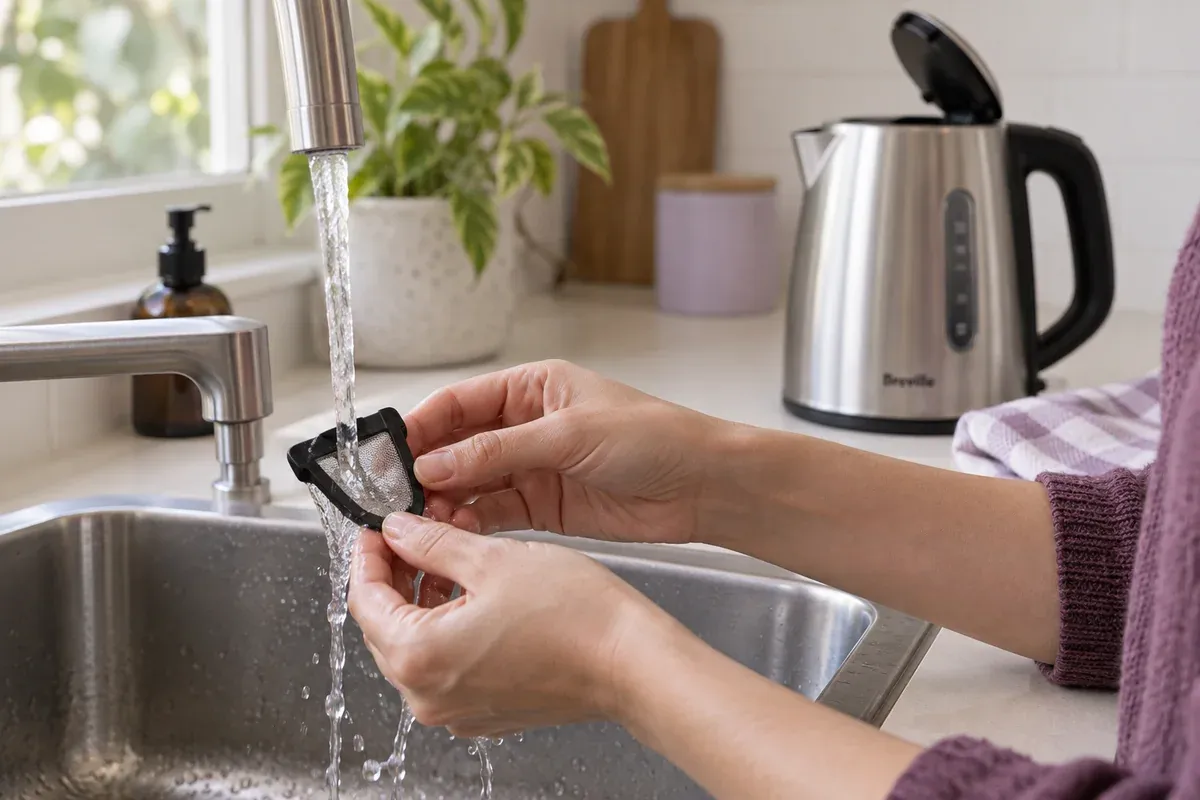
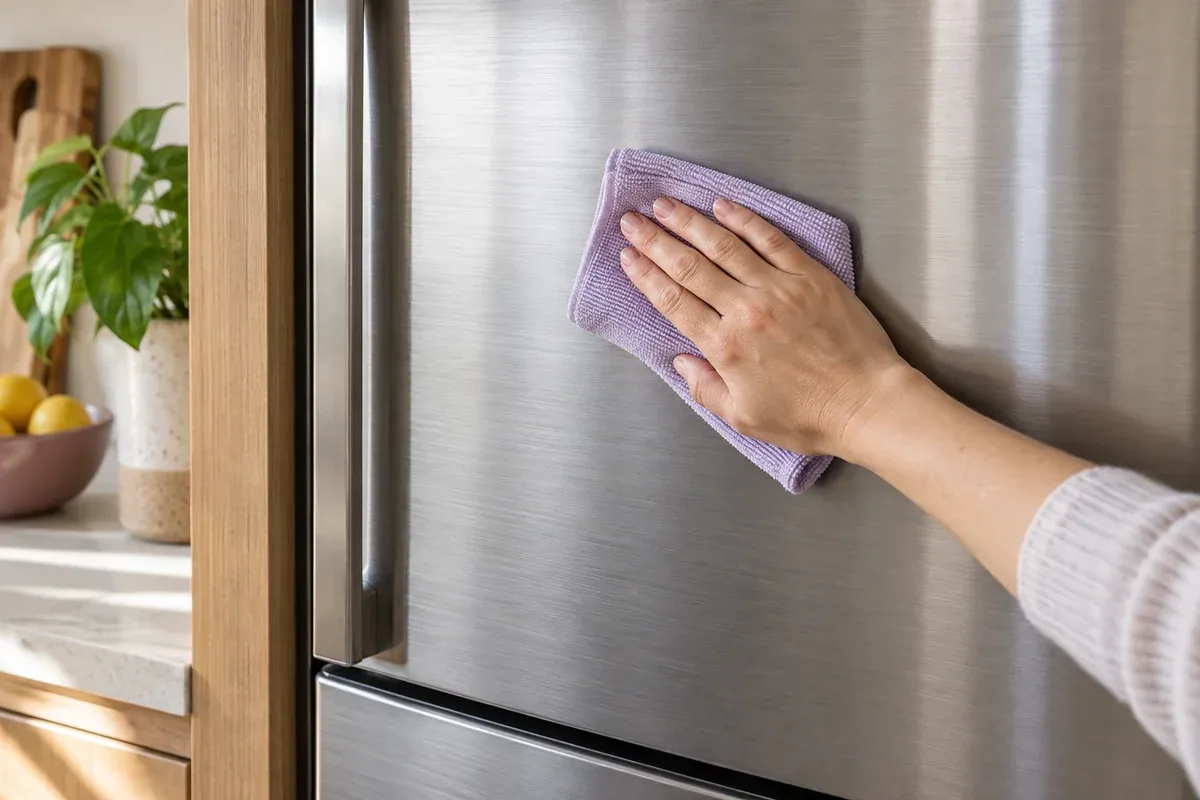
Wipe the cool exterior with a soft, lightly damp cloth and dry it. Add detergent only if the maker permits it: some instructions allow mild detergent, while others expressly exclude it. Keep liquid out of switches, connectors and the base. Do not put an electric kettle, base, cord or plug in the sink or dishwasher.
Avoid scourers, steel wool and abrasive pastes. With glass, avoid knocks against taps or the sink and sudden temperature changes; let the kettle cool before cleaning or refilling it. Do not keep using chipped or cracked glass. Painted, coated and plastic exteriors need their own care directions.
For other finishes around the kitchen, see our stainless-steel cleaning guide; its cookware advice should not be assumed suitable for an appliance coating.
How often should you descale?
Follow the interval in your kettle’s manual and check for deposits as you use it. Usage and local water hardness both matter. A city average cannot tell you that every household needs a monthly or quarterly descale. If deposits return before the suggested interval, ask the maker about more frequent treatment.
Water hardness mainly reflects dissolved calcium and magnesium. Utility figures help explain local differences, but the figures below use different periods and sampling methods. They are context, not a ranking of drinking-water safety or a tested cleaning schedule. All hardness values are mg/L as calcium carbonate.
Supply example | Value and scope |
|---|---|
Greater Sydney | About 57 Sydney Water’s water-analysis page; the figure has no stated sampling period. |
Melbourne supply reservoirs | Ranges collectively span 9–38 Treated-water reservoir table updated October 2024; not a citywide household average. |
Brisbane | 12-month mean 121.2; sample range 60–190 Seqwater report headed July 2026; 175 hardness samples in its long-term table. |
Perth region: selected localities | Bold Park mean 49; Two Rocks mean 228 Water Corporation 2024–25: respectively two and four samples. These examples are not the full regional range. |
Icon Water customers, Canberra area | Average 43 Icon Water’s appliance page explicitly cites 2021–22 data. |
Sources: Sydney Water water analysis explains hardness and local supply networks.
For the reservoir ranges, see Melbourne Water’s quality-testing table. Its table date is separate from the page’s latest update date.
The Brisbane figures come from the long-term table in Seqwater’s July 2026 report. This report link is dynamic and may later show a different period.
Perth locality means and sample counts are in Water Corporation’s 2024–25 aesthetic tables. A locality mean is not a measurement of your tap on a particular day.
The Canberra example is from Icon Water’s appliance guidance. For current information elsewhere, check your own water supplier and supply zone rather than borrowing a nearby city’s figure.
What scale does — and what it cannot tell you
The Australian Drinking Water Guidelines hardness fact sheet sets an aesthetic guideline of 200 mg/L and no health-based guideline value for hardness. This addresses hardness in drinking water; it does not establish that every unknown particle, stain or unusual taste in a kettle is harmless.
Scale can interfere with heating, but noise or slower boiling does not diagnose scale on its own. A kettle can make normal heating sounds, and a fault may have another cause. If there is a persistent leak, damaged cord, cracked body, failure to switch off or unusual electrical smell, disconnect it safely and seek manufacturer or repair advice. Do not keep boiling cleaning mixtures to troubleshoot an electrical problem.
A mesh spout filter catches loose particles; it does not establish that dissolved hardness minerals have been removed. A jug filter’s effect depends on its cartridge and stated performance. Do not assume that filtered water removes the need to check for scale.
Frequently asked questions
Should I boil vinegar in my kettle?
Only when the instructions for your exact model require it. Some manufacturer methods use a cold soak. Match the vinegar strength, dilution, fill level and rinse sequence; boiling is not a universal extra cleaning step.
Can I descale without vinegar?
Your maker may approve citric acid or a kettle descaler. Use its complete method and the current product label. Do not convert a powder dose into a liquid dose or copy instructions from a coffee machine, which has different internal parts.
Can I use bicarb soda?
Do not treat it as a substitute for the approved descaling method or mix it into an acid solution. Some manufacturers describe separate odour treatments using bicarb; that does not make it suitable for removing scale or for every kettle.
What if the kettle still tastes of cleaner?
Do not use the water for drinks. Complete the product’s rinsing instructions and any required fresh-water boil. If the taste persists, ask the maker or cleaner supplier for advice rather than adding another chemical. A new or unexplained taste should not automatically be blamed on scale.
Can I use the same method on my coffee machine?
No. Its water path, seals and cleaning programmes need their own instructions. See cleaning and descaling a coffee maker for the distinction between routine cleaning and descaling.
About this revision
Editorial correction, 20 September 2026: We replaced the universal acid recipe and MIN-only rule with model-specific instructions, removed unsupported city-based schedules and product rankings, and clarified the dates and limits of water-hardness figures. The images illustrate routine cleaning; they are not evidence of a Simply Maid appliance test.
Ready for the rest of the room? Follow our kitchen cleaning guide for a practical order of jobs.
Melbourne's and Canberra's supplies are at the soft end of the table above. If you are in Melbourne or in Canberra, you can see what a regular visit covers on our house cleaning in Melbourne and house cleaning in Canberra pages.
Change log
Who wrote and edited this article, when its sources were checked, and what changed.
View all historyHide earlier history
Earlier entries record what was published at the time. Later corrections take precedence.
- Edited by
- Huy Hoang
Editorial correction, 20 September 2026: We replaced the universal acid recipe and MIN-only rule with model-specific instructions, removed unsupported city-based schedules and product rankings, and clarified the dates and limits of water-hardness figures. The images illustrate routine cleaning; they are not evidence of a Simply Maid appliance test.