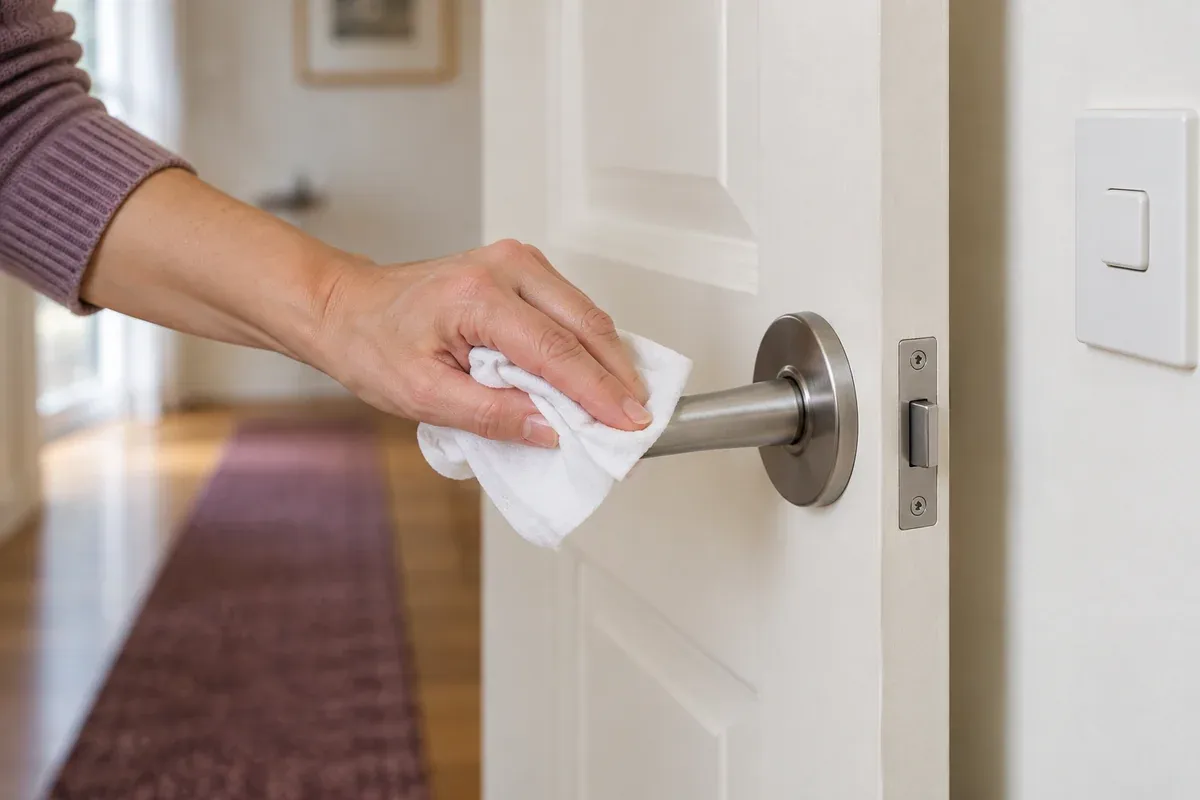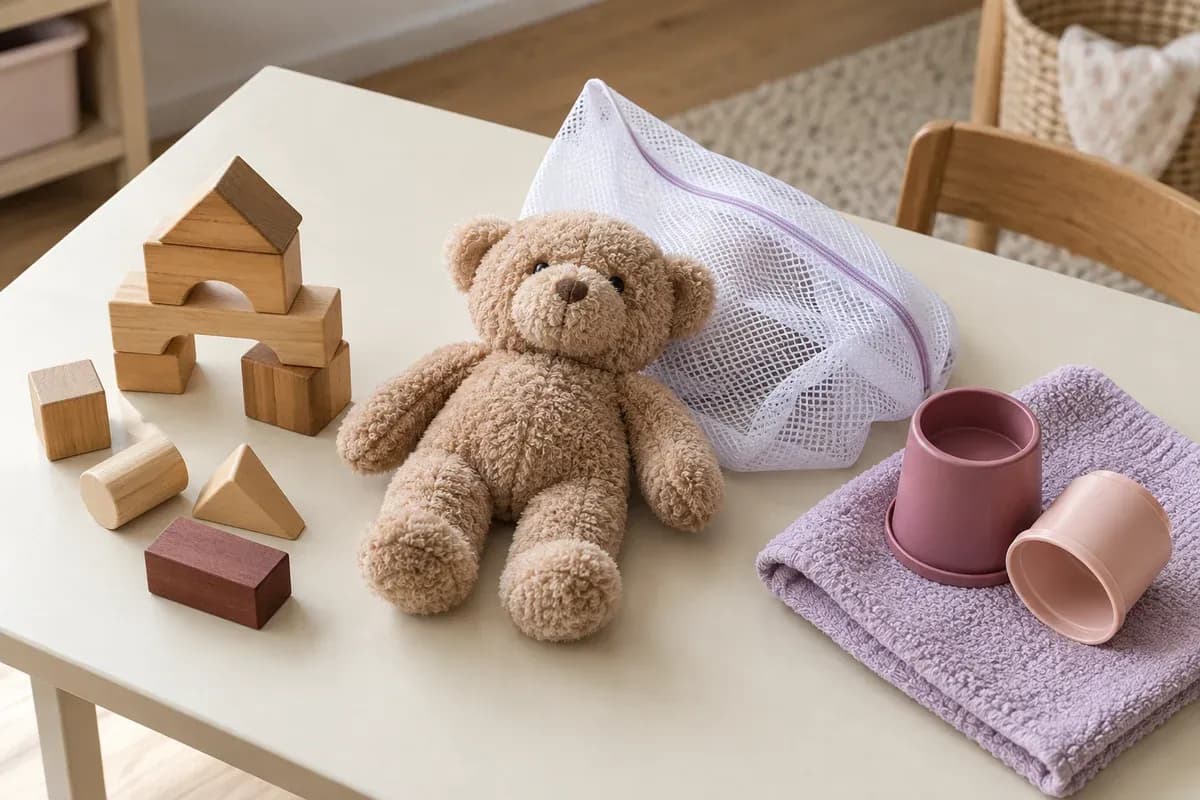
Start with the toys your child has actually used: the chewed teether, the sticky blocks and the bath toys still holding water. Sorting those few items by their care instructions is more useful than tipping the whole toy box into a wash.
Quick answer: Check each toy’s label or manufacturer instructions first. Wash washable toys with a suitable detergent, rinse as directed and dry completely. Only machine-wash, dishwash, boil or steam toys explicitly approved for that treatment. Keep electronics out of water and avoid soaking wood. For mouthed toys or contamination during illness, choose a compatible sanitising or disinfecting method and follow its exact contact-time and rinse instructions.
Sort the toys before turning on a tap

A hard shell or removable cover does not make the whole toy washable. Keep products and loose components away from children; follow situation-specific advice where disinfection is needed.
Read the illustration as text
- Washable
- Use the individual toy’s permitted wash and drying method.
- Wipe-clean
- Keep water out of batteries, sound units and trapped spaces.
- Instructions needed
- Set uncertain or damaged toys aside while checking with the maker.
Drying space belongs outside the clean toy box.
Make three small groups: washable toys, wipe-clean toys, and toys whose instructions you need to check. A hard plastic shell can still contain a battery, metal mechanism, speaker or space that traps water. Detachable fabric clothing may be washable even when the doll underneath is not.
- Find the care label, product name or model number. Photograph the instructions so they are easy to find next time.
- Check seams, loose parts, cracks and battery covers. Set damaged toys aside for repair or replacement before returning them to play.
- Prepare a clean drying space and the cloths or detergent the maker permits. Keep cleaning products and loose components away from children.
- Work on a manageable batch. Leave a favourite comfort toy until there is enough time for it to dry before it is needed again.
Soft toys: the label decides the wash
If the toy is machine-washable, use its specified temperature and cycle, and the detergent dose appropriate to your load and machine. A mesh bag may protect a permitted washable toy; it does not make a surface-wash-only toy suitable for the machine. Follow the drying instruction too.
For example, Jellycat’s care guidance says many of its toys can be washed at 30°C, while others require surface washing. It does not recommend tumble-drying its toys. This is why a general “40–60°C, then tumble dry” instruction can ruin a much-loved toy. Check the individual label even within one brand.
For a surface-wash-only toy, use the maker’s permitted method on the exterior. Do not assume “hand wash instead” means it can be submerged: a sound unit or dense filling may still be unsuitable. Let the toy dry fully before use or storage. If its instructions are missing, ask the maker rather than experimenting with heat or a long soak.
Hard plastic: hand washing is often the permitted option
For toys approved for washing, use the recommended water temperature and cleaner, work gently around grooves, rinse away detergent and leave all parts to dry. Do not use a fixed soaking time for every plastic. Separate only parts designed to come apart.
LEGO’s official instructions specify hand cleaning with a soft cloth or sponge, water no hotter than 40°C, and mild detergent followed by a clear-water rinse. LEGO says not to use a dishwasher or washing machine, or to dry pieces with an oven, microwave, hairdryer or direct sunlight. Electronic or metal parts need different handling. The advice applies to LEGO pieces, including the DUPLO bricks our earlier guide incorrectly suggested dishwashing.
Use a dishwasher only when the toy maker expressly allows it, on the cycle and rack position specified. “Top rack” alone is not permission. A cleaning cycle and a sanitising cycle may also have different temperature requirements.
Bath toys: finish with draining and drying
Bathwater does not count as a cleaning cycle. Follow the toy’s care instructions, rinse as directed and drain trapped water after use. Open toys designed to come apart so the inside can be cleaned and dried; do not cut or drill toys to create access.
Keep the drying stage separate from storage. Spread toys out with openings positioned to drain, using a clean towel or suitable rack. Empty and clean the holder too. If the towel stays wet, replace it with a dry one. Put toys away only when they are dry, rather than assuming that a night in a crowded bag is enough.
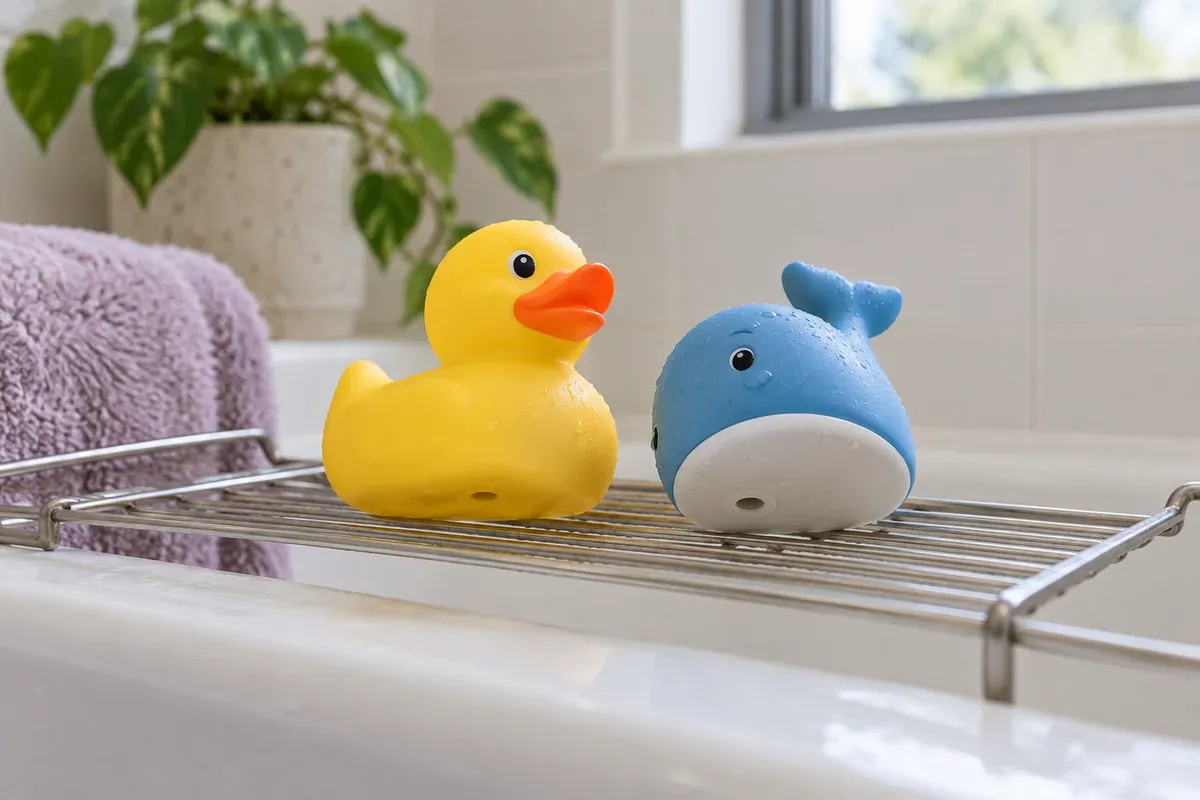
A parent described that separation plainly in this r/Parenting comment. Reddit user u/niftyba wrote:
I let them dry on a towel outside of the tub until the next day, and then put them in a plastic box under the sink.
The useful idea is drying before storing. This is one parent’s routine, not a verified drying time or disinfecting method. Choose a storage spot separate from cleaning chemicals, and check your own toys are dry before closing the box.
If dirty water or suspected mould keeps coming out of a hollow toy, take it out of use. Ask the manufacturer whether the inside can be cleaned effectively. Replace a toy if it cannot be properly cleaned and dried; a clean-looking exterior does not tell you what remains inside. A vinegar soak is not a verified substitute for a suitable sanitising process.
Wooden toys: use little moisture
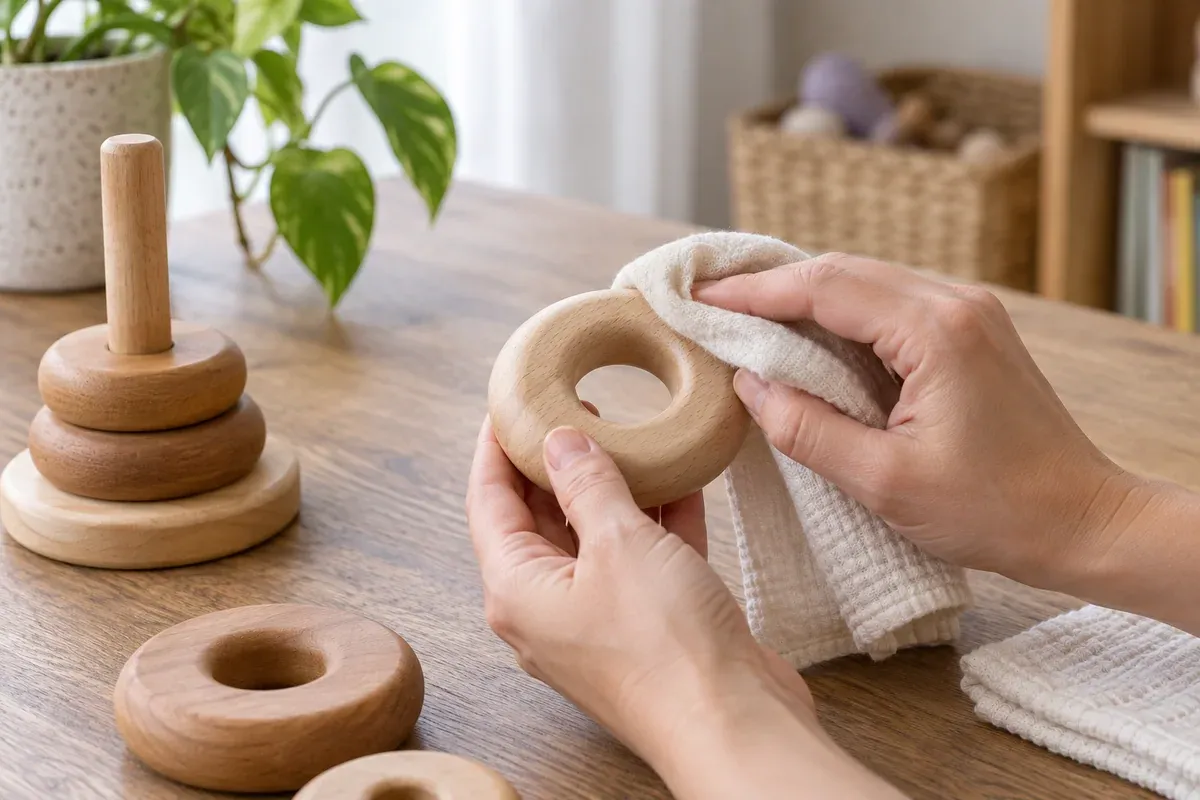
Check the finish and maker’s instructions before applying a cleaner. For example, HABA recommends wiping its wooden toys with a lukewarm washcloth and drying with a clean cloth. It warns against soaking, boiling, dishwashing and drying with direct heat or sunlight. It also warns that antibacterial wipes and sprays can damage its wooden toys.
Wipe the accessible surfaces gently and dry them promptly. Do not add oils, waxes or furniture polish unless the toy maker approves that treatment. If a wooden toy needs disinfection after contamination, ask for a compatible method rather than saturating the wood with a general surface product.
Electronic toys: keep the cleaning on the outside
Switch off and follow the model’s instructions for power or batteries before cleaning. Use only the permitted cloth and cleaner. Keep liquid out of speakers, switches, seams and battery compartments, and never immerse the toy. Replace any removed batteries and secure the cover only as instructed, once the toy is dry.
A wipe described as suitable around children is not automatically suitable for an electronic toy, its coating or a surface that goes into a mouth. If the required disinfection would wet openings or damage the toy, stop and ask its maker for advice.
When sanitising or disinfecting is needed
Cleaning removes dirt and germs; sanitising and disinfecting are additional treatments with particular conditions. CDC early-care guidance gives special attention to objects children put in their mouths and to illness or body-fluid contamination. It also says to check the item manufacturer before using heat or chemical methods. Childcare guidance provides context; it is not a universal daily schedule for every toy at home.
Clean first, then follow a method approved for both the toy and the situation. With a chemical product, check the dilution, permitted material, intended use, wet contact time and any final rinse. Glen 20’s Australian FAQ says toys treated with its applicable products need thorough rinsing with potable water before use; check the exact pack’s directions. Do not transfer one product’s timing to another.
Keep children away during treatment, ventilate as directed and never mix cleaning products. After vomit, diarrhoea or another body-fluid spill, remove the toy from play and follow illness-specific cleaning advice. If you cannot find a compatible procedure, keep it aside while getting advice. Waiting 48 hours by itself is not a cleaning method.
An easier routine: a small “to wash” container
NHMRC’s Australian childcare guidance suggests keeping a container out of children’s reach for toys that have been mouthed, sneezed on or used by a sick child. You can adapt that practical sorting idea at home: it prevents a dirty toy from disappearing back into the clean box.
Clean visible food, dirt and spills promptly. Give used bath toys their draining and drying step after each bath. Check frequently mouthed and shared toys according to use and care instructions. The daily schedules used in childcare reflect group care; there is no single weekly or monthly timetable that suits every family’s toys.
Keep the clean supply separate while a batch dries, and wash the container itself when needed. Doing a few toys properly is easier than finding the entire collection wet when playtime starts.
Can freezing a teddy remove dust-mite allergens?
No. National Asthma Council Australia says freezing soft toys overnight kills mites but does not remove their allergens. Its hot-washing advice is part of managing confirmed dust-mite allergy, not permission to exceed a toy’s care temperature. If allergy management and the toy’s label conflict, discuss suitable washable alternatives with your clinician. Our earlier four-to-five-hour “allergen reset” was incorrect.
Related reading
A family cleaning routine · Cleaning and sanitising around the home · Washing pillows by filling type
Sources and correction
Care instructions are linked beside each example. Brand examples illustrate differences between toys; they are not claims that we tested those products. The Reddit quote is reproduced verbatim and linked to its original comment.
Editorial correction, 20 September 2026: Removed blanket machine-washing, dishwasher, heat, vinegar, freezing and disinfection schedules. The earlier bacteria statistic came from a study of 70 toys in a paediatric hospital, not ordinary homes. The cited 2016 virus experiment tested bacteriophage Φ6, not influenza. Neither supports the previous claims about a child’s household illness risk.
If keeping on top of the toys, the laundry, and everything else feels like one thing too many, our friendly team is always here to help.
Care for your home. Respect for the people behind every clean.
Change log
Who wrote and edited this article, when its sources were checked, and what changed.
View all historyHide earlier history
Earlier entries record what was published at the time. Later corrections take precedence.
- Edited by
- Huy Hoang
Editorial correction, 20 September 2026: Removed blanket machine-washing, dishwasher, heat, vinegar, freezing and disinfection schedules. The earlier bacteria statistic came from a study of 70 toys in a paediatric hospital, not ordinary homes. The cited 2016 virus experiment tested bacteriophage Φ6, not influenza. Neither supports the previous claims about a child’s household illness risk.
If keeping on top of the toys, the laundry, and everything else feels like one thing too many, our friendly team is always here to help.
Care for your home. Respect for the people behind every clean.
Earlier updates
- Edited by
- Huy Hoang
Sources and correction
Care instructions are linked beside each example. Brand examples illustrate differences between toys; they are not claims that we tested those products. The Reddit quote is reproduced verbatim and linked to its original comment.