A leather couch needs a weekly dust and, every few months, a leather cleaner followed by a conditioner. What changes the method is whether the leather has a protective coating, and a drop of water tells you which kind you have.
Quick answer: Each week, vacuum the seams with a soft brush and wipe protected leather with a cloth dipped in water and wrung almost dry (aniline gets a dry cloth only). Every 2–4 months, work a leather cleaner over one cushion at a time, seam to seam, buff it dry, then rub in a thin coat of conditioner and leave it an hour or two to soak in. Allow about 30–45 minutes' work for a three-seater.
Which leather do you have? The water-drop test
Put one drop of water on a hidden spot, such as the back of the base or under a seat cushion, and start timing as soon as it lands. Australian leather-care maker Furniture Care Products sorts the common types this way:
What the drop does | Leather | How to clean it |
|---|---|---|
Beads up and sits on top | Pigmented or protected (coated) | The method below. The most forgiving type: most spills wipe straight off |
Soaks in within 3–10 seconds | Semi-aniline (lightly coated) | The method below. Wipe spills straight away |
Soaks in within 1–3 seconds and darkens | Aniline (no coating) | Dust with a dry cloth; no water or water-based cleaners. Use only a cleaner sold for aniline leather. Blot spills at once: water stains can be permanent |
Darkens straight away on a velvety, brushed surface | Nubuck or suede | A nubuck brush, in one direction; no water, cleaner or conditioner. Marks go to a specialist |
Beads and runs off; very even, plastic-like surface | Faux, bonded or PU-coated | A damp cloth, with a little mild soap for tough marks. Skip conditioner: it can't soak in |
Not sure | Treat it as aniline | A dry soft cloth for dusting; for marks, a cleaner sold for aniline leather, tested under a cushion first |
How to clean a leather couch, step by step
You'll need a vacuum with a soft brush, three soft lint-free cloths, a bowl of water, and a leather cleaner and conditioner (or a two-in-one).
Step 1: Vacuum the seams (weekly)
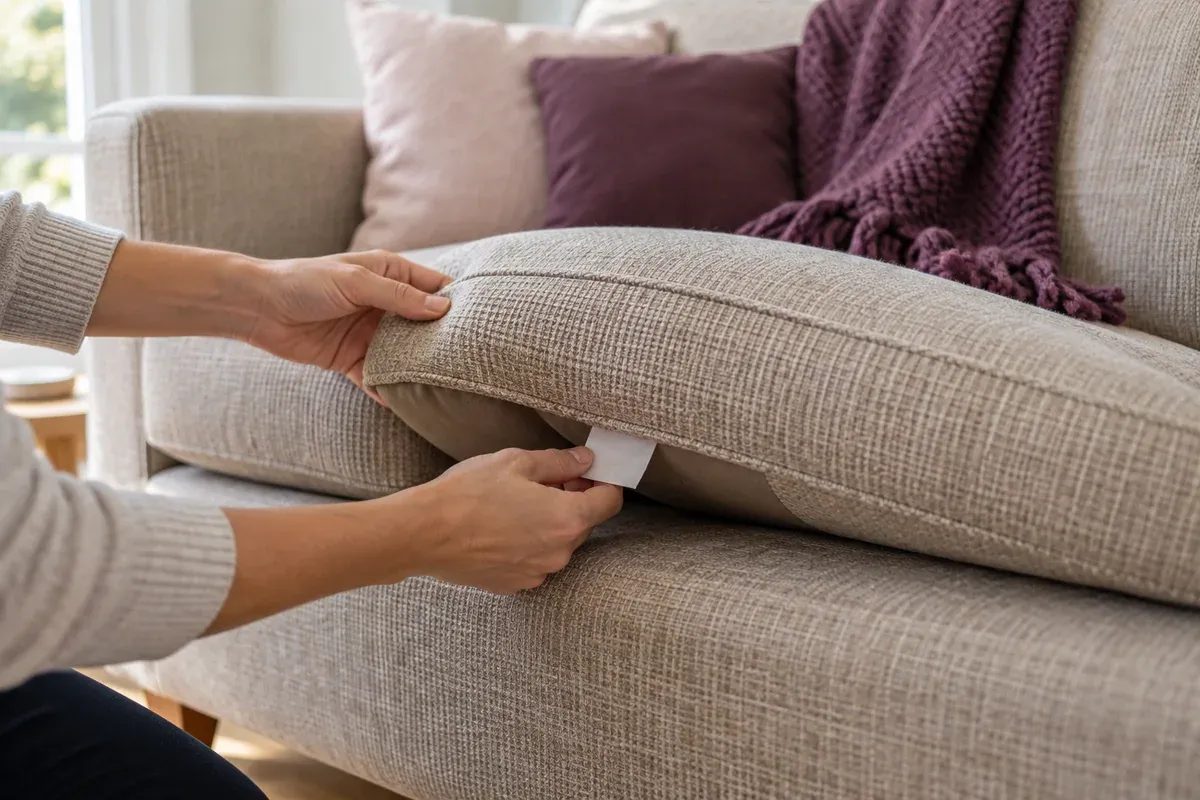
Take the seat cushions off and vacuum crumbs and grit out of the seams and crevices with the soft brush attachment (How to Vacuum Properly (and Get More From Your Machine)).
Grit scratches leather when someone sits on it: King Living advises dusting weekly or using a soft vacuum attachment "to avoid the leather being scratched by loose particles". It's the same weekly dust as the rest of the room (How to Get Rid of Dust — and Stop It Coming Straight Back).
Step 2: Wipe with a barely damp cloth (weekly, protected leather only)
Dip a cloth in plain water, wring it until it feels almost dry, and wipe the leather panel by panel, drying each one straight away with a second cloth. Nick Scali says to wipe its leathers weekly "with a soft, damp cloth" and to "take care not to soak or vigorously rub the leather". Leave out the dishwashing liquid: King Living lists detergents and soaps among the household cleaners that are "likely to damage the leather surface". On aniline or untested leather, skip the water and dust with a dry cloth: Furniture Care Products says never to use water-based cleaners on aniline.
Step 3: Deep clean with a leather cleaner (every 2–4 months)
Work one cushion or panel at a time. Put a little cleaner on a damp cloth, not on the leather, and wipe the whole panel in gentle circles from one seam to the next, so it dries evenly without a ring. Leather-care maker Colourlock puts it simply: "Always work from seam to seam." Spend longest on the headrests, arm fronts and seat edges, where skin and hair oils build up. Wipe off what's left with a clean damp cloth and buff dry.
King Living advises cleaning and conditioning every 6 to 8 weeks; Nick Scali, 3 to 4 times a year. Every 2–4 months covers both: nearer 2 for a couch used daily, by a heater or in the sun. Don't go more often: King Living warns that over-cleaning can damage the protective surface.
Step 4: Condition while the leather is clean
Once the leather is dry, put a small amount of conditioner on a clean cloth and rub a thin, even coat over each panel. Freedom says to give it "a good hour or two to dry" so it soaks in and doesn't come off on clothes. Wipe off any excess. Skip this step on nubuck, suede and faux leather.
Done looks like: an even colour with no darker damp patches or rings, and leather that feels soft and dry to the touch rather than tacky.
What leather couch cleaner to use
If the store that sold your couch sells a care kit, use that: King Living and Nick Scali each make one for their own leathers, and Nick Scali links regular cleaning with its care product to its warranty. To find yours, search the store's name plus "leather care". Otherwise, choose a leather cleaner and conditioner (or a two-in-one) sold for furniture upholstery, and one sold for aniline leather if the drop soaked in fast. Try any new product under a cushion first and judge it once it's dry.
Spills and stains: water marks, pen and grease
Blot a spill straight away with a soft cloth or paper towel, pressing lightly from the outside of the mark towards the centre (Nick Scali). King Living warns that spills and marks not cleaned within a few hours can become permanent. Fabric couch? The methods in How to Remove Couch Stains — Blood, Ink, Grease and More are for upholstery fabric; many of them, like rubbing alcohol for ink, damage leather.
Mark | What to do |
|---|---|
Drink or water spill | Blot. On protected leather, then wipe the whole panel with a barely damp cloth, seam to seam, so it dries evenly. Let it air-dry: no hair dryer or heater |
Water ring that has dried | On protected leather, try one seam-to-seam wipe as above and let it air-dry. On aniline, Furniture Care Products warns water stains are permanent: ask a specialist |
Ballpoint pen | Deal with it the same day. King Living says pen marks "must be attended to quickly" and an ink remover made for leather "may assist". No hairspray or nail polish remover |
Grease, body oil or darkened headrests | Leather cleaner over the whole panel, repeated over a few cleans. Dark spots that keep coming back mean the oil has gone deep: call a specialist |
What not to use: vinegar, baby wipes, olive oil and saddle soap
Safety Never mix cleaning products. Victoria’s Better Health Channel: “Do not mix bleach with ammonia, acids or other cleaners – this can release hazardous chlorine or chloramine fumes.” Ventilate the room during and after use. Wear gloves and eye protection. Follow the label's dilution and contact time. In an emergency call 000. For poisoning advice call the Poisons Information Centre on 13 11 26 — 24 hours, anywhere in Australia.
Method | Verdict | Why |
|---|---|---|
Baby wipes or disinfectant wipes | Don't | Most contain alcohol, which, says leather restorer Fibrenew, "breaks down the protective coat put on most upholstery leather" |
Dishwashing liquid or soapy water | Skip on real leather | King Living rules out detergents and soaps. Mild soap is fine on faux leather |
White vinegar and water | Skip | Some restorers dab a 1:1 mix on stubborn stains, but King Living and Nick Scali both say to use leather products only |
Olive oil, coconut oil or other food oils | Don't | Fibrenew discourages olive oil, and Furniture Care Products warns food oils "turn rancid within weeks" |
Saddle soap | Don't | It's made for saddles. King Living lists it among products to keep off furniture leather |
Furniture polish, wax, silicone spray or window cleaner | Don't | All on King Living's list of products to avoid |
Magic eraser (melamine sponge) | Don't | It cleans by scrubbing, and King Living says to avoid vigorous rubbing to protect the leather's surface |
Steam cleaner or hair dryer | Don't | King Living says never to soak leather, and heat dries it out: Freedom warns that "heat can cause cracks in the leather" |
How to keep a leather couch looking good
- Out of the sun and away from heaters. Nick Scali says direct sunlight "will cause leather and fabrics to fade and may also cause excessive drying", and to keep couches away from direct heat.
- Clean where skin touches. Nick Scali notes that some medications, including blood pressure, diabetes and heart medicines, can come out in sweat and damage the leather's coating, so wipe headrests and arms often.
- Watch claws, buckles and wet swimmers. Claws and buckles scratch, pets' oils can discolour leather, and King Living advises against sitting on it in wet swimmers or towels. For fur, see How to Remove Pet Hair From Couches, Carpet and Clothes.
- Watch new jeans. Dye can transfer from denim onto pale leather, so clean early if you see a blue tinge.
When to call a leather specialist
Nick Scali's advice is to "consult a specialist leather upholstery cleaner if badly soiled", and King Living recommends professional cleaning every 12 to 18 months for its leather. Call one, too, for marks on aniline leather, nubuck or suede, pen or oil that stays after a careful clean, and any cracking, peeling or fading, which need repair or recolouring rather than cleaning. Simply Maid doesn't clean, condition or restore leather or other upholstery.
Frequently asked questions
Does protected leather still need conditioning?
Yes. King Living says "all leathers need to be moisturised", including coated ones. Faux and PU-coated leather are the exception: a conditioner has nothing to soak into.
Why does my leather couch feel sticky?
Usually build-up from too much conditioner or from wipes; Furniture Care Products adds it can mean the coating is breaking down. Clean with a leather cleaner and condition less often. If it stays tacky, have a specialist look at it.
Can I clean a leather couch naturally?
Yes, for the weekly clean on protected leather: plain water on a cloth wrung almost dry is all it needs. Aniline leather gets a dry cloth only, since water can stain it. It's the kitchen remedies (vinegar, olive oil and soap) that do the damage.
Last reviewed 6 October 2026 · Update history
Sources & References
- King Living, How to care for leather furniture: products to avoid, intervals, ink.
- Nick Scali, Furniture cleaning and care guidelines: weekly wipe, spills, sun and heat.
- Furniture Care Products, What type of leather do I have?: the water-drop test.
- Furniture Care Products, Leather care myth-buster: food oils.
- Fibrenew, Do not use baby wipes on leather upholstery: alcohol and olive oil.
- Fibrenew, How to clean leather furniture: vinegar and oil spots.
- Colourlock, How to clean, care and protect aniline leather: working seam to seam.
- Freedom, How to clean leather couch: conditioner and heat.
- Better Health Channel (Victoria), Mould removal at home: never mix cleaning products.
Related Reading
Change log
Who wrote and edited this article, when its sources were checked, and what changed.