Most of us would love to put the cleaner on the tax return. For the average Australian household the answer is no: house cleaning is a private expense, the same as groceries or rent. But there are four groups who can legitimately claim some or all of it, and the amounts are not trivial once you add end-of-lease cleans, short-stay turnovers and a home office to the picture.
Quick Answer: House cleaning is not tax deductible for personal use. It is deductible, in full or in part, when the cleaning relates to earning income: a rental property that is rented or genuinely available for rent, a home-based business, a short-stay (Airbnb-style) property, or a dedicated home office. You claim the income-producing share, keep the invoices, and lodge it under the matching expense category.
This guide is general information for the 2025–26 financial year. It is not tax advice. The ATO changes rates and thresholds, so check the linked ATO pages or talk to a registered tax agent before you lodge.
How the ATO decides what is deductible
A deduction is an expense you incurred to earn assessable income. Three tests decide whether cleaning qualifies:
- Connection to income. The cleaning has to relate to a property or space that produces income, not to your own living arrangements.
- Apportionment. If the space is used for both income and private purposes, you can only claim the income-producing share.
- Records. You need invoices or receipts showing what was cleaned, when, and what it cost. Bank statements alone rarely satisfy an audit.
Fail any one of those and the deduction goes. Pass all three and the cleaning is treated like any other running cost.
Who can claim house cleaning
Landlords with a rental property
If your property is rented out, or is genuinely on the market and available to rent, cleaning is a deductible rental expense in the year you pay for it. That includes:
- End-of-lease cleaning between tenants. If part of the departing tenant's bond is kept to cover it, declare the retained bond as rental income and claim the full cleaning cost; if the tenant pays the cleaner directly, there is nothing for you to claim.
- Pre-rental cleaning to bring the property to a lettable standard once it is listed and genuinely available. A clean done before you advertise a newly bought property may fall outside the income period, so list first, or ask an adviser.
- Periodic cleaning during a tenancy that you, not the tenant, pay for: window cleaning, pest control alongside a clean, or shared areas in a duplex. In a strata block, common-area cleaning usually sits inside your body corporate fees, which you claim as fees rather than as cleaning.
- Rubbish removal and carpet cleaning done as part of a turnover.
You cannot claim cleaning while the property is used privately, sitting empty by choice, or under renovation before it is available to rent. If you do the cleaning yourself, you can claim the cleaning products but not your own labour.
Claim it as a rental expense on the rental schedule of your return. The ATO's rental properties guide lists cleaning separately from repairs and maintenance, so use the cleaning field if your return or software has one; otherwise use whichever rental expense line your software provides for it. If the same job involves replacing carpet, that part is a depreciating asset claimed over its effective life. Repainting walls worn during a tenancy is maintenance you claim now; it only becomes capital if it fixes damage that existed when you bought the property or forms part of a renovation. Ask for an itemised invoice so the parts can be separated.
People with a dedicated home office
If you work from home in a room used only for work, cleaning that room is a running expense. The ATO offers two ways to claim running expenses:
- Fixed rate method. A single hourly rate covers your energy (electricity and gas), internet and data, phone, and stationery and computer consumables for every hour you work from home. For 2025–26 the rate is 70 cents per work hour. Cleaning is not in the rate: if you have a room set up and used only as a home office, the ATO says you may claim the work-related share of cleaning that room on top of the hourly rate. Keep a record of your actual hours for the whole year (a timesheet, roster or diary kept at the time — estimates are not accepted) and at least one bill or receipt for each expense the rate covers.
- Actual cost method. You claim each expense at its work-related share, and cleaning can be one of them. The share is floor area: a 15 square metre office in a 150 square metre home is 10%, so $2,000 of annual cleaning gives $200, reduced further for any private use of that room by you or other household members. Keep every cleaning invoice, a floor-plan or measurement note, and a note of how you worked out the share. For a paper system that keeps them in one place, see How to Clean Your Desk and Keep It Organised.
If your workspace is a shared area, such as the dining table, there is no cleaning claim under either method, because the space is not used exclusively for work. The fixed rate method still covers the hours you spend there.
Home-based businesses
Running a business from home, with your home as the principal place of business, opens the widest door. Cleaning of the business area is a business running expense, and a business can claim the business share of running costs even without an exclusive area — the rules are looser than for an employee:
- The room or area used exclusively for the business: claim 100% of its share of cleaning.
- Mixed-use areas (a studio that doubles as a rumpus room): claim the business proportion, based on floor area and time used.
- Client-facing spaces such as a treatment room, a home salon, or a workshop that customers enter: these usually justify more frequent cleaning, and the whole cost of cleaning that space is deductible.
One caution: if part of your home has the character of a place of business, the ATO says you may lose part of the capital gains tax exemption on your home when you sell, even if you never claimed mortgage interest. Claiming running costs such as cleaning does not by itself have CGT consequences; setting aside a place of business can. Get advice before you set part of your home aside as a place of business, or claim occupancy costs such as rent or mortgage interest.
Sole traders claim this in their own individual return. Companies and trusts can claim cleaning of the business area only where a genuine, market-rate rental or similar agreement with the home's owner makes the business responsible for it; if the company or trust simply pays or reimburses you as an employee, fringe benefits tax can apply. A GST-registered business claims the GST credit on the cleaning invoice through its activity statements and deducts the GST-exclusive amount, so keep tax invoices, not just receipts.
Short-stay and Airbnb hosts
A clean after a paying guest is a direct cost of the letting and is claimable in full. Whole-home cleans that also serve your own use, and general running costs, are apportioned by the property's income use:
- Whole property genuinely available all year and not used by you or family for holidays: cleaning between paying guests is fully deductible.
- Whole property available part of the year: a clean after each paying guest is claimable in full; a clean after your own or your family's stay is a private cost. General running costs are apportioned by the days it was rented or genuinely available on commercial terms versus used privately.
- A room in your home: a clean of the guest's room after their stay is claimable in full. A whole-home clean, and general running costs, are apportioned by the guest's room area plus half the shared areas over the whole floor area, and by the days the room was actually rented (days it sat empty do not count).
Cleaning fees you charge guests are income; the cleaner's invoice is the matching expense. Keep the platform's payout statements alongside the invoices.
What you cannot claim
- Cleaning your own home, including before a party, after a renovation, or to present it for sale. A pre-sale clean is a private cost: your home is usually exempt from capital gains tax, and cleaning is not one of the selling costs the ATO lets you add to a cost base in any case.
- Your own time spent cleaning, even for a rental.
- Cleaning a rental while you or family live in it rent-free. If family or friends pay below-market rent, deductions (cleaning included) are apportioned and the ATO accepts capping them at the rent received; see the FAQ below.
- Work that is really an improvement rather than a repair, for example stripping and resealing timber floors as part of a renovation that leaves them better than before, or fixing damage that existed when you bought the property. Those costs are generally claimed over time as capital works, not as cleaning.
- The private share of any mixed-use space.
Worked examples
Investment unit, tenant moves out. You pay $420 for an end-of-lease clean and $180 for carpet steam cleaning before the next tenant. Both are deductible in full this year as rental expenses.
Graphic designer, dedicated office. Home 120 square metres, office 12 square metres (10%). A fortnightly cleaner at $150 a visit is $3,900 a year, so the office share is $390. Under the actual cost method you claim that $390 alongside your other actual running costs. Under the fixed rate method you claim 70 cents for every hour worked from home for energy, internet, phone and stationery — and because the office is a dedicated room, you can still add the $390 cleaning share on top. Compare the two totals before choosing.
Airbnb host, granny flat. The flat is genuinely available 300 days and used by family, rent-free, for 65 days. Turnover cleans after paying guests totalled $2,600 and are claimable in full. The two cleans after family stays, $190 in total, are private. General running costs such as rates and insurance are split 300 ÷ 365. Because family use it for holidays, you also need to show the flat is held mainly to produce rental income.
Home salon. A converted garage used only for clients is cleaned twice a week at $90 a visit. The full $9,360 a year is a business expense. If the business is registered for GST it claims the GST credit and deducts the GST-exclusive amount. Because the garage is a place of business, see the note above on capital gains tax when you sell your home.
Records the ATO expects

General recordkeeping only, not tax advice or a decision that cleaning is deductible. Check current ATO guidance and your circumstances with a registered tax agent.
Read the illustration as text
- The cleaning invoice
- Record the property, service date, work and amount.
- How the space was used
- Retain relevant work, rental or business-use records.
- The basis of any claim
- Keep the calculation and the records that support it.
Records support a claim; they do not create eligibility.
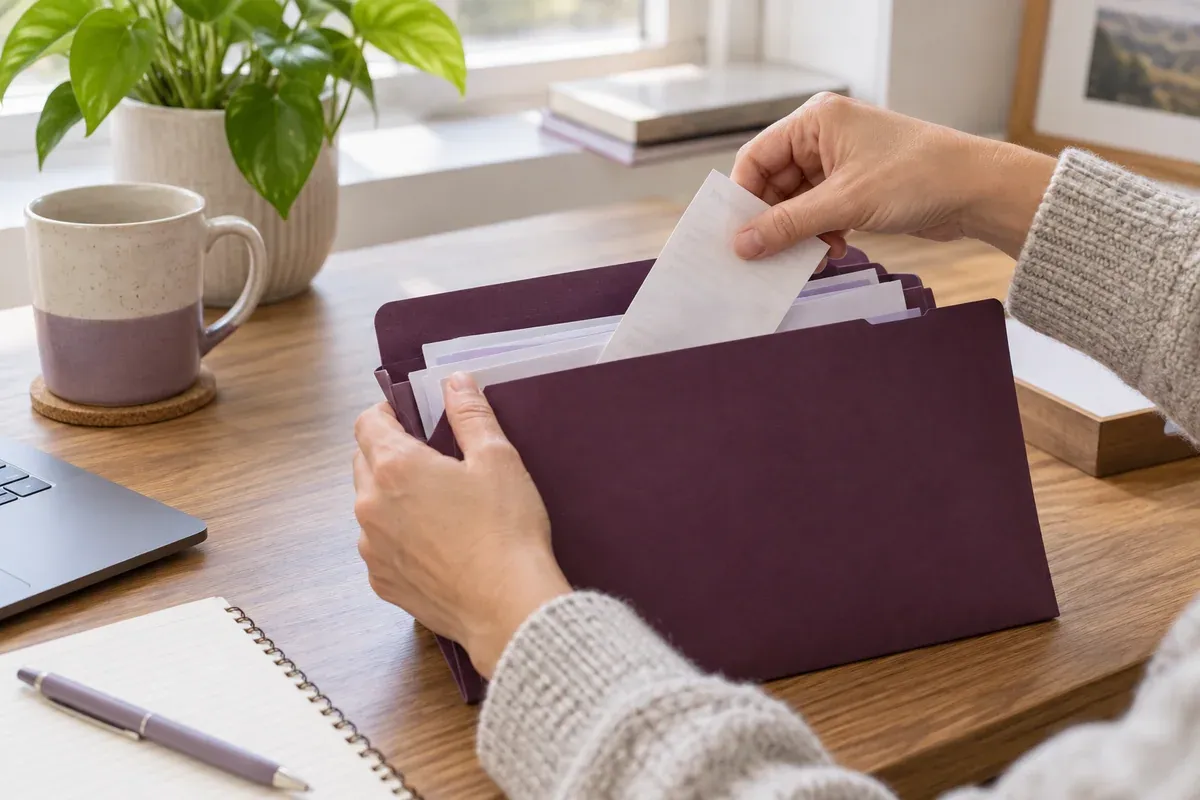
- Tax invoices showing the address cleaned, the date, the service and the amount.
- For home offices, a floor-plan measurement and, for the fixed rate method, a timesheet, diary or roster of your actual hours for the whole year plus at least one bill for each expense the rate covers (one electricity bill, one internet bill).
- For rentals, the lease and the dates the property was available for rent, so you can show the cleaning fell inside an income period.
- For short-stay, the listing calendar and payout statements.
Keep everything for five years from the date you lodge. A booking confirmation and invoice that name the property and the service, like the ones Simply Maid emails after every clean, are the records the ATO asks for.
How to claim
- Individuals lodge through myTax or a registered tax agent. Rental cleaning goes in the rental schedule; home office expenses go under work-related expenses (item D5) using whichever method you chose.
- Sole traders report business cleaning in the business section of their own individual return.
- Companies and trusts claim it as an operating expense in the entity's return only where the agreement with the home's owner makes the business responsible for it (see above), and claim GST credits on the business share through activity statements.
If the amount is small and you are confident of the apportionment, you can lodge yourself. Once rentals, a business and a home office overlap, a registered tax agent usually pays for their fee in errors avoided.
Frequently asked questions
Is end of lease cleaning tax deductible?
Yes for landlords, in the year it is paid, provided the property was rented or genuinely available for rent. Not for tenants: the ATO treats the costs of moving house as private, and a bond clean is one of them.
Can I claim my regular cleaner if I work from home?
Only the work-related share of cleaning a room used exclusively as your home office — under either method. The 70 cents per hour fixed rate covers energy, internet, phone and stationery, not cleaning, so a dedicated-office cleaning share can be claimed in addition to it. If you work at the dining table or in a shared room, there is no cleaning claim under either method.
Does the ATO accept a percentage of the whole-house clean?
Yes, for a room used as a dedicated home office or business area, when the percentage matches its floor area, reduced for any private use of that room. Note the measurement down once, keep it, and apply it consistently. For a shared space such as the dining table there is no cleaning claim.
Are cleaning products deductible if I clean the rental myself?
The products are. Your labour is not.
Do I need an ABN or GST registration to claim?
No. Individuals claim rental and home office cleaning on their personal return. GST registration only matters for a home-based business that wants the GST credit on the invoice; landlords and short-stay hosts cannot claim GST credits on a residential rental clean because GST does not apply to residential rent, so they deduct the GST-inclusive amount.
What if a relative rents the property at a discount?
Deductions are limited to the income earned, and the ATO may treat a below-market arrangement as private use. Get advice before claiming.
Summing up
House cleaning is deductible when the space being cleaned earns you income and you can show the numbers. Landlords and short-stay hosts have the clearest path. Home-office workers with a dedicated room can claim its cleaning share under either method, so compare the two totals rather than the methods' names. Home-based businesses can claim the most, and are also the most likely to be asked for evidence.
If you are booking an end of lease clean in Sydney, Melbourne or Brisbane, or a regular clean for a home office, ask for the tax invoice to name the property. It makes the deduction simple at tax time. Our pricing page shows what each service costs before you book.
Correction, 22 September 2026: an earlier version said cleaning was included in the ATO's fixed rate method and could not be claimed separately. The ATO's fixed rate covers energy, internet, phone and stationery; cleaning of a dedicated home office can be claimed in addition to it. Two worked examples, the FAQ, the short-stay apportionment and several rental details were corrected against the ATO pages listed below.
Sources & References
- Australian Taxation Office — Working from home expenses and its fixed rate method and actual cost method pages (last updated 8 June 2026). The fixed rate (70c for 2025–26), what it covers, and the separate claim for cleaning a dedicated home office.
- Australian Taxation Office — How to claim rental expenses, Rental properties 2025 — rental expenses, Repair and maintenance expenses and Rental income you must declare. Cleaning as an immediately deductible rental expense, apportionment, retained bond as income, and repairs versus improvements.
- Australian Taxation Office — Deductions for home-based business expenses, including the sole trader and company or trust pages. How a home-based business apportions running costs such as cleaning, and the capital gains tax caution.
- Australian Taxation Office — Renting out part of a home and Deductions for a rental property that isn't a holiday home. Short-stay apportionment, and cleaning after a paying guest as a directly incurred expense.
- Australian Taxation Office — Income and deductions for renting out your home and Holiday homes. Guest-only expenses claimable in full; cleaning fees are income; a holiday home must be held mainly to produce rental income.
- Australian Taxation Office — Cost base of assets. The incidental selling costs that can enter a CGT cost base; cleaning is not one of them.
Change log
Who wrote and edited this article, when its sources were checked, and what changed.
Current version
What changed
Correction, 22 September 2026: an earlier version said cleaning was included in the ATO's fixed rate method and could not be claimed separately. The ATO's fixed rate covers energy, internet, phone and stationery; cleaning of a dedicated home office can be claimed in addition to it. Two worked examples, the FAQ, the short-stay apportionment and several rental details were corrected against the ATO pages listed below.