
Looking for Clutter Rescue? This is Simply Maid's independently written decluttering guide, not Helen Butler's original Clutter Rescue resource.
Decluttering starts with deciding how you want to use a space, then making room for that purpose. You do not need an empty house, matching storage tubs or a weekend-long clear-out. One drawer, one shelf or one small surface is a useful place to begin. This guide offers a practical method, room-by-room ideas and responsible ways to pass things on.
Video transcript
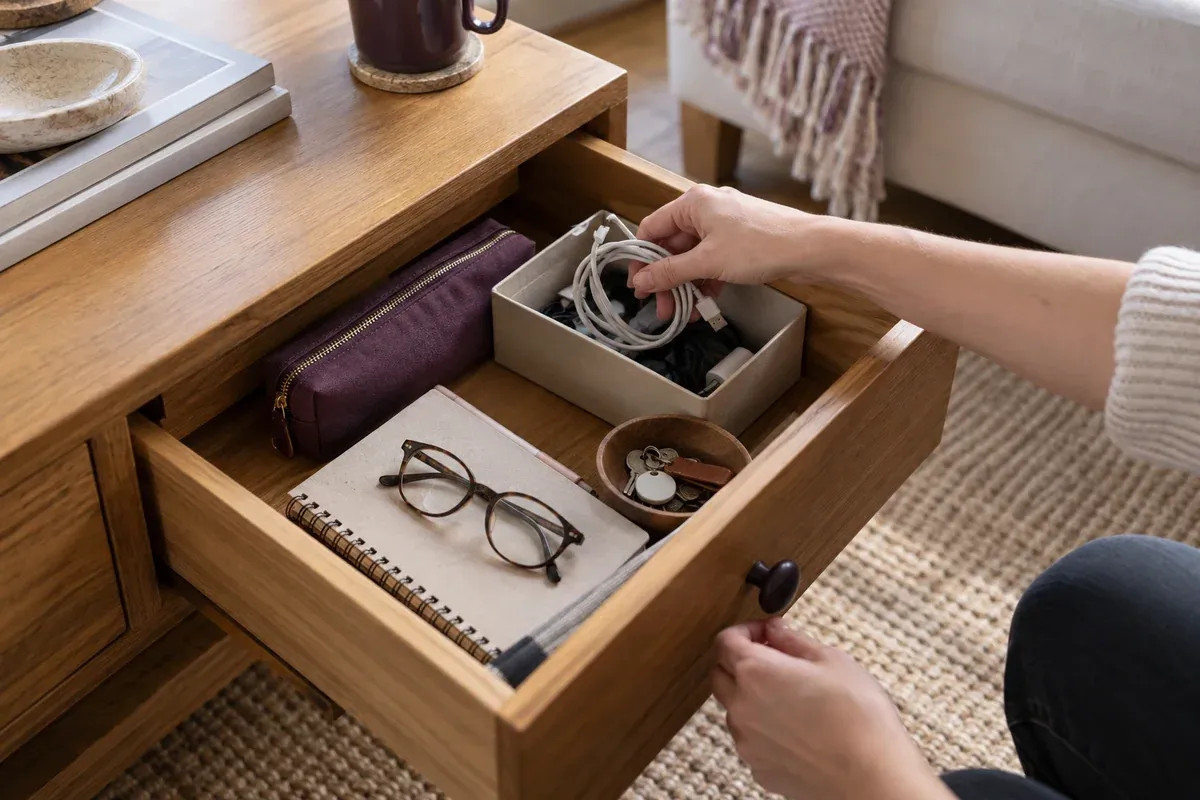
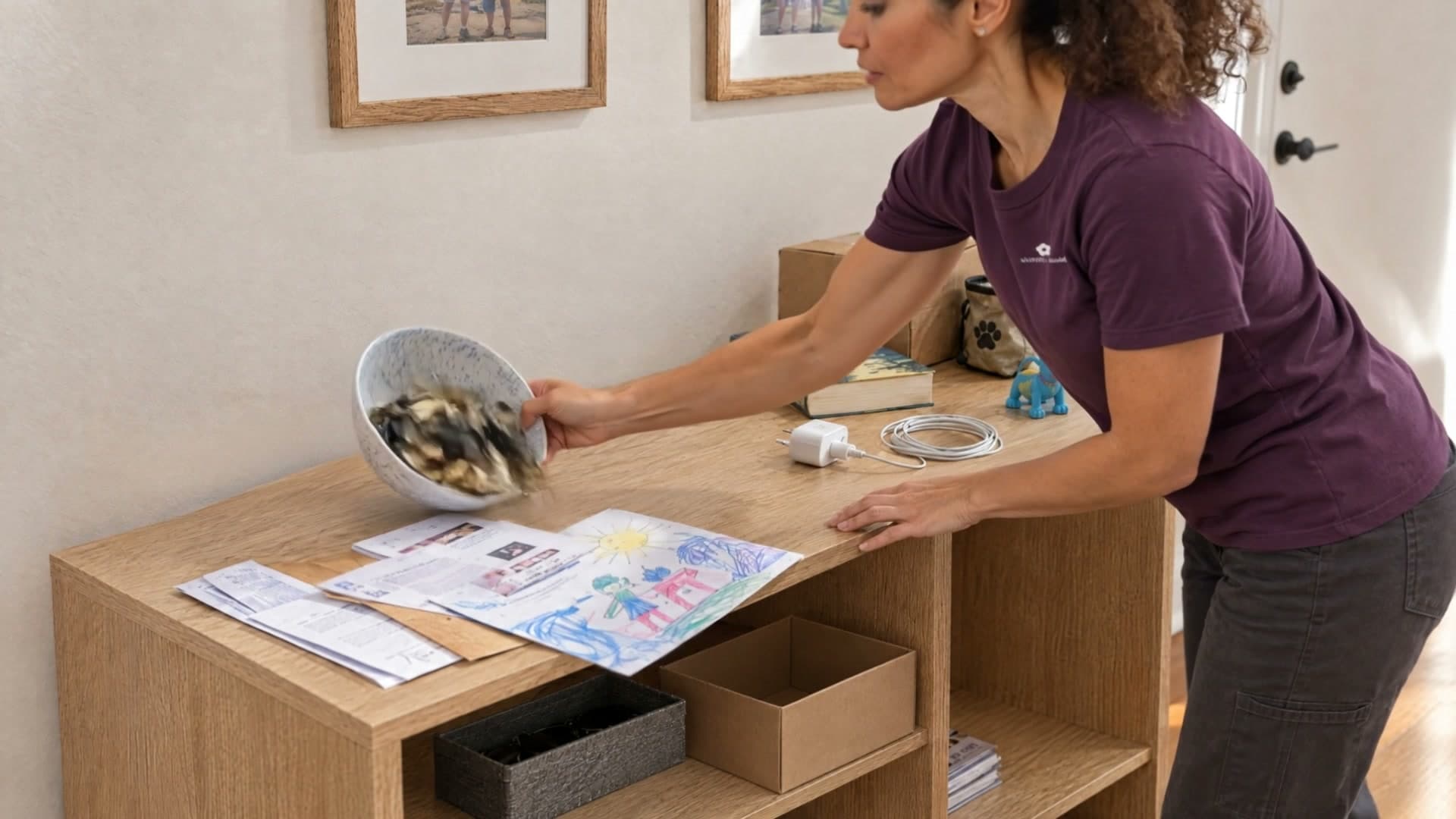
Pick one small surface and decide what it's for. Set a boundary: just the tabletop. If things are shared, agree first. Use what you already have: keep here, return elsewhere, pass on, and a review box.
One item at a time. A key that opens nothing we know of goes in the review box with a date, not the bin. Ask before touching school notes and drawings. They stay together for the family to decide. Finished with? Pass on. Check the charity's rules first.
Give what stays a home you can reach. Keys in the bowl. Lead on the hook. Mail in one tray. Finish the outgoing items today. A box by the door is a step, not a finished donation. It's not a showroom. The school bag and the lead stay. It's a table where you can find your keys.
Simply Maid. More room for life.
Quick answer: Choose one manageable area, sort your own belongings, return useful items to an accessible home and arrange the next step for anything leaving. Keep an optional review box for difficult decisions. Decluttering may feel helpful, but it does not guarantee happiness or treat a mental-health condition.
Start With a Useful Goal
Pick something you want the space to let you do: prepare a meal on the bench, find your keys, reach a cupboard or use a desk. That goal gives you a reason for each decision without requiring a particular look.
Choose an amount of work you can finish and put away in the time and energy available. Ten minutes is an optional starting point, not a rule. Avoid emptying an entire wardrobe onto the bed if you cannot restore a usable sleeping space afterwards.
Work on belongings you own or have permission to sort. Agree on decisions about shared items, children's possessions and sentimental objects with the people they belong to. Do not discard someone else's belongings as a surprise.
A Small-Area Decluttering Method

Work with permission and keep uncertain records or sentimental belongings for a considered decision. Decluttering is not presented as a health treatment.
Read the illustration as text
- Set the boundary
- Choose one drawer, shelf or tabletop and agree whose items you can sort.
- Sort with a destination
- Keep here, return elsewhere, pass on, or hold for a deliberate review.
- Complete the next step
- Return what stays and arrange the actual donation, recycling or collection.
A usable space is the goal—not a target number discarded.
1. Set a boundary
Choose one drawer, one shelf or a clear section of a table. Keep walkways and exits usable. Leave heavy furniture, unstable piles, unknown chemicals and electrical repairs outside this simple sorting session.
2. Use containers you already have
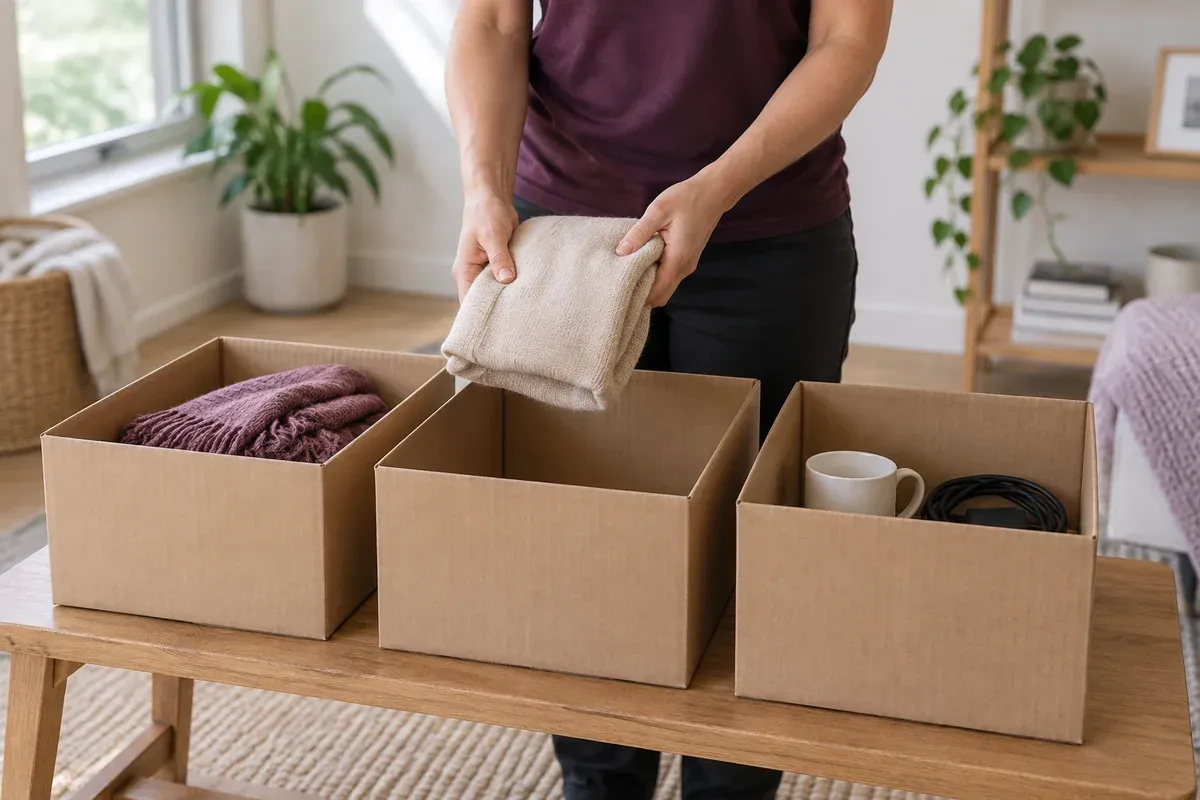
Set aside a few boxes or bags for items to keep here, return elsewhere, and pass on. Separate donations from recycling or rubbish. An optional review box is useful when you need more information or another person's decision; label its contents and choose a realistic date to revisit it.
You do not need to buy organisers before you know what will remain. A storage container helps contain a chosen set of possessions, but it cannot decide what you need.
3. Consider one item at a time
Ask whether you use it, expect to need it, value it or have a responsibility to keep it. Check duplicates against actual needs: spare bedding, accessibility aids and emergency supplies may serve a purpose even when used infrequently.
There is no universal three-year deadline for discarding possessions. Check retention requirements for important records, warranties and financial or legal documents before disposing of them. Put uncertain items aside for a deliberate follow-up instead of making a rushed irreversible decision.
4. Return what stays
Give frequently used items an easy-to-reach place near where you use them. Group related objects and label closed containers if that helps your household. Choose a setup that works for the people using it; a practical home does not have to look like a showroom.
If a cleared shelf needs cleaning, identify its material and follow the appropriate surface-care instructions before returning items. Decluttering and cleaning are separate tasks, so allow time for both when needed.
Mikail Yesilkaya, founder of Duty Cleaners, a house cleaning service in Calgary, recommends the same order: sort first, then clean. As his team's guide to keeping up between cleans puts it, "Cleaning around clutter means cleaning the same surface twice — once now, and again once the clutter finally moves."
5. Finish the outgoing items
Check a donation service's acceptance rules, arrange a sale or collection, and identify the correct recycling or disposal route. Keep outgoing bags out of walkways. A labelled box beside the door is a temporary step, not a completed donation.
Room-by-Room Starting Points
Living room
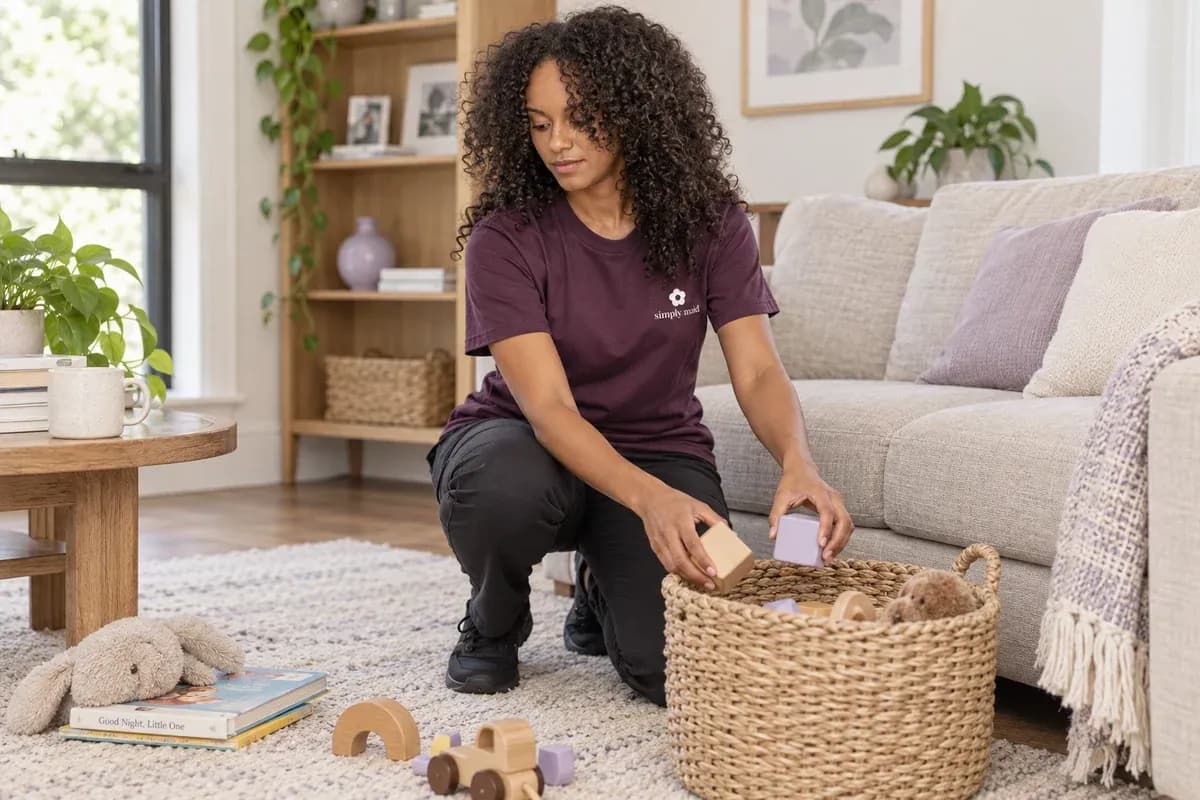
Choose one shared surface or a small group of objects. Return borrowed items, gather games with their pieces and decide together which books or media to keep. Give remotes and everyday accessories a place that everyone can find. Preserve space for hobbies and ordinary family life.
Bedroom and wardrobe
Start with one drawer or clothing category. Separate items that fit and serve a purpose from those needing repair or a decision. Seasonal clothing can stay if you use it and have suitable storage; it does not need to be discarded because it is currently unworn.
Only offer a charity items it accepts in the required condition. Torn or heavily stained clothing is not automatically a suitable donation. Check a textile-recycling scheme's own requirements before sending damaged garments there. Follow each garment's care instructions if it needs cleaning first.
For keep, repair, seasonal-storage and donation decisions, follow our wardrobe decluttering guide. It includes ways to make getting dressed and putting laundry away easier.
Kitchen
Work through one shelf at a time. Check whether duplicate tools are useful, identify damaged items and follow the maker's advice before continuing to use them. Keep food labels and storage directions with the food.
For pantry and fridge checks, distinguish the dates. Food Standards Australia New Zealand explains that a use-by date concerns safety: do not eat food after it. A best-before date primarily concerns quality and is not an automatic disposal deadline. Follow storage conditions and directions for opened foods; a printed date does not override mishandling or signs that food is unfit to eat.
Bathroom and medicines
Review one shelf, keeping labels readable and checking product-specific expiry and disposal directions. Avoid transferring cleaners or medicines into unlabelled decorative containers.
Take unwanted or expired medicines to a community pharmacy participating in the Return Unwanted Medicines scheme, which is free for consumers. Do not flush them or put them in household rubbish. Ask the pharmacist about preparation and items the scheme excludes. Needles and syringes require an appropriate sharps-disposal route. Keep medicines that are still needed according to their labelled storage directions, away from children and pets.
Projects You Might Finish One Day
An unfinished project may still matter to you. Name the next action and decide whether you want to make time for it. If a repair needs a part, identify the part; if a hobby needs space, consider where it will happen. Choose a review date that fits your circumstances.
If the project no longer suits your life, you can make a new decision about its materials. Consider current use, sentimental value and storage effort alongside what you originally spent. Keep uncertainty in a deliberate review box, and arrange a responsible destination for anything you decide to pass on.
Decluttering Before Downsizing
Start with the space you are moving into. Measure useful storage and decide what each room needs to do before sorting whole categories of belongings. Keep the items that serve those needs, and review duplicates against your household's actual routine. A smaller home does not mean everyone needs the same number of towels or kitchen tools.
Agree with family members about possessions they own or expect to keep. Give people a practical opportunity to make decisions. Arrange the next step for donations, sales and collections before moving day so outgoing items do not follow you into the new home by default.
For the wider timetable, use our moving resources.
Donate, Recycle or Dispose With a Destination in Mind
Salvos Stores accepts suitable items in good condition and publishes a donation guide with exclusions. Check the receiving service before travelling, especially for furniture, electrical goods or large quantities. Another organisation may have different requirements.
For recycling and household waste, follow your council or collection service's rules for the exact material. Do not assume textiles, batteries, electronics or unwanted chemicals belong in the kerbside recycling bin. Keep potentially hazardous items separate until you have identified an appropriate collection route.
Selling may suit some possessions, but consider the time involved. Give yourself a realistic deadline for arranging the next step. Passing an item on responsibly can be a reasonable choice even if it does not recover its original purchase price.
Five Options for Passing On Usable Belongings
Choose an option that accepts the particular item, in its current condition. Confirm arrangements before dropping goods off; collection is not automatic.
- Salvos Stores: check its donation guide for accepted goods and exclusions, then choose a suitable drop-off or request a collection.
- Vinnies shops: find your local shop and check what it can accept. Furniture and electrical-goods acceptance varies between shops.
- GIVIT's What's Needed list: look for a request matching your good-quality item. If matched, arrange delivery or collection with the receiving charity; GIVIT is not a general rubbish-removal service.
- The Bower: Sydney readers can check its current acceptance list and collection arrangements for suitable household goods. Confirm the item and service area before making plans.
- A local community reuse group: offer usable items with an accurate description and arrange an agreed handover. Check the group's rules, and do not leave unwanted goods outside a charity or another person's home.
If an item cannot be reused, check your council's disposal or recycling guidance. A recycling collection is different from a donation, and neither should be assumed to accept damaged or hazardous goods.
What Can Research Tell Us About Clutter and Wellbeing?
People experience their homes differently. Some feel more comfortable after clearing a surface; others need support, time or a different approach. A practical benefit such as finding belongings more easily is a useful goal without promising a medical outcome.
In Saxbe and Repetti's home-tour study, researchers analysed how 60 dual-income spouses described their homes. Among the women, more stressful descriptions were associated with particular daily cortisol and mood patterns. This was an observational association, not an experiment showing that decluttering lowers cortisol or treats depression.
Claims that a tidy home necessarily improves creativity, relationships, property value or physical health go beyond what that study establishes. A cluttered room is also not a measure of someone's character or a diagnosis.
If difficulty discarding possessions causes substantial distress or prevents rooms being used, seek appropriate support rather than forcing a clear-out. Healthdirect's hoarding-disorder guide explains when to speak with a GP or mental-health professional. Ordinary household clutter and hoarding disorder are not interchangeable terms.
Keep the System Manageable
- Return frequently used items to their agreed places when practical.
- Review a small area periodically at a pace that suits your household.
- Before buying storage, check the space, dimensions and possessions it needs to hold.
- Before bringing something new home, consider where it will live and whether it meets a need.
- Adjust the system when work, health, caring responsibilities or household needs change.
A one-in, one-out habit can be useful for a particular collection, but it is optional. New necessities do not have to trigger the disposal of something unrelated. If the system takes more effort than it saves, simplify it.
Choosing Practical Help
If the main problem is deciding what stays or making storage work, an organiser may be suitable. If accessible surfaces need washing, dusting or vacuuming, a cleaner may help. Read professional organiser or cleaner for scope questions to ask before booking either service.
Frequently Asked Questions
Where should I start when everything feels overwhelming?
Choose a small, low-stakes area with an obvious purpose, such as the space needed for a meal or a place for keys. Start with easy decisions and leave sentimental items for another session. Ask a trusted person for practical help if you want it, while keeping control of decisions about your belongings.
Do I have to throw things away to declutter?
No. Some items simply need to return to another room or an accessible storage place. Others may be repaired, donated or recycled through an appropriate scheme. The aim is a usable home that fits your needs, not a target number of discarded possessions.
Will decluttering make me happier or help depression?
Some people find sorting a small area satisfying, but the outcome varies. The research discussed above does not establish decluttering as a treatment for depression. If persistent low mood or distress is affecting your life, speak with a health professional rather than treating tidiness as a test you must pass.
Should I buy matching storage boxes first?
Sort first and measure the space. Reuse suitable containers while you work out what is staying. Buy storage only when you know what problem it needs to solve.
Sources and Review
Reviewed on 20 September 2026 against the linked research, Australian health guidance, food-labelling guidance, medicines-return information and charity acceptance rules. This revision replaces unsupported health guarantees and rigid disposal rules with a practical, flexible sorting method.
Donation options and the new wardrobe, organising and downsizing sections were added on 14 October 2026 with AI assistance. Current service details are linked above; check acceptance and availability before arranging a donation.
Turn one cleared space into a repeatable routine
For a manageable sequence from choosing a goal to maintaining it, follow six steps to an organised home. Its worksheet helps you choose one small area, decide where belongings go and plan a reset. If paperwork is the main obstacle, start with our home-office organisation guides.
Related Reading
- Bedroom Styling Tips That Make the Room Feel Calmer
- How to Clean and Organise Your Attic in 9 Simple Steps
- Easy, Effective and Everlasting Cleaning Habits for the Whole Family
- A Quick Nightly Cleaning Routine for a Better Tomorrow
- 5 Reasons Why Homeowners Neglect House Cleaning
A hand with everyday housework
Once you've cleared the surfaces and put things away, regular cleaning can help you keep the rooms feeling fresh. Explore our standard cleaning inclusions for kitchens, bathrooms, floors and everyday surfaces.
Explore standard house cleaning.
If you are in Sydney, our Sydney house cleaning services page shows what a regular visit covers once the clutter is gone.
Preparing to sell? Start sorting before the photography date, so cleaning and furniture arrangement can follow. Our home staging and pre-sale preparation guide puts those jobs in order and helps you keep the home usable between inspections.
Change log
Who wrote and edited this article, when its sources were checked, and what changed.
