Most cleaning checklists fail for the same reason: they list everything a house could need without saying how often it needs it, or how long it takes. So the list gets read once, feels enormous, and becomes a weekend that never gets scheduled.
This one is organised the other way around — by interval first, then by room, with realistic timings. Australians spend a substantial share of their unpaid work hours on housework, according to the Australian Bureau of Statistics' time use survey, and most of that time goes on the tasks in the daily and weekly sections below. The monthly and yearly lists are short by comparison.
Quick Answer: Ten minutes of daily reset, about ninety minutes of weekly cleaning split across two sessions, an hour a month on the deeper tasks, and two half-days a year on the annual list. If a task isn't on one of those four lists, it probably doesn't need doing on a schedule.
The Daily Reset — 10 to 15 Minutes
Not cleaning. Resetting. This is the list that decides whether the weekly clean takes ninety minutes or four hours.
Task | Where | Time |
|---|---|---|
Make the beds | Bedrooms | 2 min |
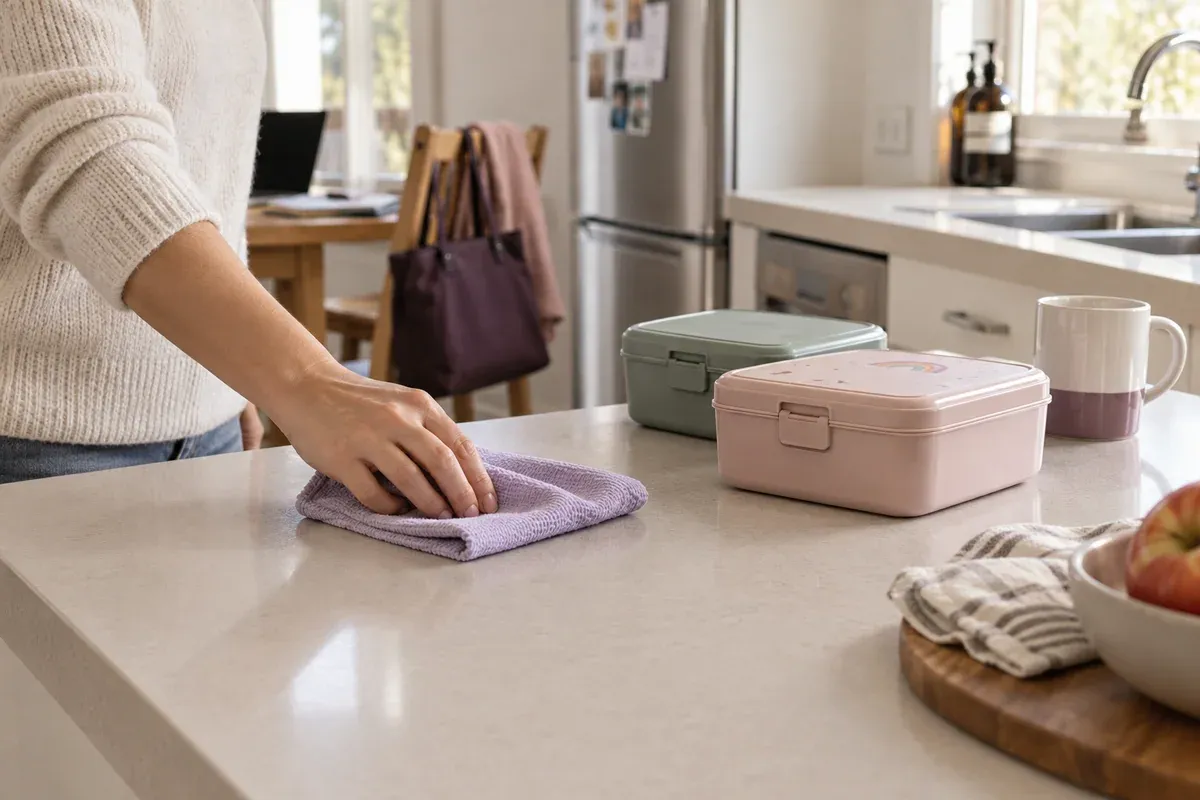
Wipe kitchen benches and the sink | Kitchen | 3 min |
Load and run the dishwasher, or wash up | Kitchen | 5 min |
Wipe the bathroom basin | Bathroom | 1 min |
Squeegee the shower screen | Bathroom | 30 sec |
Put things back where they live | Everywhere | 3 min |
Take out anything smelly | Kitchen | 1 min |
The two that matter most are the sink and the shower screen. An empty sink changes how the whole kitchen reads, and thirty seconds with a squeegee prevents most of the soap scum and glass scale that otherwise becomes a scrubbing job.
If you can only do one thing, do the nightly ten-minute reset before bed. Waking to a clean kitchen is worth more than the ten minutes costs.
The Weekly Clean — About 90 Minutes
Split it into two sessions of forty-five minutes rather than one block. Wet rooms in one, living areas in the other.
Kitchen — 25 minutes
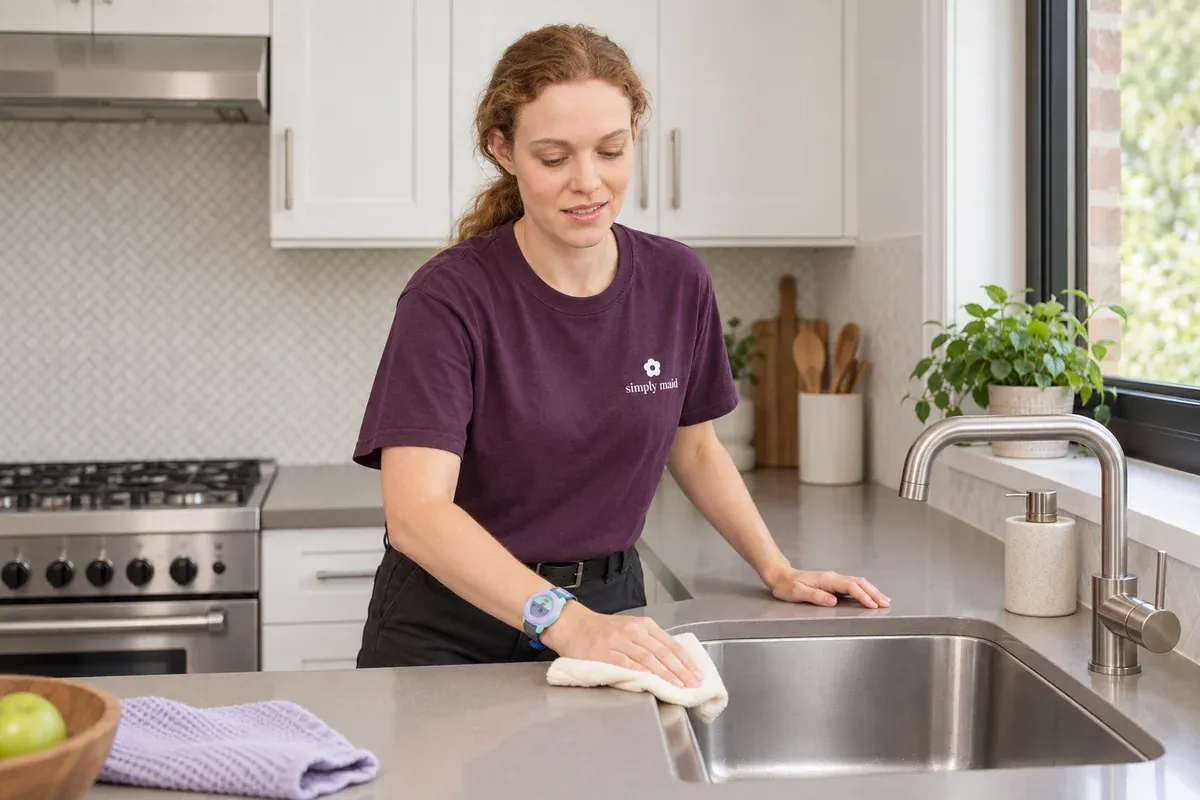
- Wipe down all benchtops and the splashback
- Clean the cooktop and wipe the rangehood face
- Wipe the front of the fridge, oven, dishwasher and cupboard doors
- Clean the microwave inside and out
- Empty the bin and wipe the lid and rim
- Wipe the kitchen table and chairs, including chair legs
- Sweep and mop the floor
Work in a fixed order rather than at random — a systematic route through the kitchen is consistently faster than doing whatever catches your eye.
Bathrooms — 15 minutes each
- Spray shower, bath and basin, then leave the product to dwell
- Clean the mirror while it dwells
- Scrub shower walls, screen, bath and basin
- Clean the basin, taps and vanity top
- Clean the toilet last, with its own cloth
- Empty the bin
- Mop the floor, working out of the room
- Fresh towels
Full detail and the reasoning behind the order is in how to clean a bathroom.
Bedrooms — 10 minutes each
- Change the sheets and pillowcases
- Dust bedside tables, dresser tops and windowsills
- Clear surfaces and put clothes away
- Vacuum, including under the bed
Wash bedding weekly on a hot cycle if anyone in the house has asthma or dust allergy. The Better Health Channel notes that a wash above 55°C is what actually kills dust mites — a cold wash removes allergen but not the mites themselves.
Living areas — 20 minutes
- Tidy and clear all flat surfaces
- Dust shelves, sills, skirting tops, TV and the tops of picture frames
- Wipe light switches, door handles and remote controls
- Vacuum upholstery and under cushions
- Vacuum or sweep and mop the floors
- Shake out or vacuum entry mats
Laundry — 5 minutes
- Wipe the washing machine door seal (front loaders)
- Empty the lint filter (dryers)
- Wipe the tub and benchtop
- Sweep the floor
The Monthly List — About 60 Minutes
These are the jobs that go unnoticed for months and then need an afternoon. On a monthly rhythm each one is a few minutes.
Task | Room | Time |
|---|---|---|
Clean the oven (light bicarb pass) | Kitchen | 15 min |
Run a hot maintenance cycle in the washing machine | Laundry | 5 min |
Rinse the dishwasher filter | Kitchen | 5 min |
Descale the shower head | Bathroom | 5 min |
Clear hair from shower and basin drains | Bathroom | 5 min |
Scrub grout in the shower | Bathroom | 10 min |
Wash the exhaust fan cover | Bathroom | 5 min |
Wipe out the fridge and bin expired food | Kitchen | 10 min |
Dust ceiling fans and light fittings | Everywhere | 5 min |
Wipe blinds and window sills | Everywhere | 10 min |
Clean interior windows | Everywhere | 15 min |
Vacuum mattresses and flip or rotate | Bedrooms | 10 min |
Wash pet bedding | Wherever it lives | 5 min |
Wipe the inside of the bins | Kitchen | 5 min |
Pick one Saturday a month, or split the list across four weeks and add three or four items to each weekly clean. The second approach is easier to sustain.
The Quarterly List — About 2 Hours
- Clear the front of the fridge coils and vacuum behind it
- Clean the washing machine pump filter (front loaders)
- Clear the spray arm jets in the dishwasher
- Wash curtains or have them cleaned
- Wash cushion covers and throws
- Deep clean the couch and vacuum under the cushions properly
- Wipe inside kitchen cupboards and drawers
- Clean out the pantry and check use-by dates
- Sweep out the garage, porch or balcony
- Check smoke alarm batteries
- Declutter one category of possessions — not one room, one category
That last one carries more weight than it looks. Decluttering has a measurable effect on how a home feels to live in, and doing it by category rather than by room stops you moving the same objects around the house.
The Annual List — Two Half-Days
- Deep clean the oven, including the door glass
- Seal bathroom and kitchen grout
- Check and replace failing silicone seals around baths and sinks
- Wash exterior windows and flyscreens
- Clean gutters
- Steam clean or professionally clean carpets
- Wash walls and skirting boards
- Clear out the wardrobe properly
- Service the air conditioner filters before summer
- Clean light fittings and replace globes
- Wash or dry clean heavy curtains and rugs
The natural time for the first half-day is early spring, before the weather turns; the second sits well in autumn, before the house closes up for winter. The room-by-room spring cleaning checklist covers this in more detail.
A Weekly Schedule That Holds Up
If a single ninety-minute block never happens, spread it. This version fits around a working week and never asks for more than twenty-five minutes on a weeknight.
Day | Task | Time |
|---|---|---|
Monday | Bathrooms | 25 min |
Tuesday | Bedrooms — sheets, dust, vacuum | 20 min |
Wednesday | Kitchen — benches, appliance fronts, floor | 25 min |
Thursday | Living areas — dust and vacuum | 20 min |
Friday | Laundry, bins, entry, one monthly task | 15 min |
Saturday | Nothing scheduled | — |
Sunday | 15-minute reset, plan the week | 15 min |
Plus the daily reset every day, which is the part that makes the rest of it small.
Making It Work in a Household
Split it, don't share it. Assigning whole tasks to individual people works; "we'll both do the kitchen" doesn't. Research from Cornell's Bronfenbrenner Center supports children having real, owned responsibilities rather than being asked to help — ownership is the active ingredient.
Give kids age-appropriate jobs and leave them alone. Redoing a child's task in front of them teaches that the task doesn't matter. There's more on building habits that stick across a whole family.
Adjust the intervals to your house, not to a template. A two-person apartment does not need a family home's frequency. A house with two dogs and a sandy back yard needs more than either. Move tasks between the weekly and monthly lists until the lists match your actual house.
Keep supplies where they're used. A caddy in each bathroom removes the ten-second decision that turns into not doing it.
If the week gets away from you, do the daily reset and nothing else. Keeping a home clean around a genuinely busy schedule is about protecting the small routine, not catching up on the big one.
How Long Should Cleaning a House Take?
Rough guide, for a home already on a routine:
Home size | Weekly clean | Monthly extras |
|---|---|---|
1-bed apartment | 45–60 min | 30 min |
2-bed, 1 bath | 60–90 min | 45 min |
3-bed, 2 bath | 90–120 min | 60 min |
4-bed, 2+ bath | 2–3 hours | 90 min |
A house that hasn't been on a routine takes considerably longer the first few times, and then converges on these numbers. That's the whole argument for the daily reset.
Frequently Asked Questions
Q: What should be cleaned daily, weekly and monthly?
Daily: beds, kitchen benches and sink, dishes, bathroom basin, shower screen, and a general put-away. Weekly: bathrooms, bedding, dusting, vacuuming, mopping, appliance fronts, bins. Monthly: oven, grout, drains, shower head, fridge interior, blinds, ceiling fans, mattresses, washing machine maintenance cycle.
Q: In what order should I clean my house?
Top to bottom, dry before wet, and finish with the floors. Within the house, do the rooms that need product dwell time first — bathrooms and the kitchen — so the chemicals are working while you're dusting elsewhere.
Q: How long does it take to clean a 3-bedroom house?
About ninety minutes to two hours weekly when the house is already on a routine, plus roughly an hour a month for the deeper tasks. Two to three times that on the first pass if it hasn't been cleaned to a schedule.
Q: What's the difference between a regular clean and a deep clean?
A regular clean covers the surfaces you touch and see — benches, floors, bathrooms, dusting. A deep clean adds the things underneath and behind: inside the oven, grout, skirting boards, behind the fridge, inside cupboards, window tracks. The monthly and annual lists here are the deep-clean tasks, spread out so they never become one overwhelming day.
Q: How do I get started when the house is already out of control?
Don't start with the checklist. Start with one room, and inside that room start with rubbish, then dishes, then surfaces, then floors. Finish that room completely before moving. A single finished room resets the standard for the rest of the house, and then the daily reset keeps it.
Q: Should I clean a little every day or all at once?
Both, in different proportions. The ten-minute daily reset is non-negotiable because it's what keeps the weekly clean at ninety minutes. Whether you do the weekly clean in one block or spread it over five weeknights is a matter of what fits your week.
Related Reading
- A Quick Nightly Cleaning Routine for a Better Tomorrow
- How to Keep Your Home Clean With a Busy Schedule
- Easy, Effective Cleaning Habits for the Whole Family
- Top 10 Cleaning Mistakes That Are Wasting Your Time
- How to Clean a Bathroom Properly
- A Systematic Way to Clean Your Kitchen
Sources & References
- Australian Bureau of Statistics — How Australians Use Their Time. Referenced for the share of unpaid household work Australians spend on housework.
- Better Health Channel, Victorian Government — House Dust Mite. Referenced for the wash temperature required to kill dust mites in bedding.
- Asthma Australia — Dust and Asthma: How to Minimise Dust in the Home. Referenced for dust management frequency in households with asthma.
- Bronfenbrenner Center for Translational Research, Cornell University — Research Confirms Chores Are Good for Kids. Cited for the value of children owning real household responsibilities.
- CHOICE Australia, Chris Barnes, Senior Project Officer — How to Buy a Great Vacuum Cleaner. Referenced for vacuuming technique and attachment choice.
If the weekly ninety minutes never quite happens, that's exactly the gap we fill.
Your trusted partner in a calmer, cleaner home.
A hand with everyday housework
Use this checklist to choose the jobs you want help with, then compare them with our standard cleaning inclusions. You can check local coverage before arranging a visit.