If you've ever felt guilty about even considering hiring a housekeeper, you're in good company. "It struck me as a weak, self-indulgent thing to do," one working parent wrote online — while putting in 65-hour weeks. The truth is, hiring a housekeeper isn't about giving up. It's about choosing what matters most.
Quick Answer: Hiring a housekeeper saves you time, reduces stress, and protects your relationships. Research from Harvard Business School shows that spending money on time-saving services — like professional cleaning — is directly linked to greater life satisfaction. If you've been weighing up the decision, the evidence strongly supports making the switch.
The Invisible Load You're Already Carrying
The HILDA Survey from the University of Melbourne found that women still do almost double the unpaid work of men — and men's contribution hasn't shifted since 2002. ABS time-use data tells a similar story, putting unpaid housework and domestic work at more than an hour a day for most Australian adults.
That's not just physical work. Research from Harvard's Radcliffe Institute found that mothers handle 67% more household management than fathers — the planning, scheduling, and mental tracking that nobody sees but everyone relies on.
Whether the trade stacks up in dollars is a separate question, and we've run those numbers in cleaning yourself vs hiring a professional. This article is about something else: what actually changes in your week once someone else takes the cleaning on. Here are seven of those changes — backed by real research, not just opinions.
1. Buy Back Your Time — The Most Valuable Thing You Have
A landmark study published in the Proceedings of the National Academy of Sciences surveyed 6,271 people across four countries. The finding? People who spend money on time-saving services report significantly greater life satisfaction.
Lead researcher Ashley Whillans from Harvard Business School put it plainly: "People who hire a housecleaner or pay the kid next door to mow the lawn might feel like they're being lazy. But our results suggest that buying time has similar benefits for happiness as having more money."
What takes you most of a Saturday — vacuuming, mopping, scrubbing bathrooms, wiping surfaces — a professional team handles in a couple of hours. That's not a luxury. That's a recalculation of how your time is best spent.
2. Reduce Stress and Protect Your Mental Health
That overwhelmed feeling you get when you walk into a messy home? It's measurable.
A study by Dr Darby Saxbe and Dr Rena Repetti at UCLA found that women who described their homes as cluttered had elevated cortisol levels throughout the day — a stress pattern linked to poorer long-term health outcomes. Women who described their homes as "restful" showed healthier cortisol patterns.
The Australian Institute of Family Studies reported that mothers experiencing ongoing work-family strain showed significant declines in both physical and mental health. Hiring a housekeeper doesn't solve every problem. But it removes one of the biggest daily stressors from your plate.
3. End the Housework Arguments with Your Partner
"A house cleaner is cheaper than a divorce." It's a line that keeps surfacing on Reddit — because it's uncomfortably close to the truth.
Research published in Socius (SAGE Journals) found that the division of housework is one of the strongest predictors of relationship satisfaction. When one partner carries the bulk of the domestic load, resentment builds quietly — until it doesn't.
When a third party takes over the cleaning, there's no more score-keeping. No more passive-aggressive sighs about the bathroom. Just two people who can spend their evenings together without a mental checklist running in the background.
4. Professional Results You Simply Can't Match
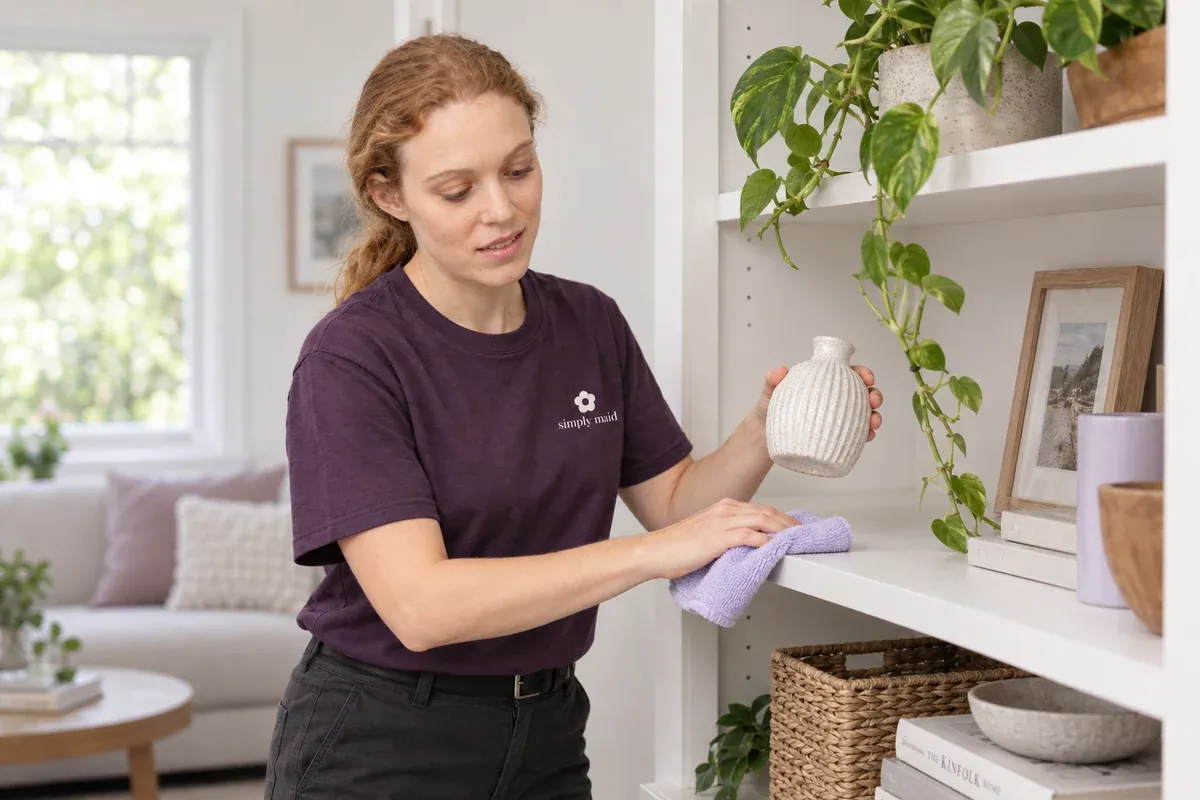
Professional cleaners bring training, commercial-grade equipment, and a systematic approach to every job. What you might spend three to four hours on, they complete more efficiently and more thoroughly.
They know which products work on which surfaces — from stainless steel appliances to chrome bathroom fittings. They catch the spots you miss — behind the toilet, the tops of door frames, the grease film above the stove.
Consistency is part of the service, not something you have to will yourself into every weekend.
5. Protect Your Home and Belongings
Regular cleaning isn't just about appearances. Dust buildup degrades fabric fibres and upholstery. Grease accumulation reduces kitchen appliance efficiency. Soap scum and grime etch into grout and sealant over time, leading to costly repairs.
A professional housekeeper helps maintain your home's surfaces, fixtures, and appliances — extending their lifespan and saving you money on replacements down the track. Think of it as preventive care for your biggest investment.
6. Flexible Scheduling That Works Around Your Life
Modern cleaning services work around you, not the other way around. There's no need to be home and no need to rearrange your day — a reliable housekeeper simply fits into your routine, so cleaning happens without you having to think about it.
Choosing the rhythm is its own decision, and we've covered it properly in how often should you hire a professional house cleaner.
7. Reclaim Your Identity Beyond "The One Who Cleans"
The mental load of housework isn't just about the physical tasks. It's the never-ending to-do list running in the background — remembering to buy cleaning products, noticing the shower screen needs descaling, planning when to tackle the fridge.
Harvard researchers found that the most harmful aspect of this invisible labour "may be due, in part, to its invisibility." Nobody sees it, so nobody shares it.
When someone else takes ownership of the cleaning, you free up cognitive space for the things that actually matter to you — your work, your family, your creativity, your rest. It's one less thing on your plate, and often the thing that tips the balance from coping to thriving.

Why You Shouldn't Feel Guilty About Hiring a Housekeeper
Let's address this head-on. The reluctance is real. Plenty of people who hire a cleaner keep quiet about it, often because they feel they "should" be able to manage on their own.
But consider this: you don't feel guilty about eating at a restaurant. You don't feel guilty about using a mechanic. Outsourcing cleaning is no different — it's a practical decision about how to spend your finite time and energy.
The PNAS study mentioned earlier found something particularly powerful: the happiness benefits of buying time were actually stronger for people with less disposable income. This isn't just a privilege for the wealthy. It's a meaningful trade that works across income levels.
Hiring a housekeeper isn't a sign of failure. It's a declaration that your time, your health, and your relationships are worth investing in.
Frequently Asked Questions
Q: What actually changes when you hire a housekeeper?
Three things, mostly. You get back the hours a full clean would have taken — typically most of a Saturday. The household stops negotiating over who does what. And the mental load lifts: no more tracking which room is overdue or remembering to restock cleaning products. The clean home is almost the smallest part of it.
Q: Will a housekeeper really reduce arguments about housework?
Often, yes. Research published in Socius found the division of housework is one of the strongest predictors of relationship satisfaction. When a third party handles the cleaning, there's nothing left to keep score over — which is why the decision is so often described in relationship terms rather than financial ones.
Q: Do I need to tidy up before the cleaner arrives?
A quick tidy helps your housekeeper focus on the deep cleaning — wiping, scrubbing, vacuuming, mopping — rather than spending time clearing surfaces. You don't need to clean before the clean, but putting away personal items and picking up toys means they can get straight to work.
Q: What if the cleaner doesn't clean to my standard?
A good cleaning service welcomes feedback after every visit. Be specific about what matters most to you — whether it's the oven, the bathrooms, or the skirting boards. Consistent communication means the clean improves with every visit, and reliable services will make it right if something's missed.
Q: Should I hire an individual cleaner or use a cleaning service?
Both have advantages. An individual cleaner may cost less per hour, but a service provides insurance, ID checks, backup cleaners if yours is unwell, and a clear process for feedback. For peace of mind and reliability, many Australian families prefer a service — especially one with online booking and quality guarantees.
Related Reading
- House Cleaning Yourself vs Hiring a Professional Cleaner
- How Often Should You Hire a Professional House Cleaner
- 5 Reasons Why Homeowners Neglect House Cleaning
- How to Keep Your Home Clean With a Busy Schedule
- Easy, Effective and Everlasting Cleaning Habits for the Whole Family
Sources & References
- Australian Bureau of Statistics — How Australians Use Their Time 2024. Referenced for unpaid housework and domestic work statistics among Australian adults.
- Ashley Whillans et al., Harvard Business School — Buying Time Promotes Happiness (PNAS, 2017). Cited for the finding that spending money on time-saving services increases life satisfaction across 6,271 participants.
- Dr Darby Saxbe & Dr Rena Repetti, UCLA — No Place Like Home: Home Tours Correlate with Daily Patterns of Mood and Cortisol (2010). Cited for cortisol elevation in women who described their homes as cluttered.
- HILDA Survey, University of Melbourne — Women Still Do Almost Double the Unpaid Work of Men. Referenced for longitudinal data showing women do almost double the unpaid work of men, with men's share unchanged since 2002.
- Australian Institute of Family Studies (AIFS) — Persistent Work-Family Strain Among Australian Mothers. Cited for the link between household strain and declining physical and mental health.
- Harvard Radcliffe Institute — Counting Invisible Work in Household Division of Labor (2023). Cited for the finding that mothers handle 67% more household management than fathers.
- Carlson, Miller & Rudd — Division of Housework, Communication, and Couples' Relationship Satisfaction (Socius/SAGE, 2020). Referenced for the link between housework division and relationship quality.