Fingerprints, crumbs and dust call for careful external cleaning. A bacteria count from a different device does not describe your laptop or justify using a stronger chemical.
Start with the care instructions for your exact laptop and display. Shut down and unplug before external cleaning; use only the cloth, liquid and method permitted for that surface. Do not insert tools into vents or assume one screen-cleaning recipe suits every model.
What You'll Need
You don't need a specialist toolkit. Everything is available at your local Bunnings, Officeworks, or Kmart.
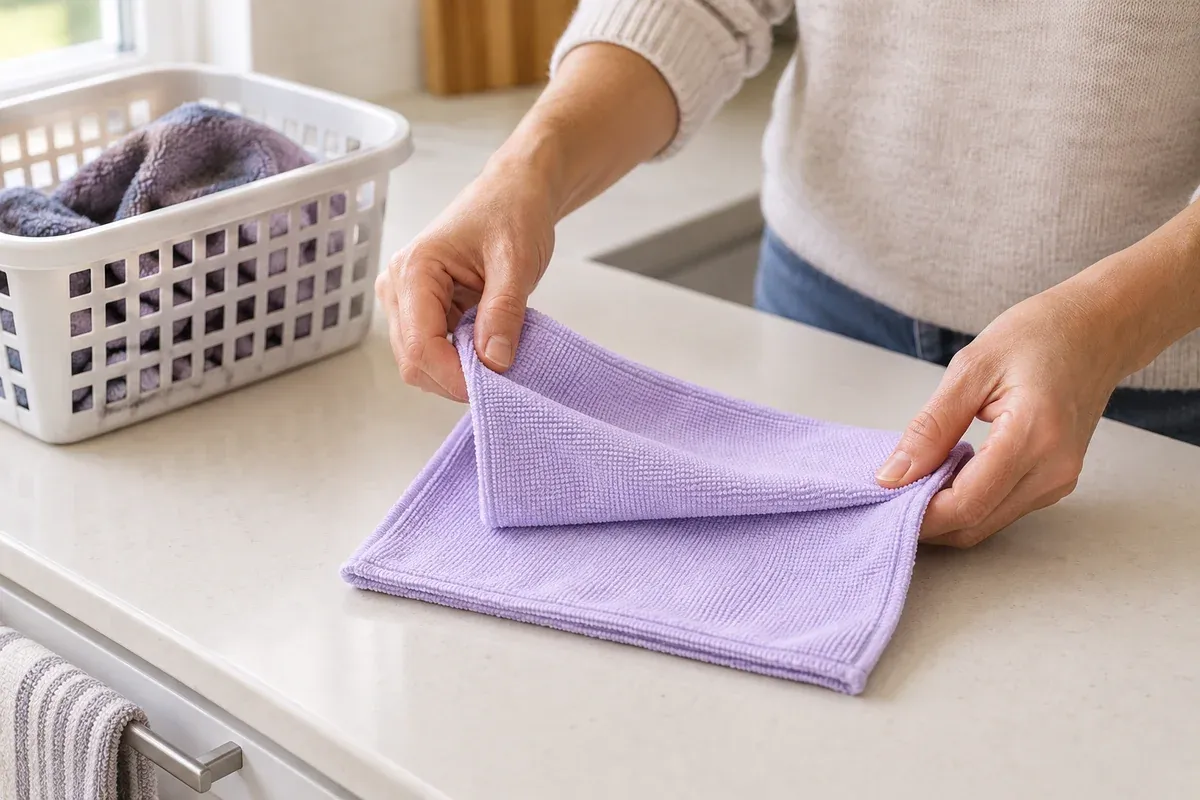
- Microfibre cloths (at least 2) — one for the screen, one for the keyboard and case. Avoid paper towels, tissues, or old t-shirts. According to CNN tech experts, paper products can scratch screen coatings that are only microns thick.
- Compressed air only if your laptop’s own cleaning procedure calls for it.
- A cleaning product expressly permitted for your model and surface, if needed. Check its concentration and ingredients; a bottle labelled isopropyl alcohol is not automatically the recommended dilution.
- Any additional tool expressly permitted by your laptop maker; do not improvise tools for vents or ports.
- A clean, flat surface — a kitchen table or desk with good lighting so you can spot dust and grime.
⚠️ Safety note: Never spray any liquid directly onto your laptop. Always apply cleaning products to your cloth first, then wipe the surface. — Melbourne PC User Group
Step 1: Power Down and Prepare

Do not open the case, force off keys or insert tools into the fan. Follow the exact device instructions rather than a universal alcohol or compressed-air recipe.
Read the illustration as text
- Shut down properly
- Disconnect power and accessories as the model’s instructions specify.
- Separate the screen cloth
- Check the display coating and permitted cleaning method.
- Keep liquid out
- Apply permitted cleaner to a cloth, never into keys, vents or ports.
Reconnect only after the permitted cleaning and drying are complete.
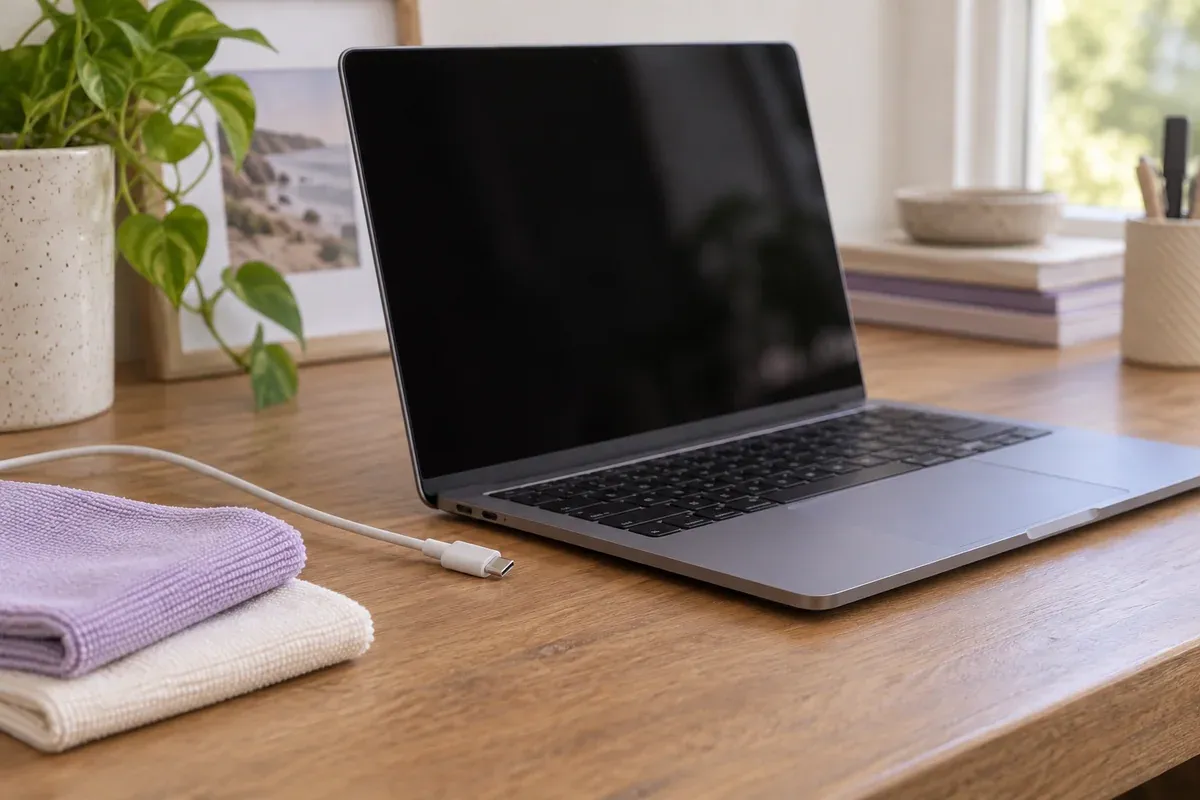
Before you touch anything, shut down your laptop completely. Don't just close the lid — go to the menu and select Shut Down.
Disconnect the charger and accessories. Follow the model’s shutdown instructions; do not remove an internal battery or apply a service-manual electrical-discharge procedure as a universal cleaning step.
Place your laptop on a clean, flat surface. A desk or table works best — not the couch, where loose dust and fibres can resettle into the machine.
Step 2: Clear the Vents and Fans
Blocked vents and accumulated dust can contribute to cooling problems. Heat also has other causes, so use the manufacturer’s diagnostics when symptoms persist.
Pick up your can of compressed air and attach the straw nozzle. Hold the can upright at all times — tilting it releases liquid propellant, which is extremely cold and can damage your electronics.
How to Use Compressed Air Safely
Use compressed air only for the parts and method the laptop maker permits. Follow the can’s handling directions and stop if liquid appears; do not dismantle the laptop for routine external cleaning.
Do not spray every opening as a routine. Check the model’s instructions for ports and vents; inaccessible debris may require servicing.
Do not insert a toothpick or other object through a vent to hold the fan. If internal dust or a noisy fan needs attention, use the manufacturer’s support or service procedure rather than reaching through the grille.
If the can starts to feel cold, set it down for a minute before continuing. This is normal and nothing to worry about.
Step 3: Clean the Keyboard
Keyboards are crumb magnets — especially in a busy household where the laptop doubles as a homework station, recipe viewer, and movie screen. For a separate desk or mechanical keyboard, see How to Clean a Keyboard.
For keyboard debris, use the laptop maker’s procedure. Apple’s compressed-air instructions apply to specified MacBook keyboards, with a stated angle and distance; they are not a general instruction for fans or every laptop.
Wipe keys gently using the maker-approved cloth or wipe. Keep moisture out of gaps. A brief wipe with alcohol is not a verified disinfection process for every laptop.
Keep liquid and cleaning tools out of openings. Do not remove keycaps unless the model’s instructions expressly permit it.
Tip: Don't press too hard on individual keys, especially on thinner laptops. Keycaps can be fragile and may pop off if forced.
Step 4: Clean the Screen
This is where most people go wrong. Laptop screens have delicate anti-glare and anti-reflective coatings that the wrong product can strip away permanently. For an external monitor or iMac, see How to Clean a Computer Screen.
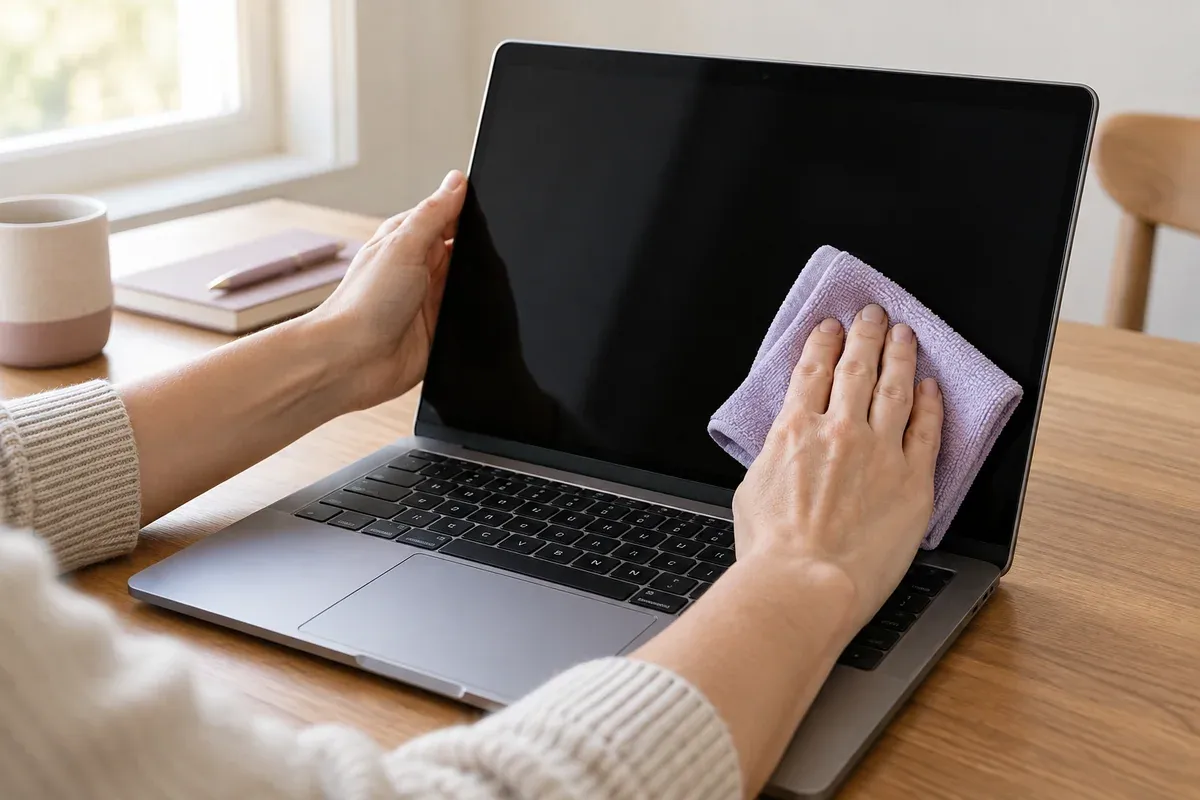
Apple's official support page recommends starting with a soft, lint-free cloth dampened with water only. For best results, use distilled water rather than tap water — mineral deposits in tap water can leave faint streaks.
Wipe gently in one direction (top to bottom or side to side). Avoid circular motions, which can create swirl marks on coated screens.
What About Stubborn Smudges?
If water alone doesn't shift a mark, check your manufacturer's guidelines before reaching for anything stronger:
Manufacturer example | What its guidance says | Important limit |
|---|---|---|
Apple | Standard Mac displays: water first; 70% IPA for stubborn marks. | Nano-texture displays have separate care instructions. |
Dell | Its equipment-cleaning guide specifies a 70% IPA / 30% water solution. | Check the exact equipment and keep moisture out of openings. |
ASUS | The laptop guide permits 70–75% IPA or suitable LCD cleaner. | Other ASUS display manuals differ; follow the model’s own guide. |
Lenovo | Some ThinkPad instructions permit water or a 50:50 IPA/water mix. | The previous blanket “no alcohol” claim was incorrect; check the model. |
HP | The PC support guide specifies 70% IPA / 30% water. | Do not substitute a generic vinegar recipe for the device’s instructions. |
⚠️ Safety note: Never use window cleaners (like Windex), ammonia-based products, or acetone on your laptop screen. These chemicals strip protective coatings and can cause permanent clouding. — Apple Support
Step 5: Wipe Down the Case
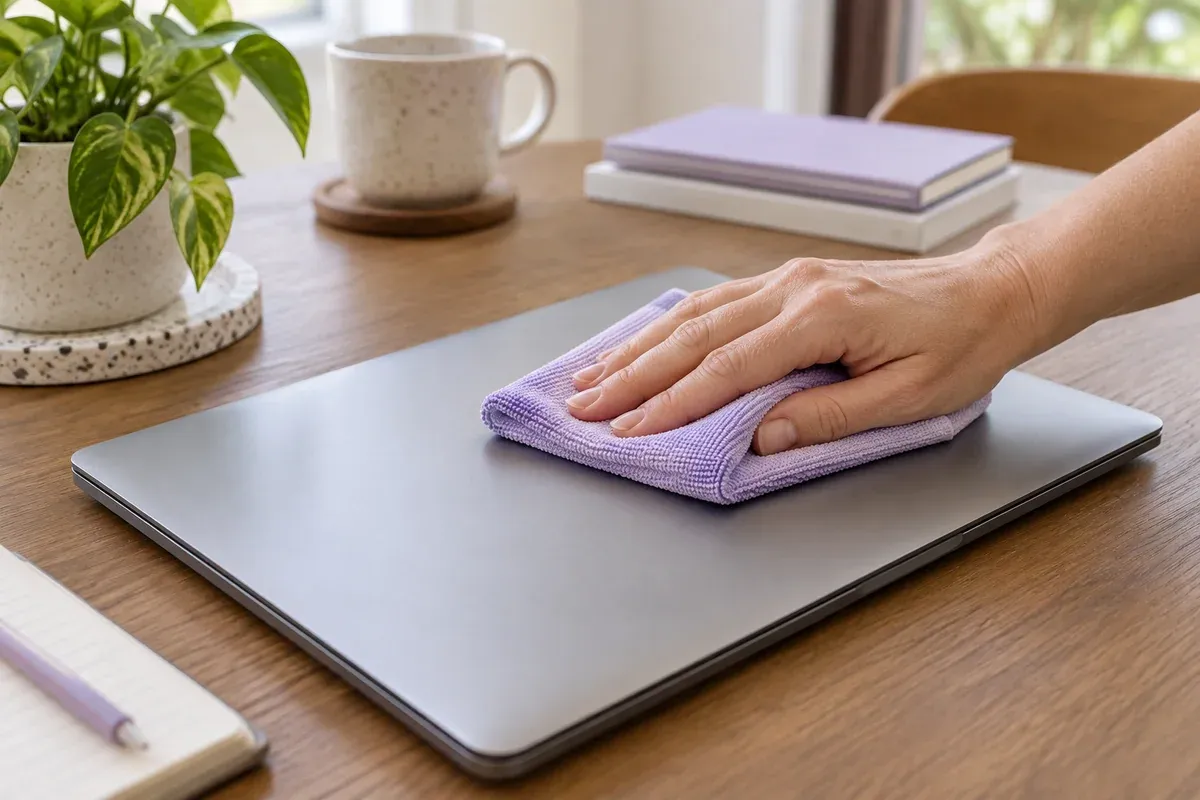
Clean the enclosure with the method permitted for its finish. A product approved for one part of the laptop is not automatically approved for the screen, trackpad or soft-touch coating.
Give the underside a quick wipe too, especially if your laptop lives on the kitchen table or the couch. If you're interested in keeping other household surfaces in top shape, our guide on how to clean stainless steel appliances uses many of the same gentle techniques.
Quick Clean vs Deep Clean
Not every clean needs to be a full production. If you're juggling everything else at home, here's a simple two-tier approach — similar in spirit to having a quick nightly routine for the rest of your house.
Weekly quick clean (2 minutes):
- Wipe the screen with a dry microfibre cloth
- Remove loose keyboard debris using the manufacturer’s method; do not shake the laptop.
- Wipe the keyboard and trackpad with a lightly damp cloth
Monthly deep clean (15 minutes):
- Check accessible vents visually; use only the maintenance method your model permits.
- Clean keyboard, case and trackpad according to their separate surface instructions.
- Clean the display using its exact care instructions, including any special-coating requirements.
- Check for dust in USB ports and headphone jack
The desk underneath gets its own routine in How to Clean Your Desk and Keep It Organised.
How Often Should You Clean Your Laptop?
Inspect the laptop when dirt accumulates and follow its maintenance guide. There is no single cleaning interval for every device and household.
Keep vents unobstructed and follow the maker’s external-care instructions. Cleaning does not guarantee a longer lifespan, lower operating temperature or a health benefit.
Frequently Asked Questions
Q: Can I use isopropyl alcohol to clean my laptop screen?
Check the exact display, not just the brand. Some standard screens permit a specified alcohol solution; special coatings such as Apple’s nano-texture glass have separate instructions. If the model is unknown, confirm its care guide before using liquid.
Q: How often should I clean my laptop?
Clean when needed using the model’s instructions. Persistent dirt inside openings, liquid damage or cooling faults need appropriate service advice.
Q: Will cleaning my laptop fix overheating?
Not necessarily. Blocked ventilation can contribute to heat, but persistent overheating, unexpected shutdowns or fan faults need diagnosis. Follow the manufacturer’s troubleshooting steps instead of promising that cleaning will fix the problem.
Q: Can I use a vacuum cleaner instead of compressed air?
Do not use a household vacuum or improvised cleaning tool inside the laptop. Follow the maker’s permitted external-cleaning procedure and use authorised support for internal work.
Q: Where can I buy laptop cleaning supplies in Australia?
Everything you need is widely available. Bunnings stocks Diggers isopropyl alcohol. Officeworks carries compressed air cans and screen cleaning kits. Kmart sells affordable microfibre cloth packs. You shouldn't need to spend more than $20–$25 for a complete kit.
Related Reading
- A Cleaning Guide to Sparkling Stainless Steel Appliances
- Green Cleaning 101: How to Make and Use Natural Cleaning Solutions
- Top 10 Cleaning Mistakes That Are Wasting Your Time
- A Quick Nightly Cleaning Routine for a Better Tomorrow
Sources & References
- Apple Inc. — How to Clean Your Apple Products. Referenced for screen cleaning guidelines, permitted use of 70% isopropyl alcohol, and chemical safety warnings.
- Dell Technologies — Guidance for Keeping Your Dell Equipment Clean. Referenced for screen cleaning recommendations and IPA dilution ratios.
- Dell Technologies — How to Drain Residual Flea Power. Referenced for the correct power discharge method (hold button for 20 seconds).
- National Center for Health Research, citing University of Arizona research — Bacteria on Computer Keyboards. Referenced for the keyboard bacteria comparison statistic.
- HP Inc. — How to Clean Your Laptop. Referenced for cleaning frequency recommendations and compressed air safety guidance.
- How-To Geek — How to Clean the Dust Out of Your Laptop. Referenced for fan damage warning when using compressed air.
- ASUS Support — How to Clean and Maintain Your ASUS Laptop. Referenced for manufacturer-specific IPA guidelines (70–75% on surfaces).
- CNN Underscored — How to Clean Your Computer or Laptop Screen. Referenced for screen coating fragility and warning against paper products.
- Dell Technologies — How to Troubleshoot Overheating on a Dell PC. Referenced for dust buildup as a primary cause of laptop overheating.
- Lenovo — How to Clean Laptop Screen. Referenced for the alcohol-free screen cleaning recommendation.